
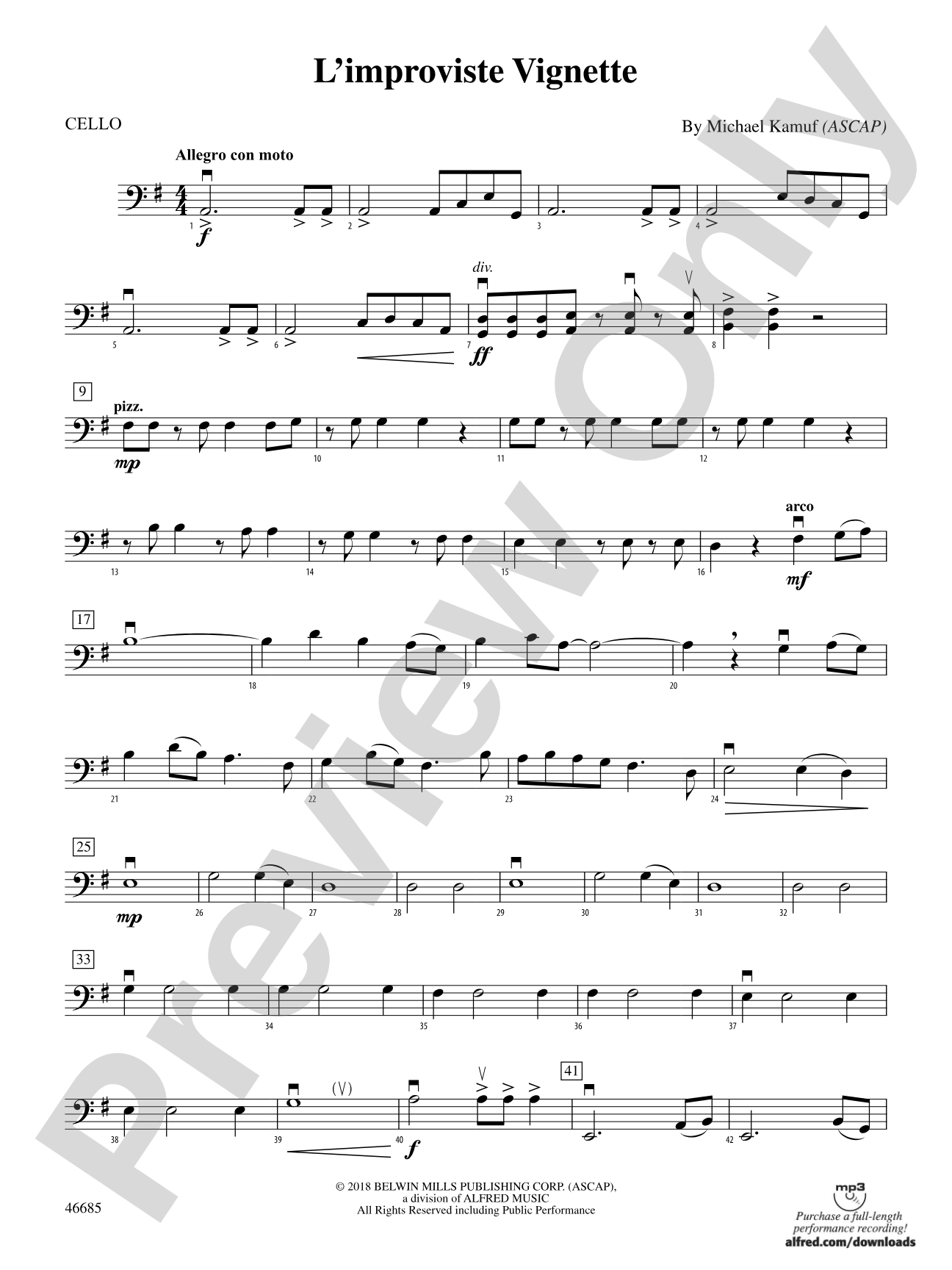

L'improviste Vignette: Cello
By Michael Kamuf
Grade: 2
Item: 00-PC-0017823_VC1
$5.99
Pickup currently not available
Description
"L'improviste Vignette" is a bold and energetic work for young string orchestra by composer and educator Michael Kamuf. The interesting melodic and accompaniment passages will keep all players engaged. Using flowing melodies with strong harmonies and bold rhythmic figures, this piece works perfectly as an opening or closing selection for concerts and festival performances.


Don't just read it, hear it, play along with it, and watch your students grow with it. In MakeMusic Cloud, L'improviste Vignette: Cello comes alive with professional accompaniment, adjustable tempo, and built-in practice tools that turn solo practice into real progress.
Open in the Player
Jump straight in and assign it today.
Start Your Free Trial
Open this title and explore the full library in minutes.
Sample Audio
1
Audio File
--:--
0:00
0:00
Sample Video
Additional Details
Series:
Belwin Intermediate String Orchestra
Publisher:
Alfred Music
Page Count:
144
SKU:
00-PC-0017823_VC1
More about this title
About the Composer: Michael Kamuf

Michael Kamuf earned his Bachelor of Music degrees in Jazz Performance and Music Education from the Dana School of Music at Youngstown State University, followed by a Master of Arts in Instrumental Conducting from George Mason University. His compositions and arrangements have appeared on stages across the country, performed by ensembles ranging from the Woody Herman Orchestra to the USAF Airmen of Note, and by soloists including James Moody, Eddie Daniels, and Sean Jones. As an exclusive Belwin composer, Kamuf has published over 100 works across jazz, orchestra, and concert band catalogs.
For three decades, Kamuf shaped young musicians in Montgomery County, Maryland public schools, serving as Director of Bands and Orchestras and Music Department Chair at John T. Baker Middle School. Under his leadership, the Baker ensembles earned consistent festival recognition and commissioned multiple works for developing musicians. Today, he leads the Mike Kamuf Little Big Band, a jazz octet drawing top talent from the Baltimore and Washington, DC regions.
Why we love this
Kamuf understands exactly what Grade 2 string players need: engaging material that doesn't condescend. The interplay between melody and accompaniment keeps every section invested, while the bold rhythmic vocabulary adds real character without overwhelming young musicians. That balance between accessibility and substance makes this genuinely rewarding to conduct.
What to expect
Energy and momentum carry this piece forward. Flowing melodic lines dance over supporting harmonies while sharp rhythmic figures punctuate the texture, creating a work that feels confident and alive without losing accessibility. The result is music that feels alive in the hands of young players.
Who it's for
String orchestras tackling Grade 2 repertoire, particularly those looking for material that works equally well as a concert opener or closer. Directors want pieces that challenge developing musicians without overwhelming them, and this one delivers on both counts.
How to get the most out of it
- Establish the rhythmic confidence early in rehearsal. Bold rhythmic figures define this piece, so lock in the pulse before refining the melodic lines.
- Shape the flowing melodies with phrase arches rather than note-by-note phrasing. This keeps the energy moving and prevents the piece from feeling static.
- Balance the accompaniment parts so they support rather than overshadow the primary melodic voice. Young players often push rhythm section material too hard.
- Use the full dynamic range. Kamuf's use of strong harmonies means shifts in volume create real impact at this level.
How to use it
The special features designation confirms its versatility: open a concert with its bold energy, or close one with its confident melodic sweep. It fits naturally alongside other Grade 2 string literature at festivals or classroom concerts, and the 144-page full score and parts mean your entire orchestra can dive in immediately.
Skills your students will build
- Rhythmic precision in bold, syncopated figures
- Melodic phrasing and shaping in flowing lines
- Balance between primary and secondary melodic material
- Dynamic control across a full range
- Harmonic awareness through counterpoint between sections