

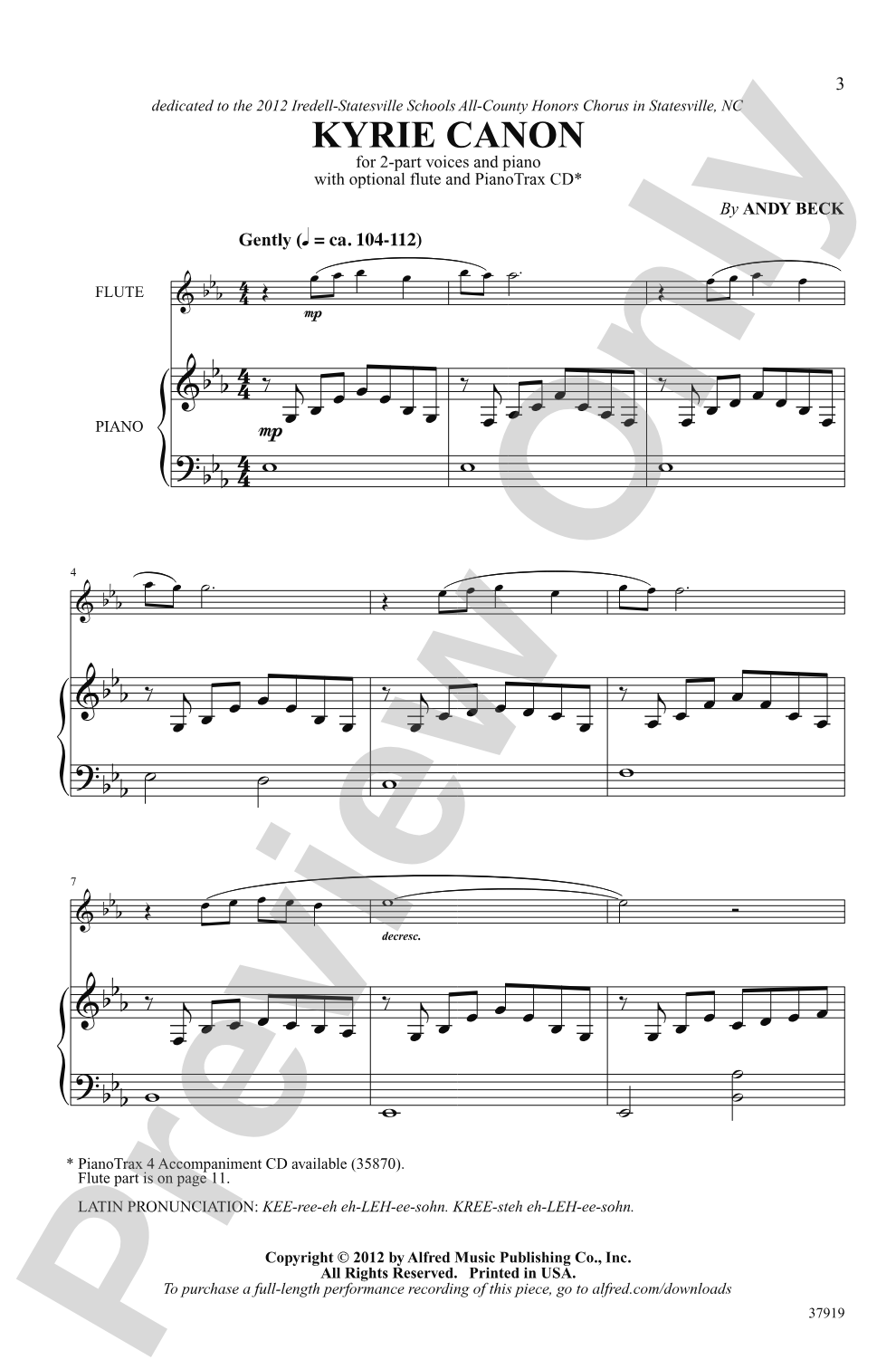

Kyrie Canon: 2-Part Choral Octavo
By Andy Beck
Item: 00-PO-0001270

$2.50
Minimum order quantity: 20 copies
Pickup currently not available
Description
This original art song ensures a distinctly musical experience for developing voices. The optional obbligato may be played by any C-instrument and adds another statement to the lyrical round. Three Latin words in all.


Don't just read it, hear it, play along with it, and watch your students grow with it. In MakeMusic Cloud, Kyrie Canon: 2-Part Choral Octavo comes alive with professional accompaniment, adjustable tempo, and built-in practice tools that turn solo practice into real progress.
Open in the Player
Jump straight in and assign it today.
Start Your Free Trial
Open this title and explore the full library in minutes.
Sample Audio
1
Audio File
--:--
0:00
0:00
Sample Video
No sample videos found.
Additional Details
Series:
Alfred Choral Designs
Publisher:
Alfred Music
Page Count:
12
SKU:
00-PO-0001270
Instrumentation:
Opt. Flute
More about this title
About the Composer: Andy Beck

Andy Beck directs choral publications at Alfred Music and has established himself as one of the most performed composers in modern choral education. His catalog exceeds 450 works spanning choral octavos, vocal resources, and children's musicals, alongside pedagogical titles like Sing at First Sight and Vocalize! 45 Vocal Warm-Ups That Teach Technique. His compositions reach singers across the globe, with regular performances documented on YouTube and in concert halls worldwide.
Beyond the page, Beck remains active as a guest conductor, adjudicator, and clinician for music educators and students throughout the United States and internationally. He has served as commissioned composer and guest conductor for honor choirs of all ages, including all-state ensembles across the Southeast. A trained tenor with degrees in Music Education from Ithaca College and Northwest Missouri State University, Beck performs regularly with the North Carolina Master Chorale Chamber Choir and has been an Alfred Music studio singer since 1992. His dual commitment to choral artistry and music literacy shapes every publication he brings forward.
Why we love this
This piece strikes a balance between artistic ambition and accessibility that younger choirs rarely find at the 2-part level. The optional flute obbligato transforms what could feel like a straightforward round into a layered composition that rewards both careful listening and skillful ensemble work, making it equally engaging for singers and their instrumental colleagues in a mixed rehearsal setting.
What to expect
The piece carries a meditative quality, built on the natural momentum of the canon structure and grounded in the reverent simplicity of the Latin text. The optional flute part adds an ethereal dimension that lifts the piece into something almost processional, creating moments of unexpected depth within a brief, focused work.
Who it's for
This work suits developing choirs ready to explore the canon form with musical sophistication. It serves middle school and early high school singers, as well as adult beginner ensembles seeking accessible sacred literature that doesn't sacrifice compositional craft.
How to get the most out of it
- Establish the canon's opening statement with clarity and confidence; the flute, if included, should enter as an equal voice, not an accompaniment, so rehearse the instrumental obbligato alongside the choir from the start.
- Shape the Latin text with proper vowel purity and consistent breath placement across both parts to keep the round unified and resonant.
- Allow time for singers to hear and absorb the canon's structure in sectional rehearsals before combining parts; understanding how their line weaves with the other creates ownership and stability.
How to use it
Program this as a concert opener or closer in a sacred music set; its brevity and clear structure work well as an intermission palate cleanser between larger works. It also serves as an effective festival or competition piece for 2-part choirs seeking musically substantial but age-appropriate sacred repertoire.
Skills your students will build
- Canon singing and listening to independent melodic lines
- Latin diction and sustained vowel purity
- Ensemble balance and independence within ensemble texture
- Coordination with optional instrumental obbligato