
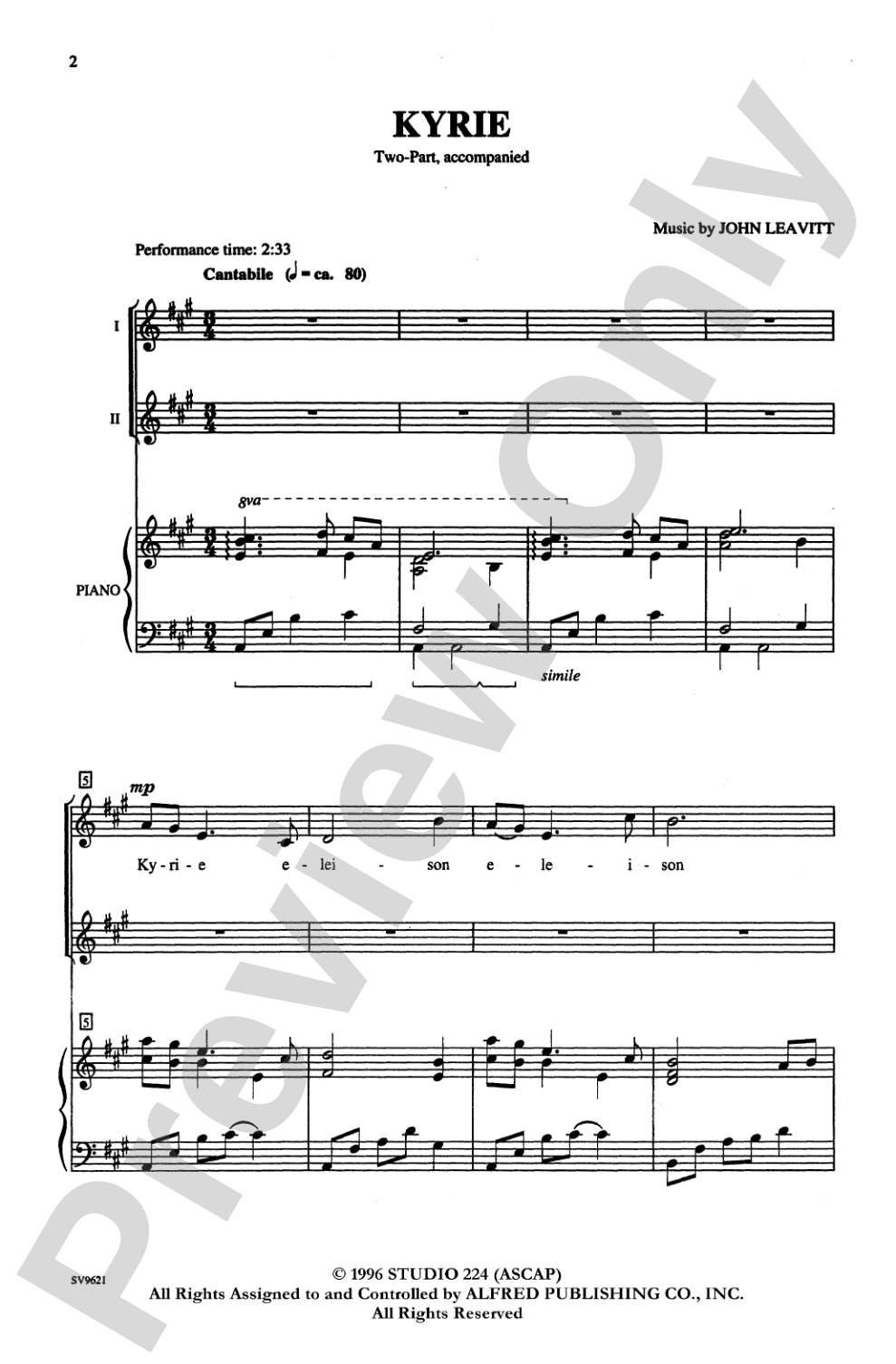
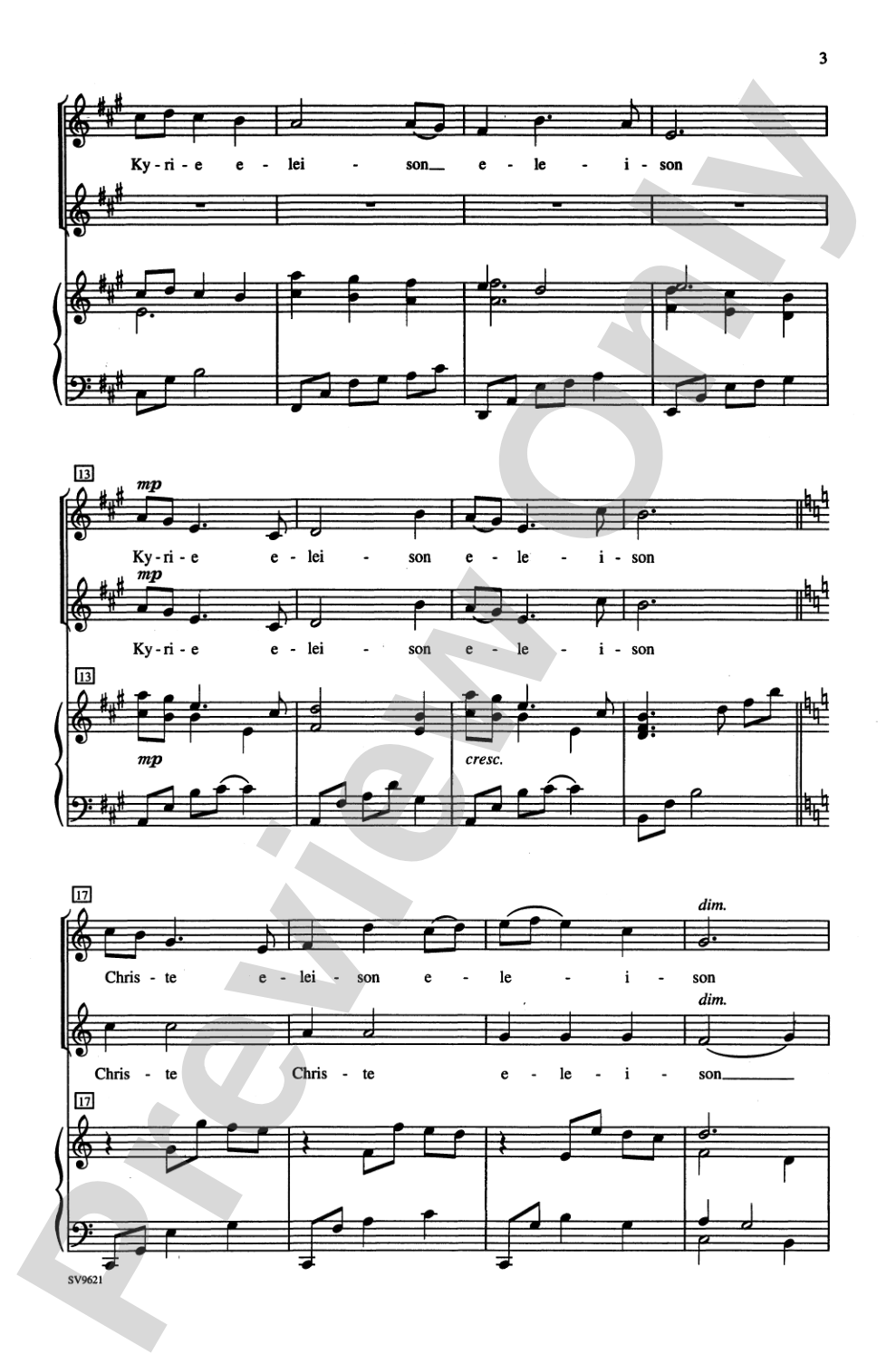

Kyrie: 2-Part Choral Octavo
By John Leavitt
Level: Moderate
Item: 00-PO-0002754
$2.25
Minimum order quantity: 20 copies
Pickup currently not available
Related Items
Kyrie: SoundTrax Digital Audio Download |
$24.99
|
View | |
Kyrie: TTB Choral Octavo |
$1.75
|
View | |
Kyrie: Choral SoundPax |
$35.00
|
View | |
Kyrie: SATB Choral Octavo |
$2.05
|
View | |
Kyrie: SAB Choral Octavo |
$2.25
|
View | |
Kyrie: SSA Choral Octavo |
$2.25
|
View | |
Kyrie: TTB Choral Octavo |
$1.75
|
View | |
Kyrie: Choral Octavo SoundTrax CD |
$24.99
|
View | |
Kyrie: Choral SoundPax |
$35.00
|
View | |
Kyrie: SATB Choral Octavo |
$2.05
|
View | |
Kyrie: SAB Choral Octavo |
$2.25
|
View | |
Kyrie: SSA Choral Octavo |
$2.25
|
View | |
Kyrie: 2-Part Choral Octavo |
$2.25
|
View |
Description
At last, a two-part setting of John Leavitt's well-known 'Kyrie' from his Missa Festiva. Previously published in SATB, SAB and SSA editions, the piece has been one of the most performed contemporary choral works of the past decade. Its rich, warm and beautiful lines soar over the strongly moving accompaniment to make it a wonderful addition to any concert or festival program. A must for the library of any serious choir!


Kyrie: 2-Part Choral Octavo isn't in MakeMusic Cloud just yet...but it could be. Let us know you'd like to see it, and you'll help shape what comes next. In the meantime, start a free trial and dive into thousands of interactive titles your students can play along with today.
Request This Title
Tell us you want it.
Start Your Free Trial
Explore everything that's ready to play right now.
Sample Audio
1
Audio File
--:--
0:00
0:00
Sample Video
No sample videos found.
Additional Details
Series:
Alfred Archive Edition: Studio PR Catalog
Publisher:
Alfred Music
Page Count:
8
SKU:
00-PO-0002754
More about this title
About the Composer: John Leavitt
John Leavitt is a prolific composer whose sacred and secular choral works have become staples in American music education and performance. His compositions balance accessibility with musical substance, making them equally at home in school settings and professional concert halls. Leavitt's output spans decades and includes masses, motets, secular part-songs, and arrangements that serve choirs at every level.
His Missa Festiva stands among his most celebrated works, recorded and performed thousands of times since its premiere. Leavitt's gift for crafting singable lines that don't compromise harmonic richness has made him one of the most frequently programmed contemporary composers in American choral literature.
Why we love this
This two-part version opens Leavitt's beloved 'Kyrie' to choirs that lack the range or experience needed for SATB, SAB, or SSA settings. The piece retains all the warmth and liturgical dignity of the original; you're not sacrificing musical substance for accessibility. Programming a Leavitt work audiences already know builds program coherence while honoring the piece's proven resonance with listeners.
What to expect
The 'Kyrie' unfolds with gentle reverence. Warm harmonic movement and a thoughtful accompaniment create an atmosphere of quiet dignity rather than dramatic intensity. The two-part writing allows voices to interweave without crowding; listeners hear clarity and space alongside harmonic richness.
Who it's for
Treble choirs, developing mixed ensembles, and any group working with limited range or experience who want to perform an authentic, substantial sacred work. Directors seeking repertoire for singers in Grades 3-5 will find this setting both musically rewarding and technically manageable. This edition serves programs where a full SATB voicing isn't practical but a serious liturgical piece is essential.
How to get the most out of it
- Honor the warm, contemplative character by keeping vibrato controlled and allowing phrases to breathe. This isn't a fast-moving piece; let the harmony do its work.
- Balance the parts carefully so neither voice overshadows the other. The accompaniment carries significant musical weight, so rehearse choir and pianist together early.
- Pay attention to vowel consistency across the two-part texture. Unified vowel sound on sustained notes prevents the parts from sounding separated.
- Shape longer phrases with gentle dynamic swells rather than holding dynamics flat. The piece's richness emerges through subtle shaping.
How to use it
This works beautifully as the opening or closing piece of a sacred concert, particularly in liturgical or ecumenical settings where the 'Kyrie' text carries historical weight. Pair it with other contemporary sacred works or earlier mass settings to build a thematic program. Many directors reserve it for spring or early summer festivals where repertoire standards include substantial but accessible sacred music.
Skills your students will build
- Reading two-part voicing with independent line movement
- Sustaining legato singing through harmonic changes
- Balancing blend between two equal voices
- Interpreting liturgical text with appropriate musical character
- Collaborating with piano accompaniment