
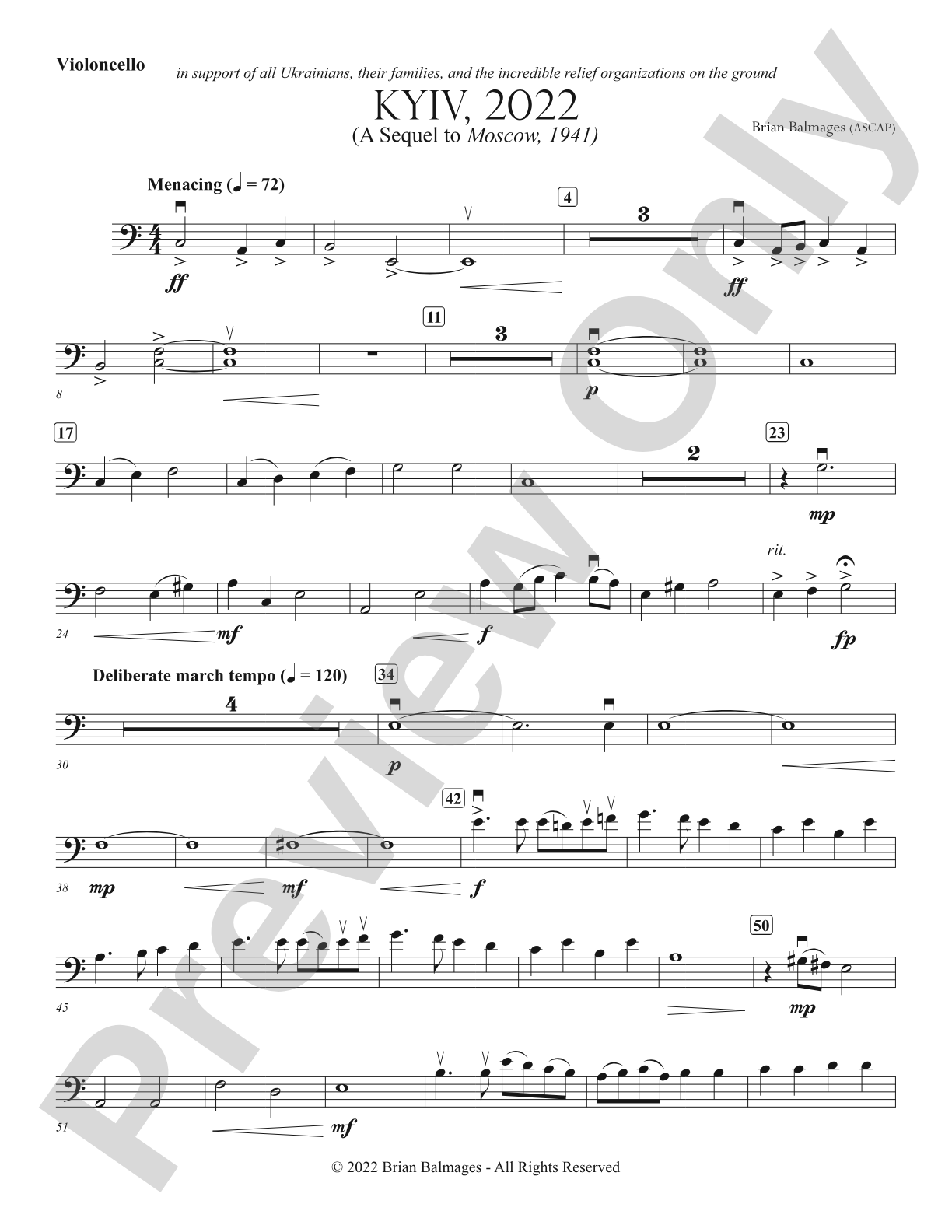

Kyiv, 2022: Cello
A Sequel to Moscow, 1941, Arranged for Symphony Orchestra
By Brian Balmages
Grade: 3
Item: 00-PC-0018752_VC1
$3.00
Pickup currently not available
Description
Written as a powerful sequel to Moscow, 1941, this work (originally written for band, now arranged for full orchestra) changes the narrative, where the theme from Moscow now becomes the aggressor, and the heroic people of Ukraine are represented by the Ukrainian National Anthem and the powerful song "Prayer for Ukraine." Certain to spark discussions about humanity, history, and culture, this piece can easily be performed alongside Moscow, 1941 or in place of it. (4:35)
"Kyiv, 2022" Performances


"Kyiv, 2022" Performances
Don't just read it, hear it, play along with it, and watch your students grow with it. In MakeMusic Cloud, Kyiv, 2022: Cello comes alive with professional accompaniment, adjustable tempo, and built-in practice tools that turn solo practice into real progress.
Open in the Player
Jump straight in and assign it today.
Start Your Free Trial
Open this title and explore the full library in minutes.
Sample Audio
1
Audio File
--:--
0:00
0:00
Sample Video
Additional Details
Series:
MakeMusic Full Orchestra
Publisher:
MakeMusic Publications
SKU:
00-PC-0018752_VC1
More about this title
About the Composer: Brian Balmages

Brian Balmages has built a career composing and conducting across orchestral, band, and chamber music at the highest levels. His works have been performed by ensembles spanning from professional symphony orchestras to elementary school groups in venues including Carnegie Hall, the Kennedy Center, and the Sydney Opera House. He received the A. Austin Harding Award from the American School Band Directors Association and won the 2020 NBA William D. Revelli Composition Contest. His music was performed at the 2013 Presidential Inaugural Prayer Service attended by President Obama and Vice President Biden.
Balmages is an elected member of the American Bandmasters Association and holds the inaugural James Madison University Distinguished Alumni Award from the School of Visual and Performing Arts. He was commissioned by the University of Miami to compose music for the inauguration of the institution's 6th president. As a conductor, he maintains regular engagements with all-state, regional, university, and professional ensembles worldwide, with notable guest conducting appearances at the Midwest Clinic, Western International Band Clinic, and numerous international venues. He currently serves as Director of MakeMusic Publications and Digital Education for Alfred and MakeMusic.
Why we love this
Balmages creates music that serves genuine artistic purposes beyond technical display. This sequel transforms the thematic material from Moscow, 1941 into a narrative statement about aggression and resistance, asking students and audiences to engage with contemporary history through Ukrainian folk traditions and the National Anthem. The Grade 3 orchestration makes this sophisticated storytelling accessible to ensembles that might otherwise lack repertoire addressing these urgent human themes.
What to expect
The piece moves through layers of tension and resolution, with the familiar Moscow theme reframed as a force of disruption while Ukrainian musical traditions surge forward as expressions of resilience. The combination of anthem and prayer creates moments of soaring lyricism that contrast sharply with the aggressive material, drawing listeners into an emotional arc about resistance and hope.
Who it's for
Orchestras at the Grade 3 level seeking repertoire that combines musical substance with meaningful cultural and historical content. This work is ideal for ensembles ready to tackle programmatic music with depth and for conductors who want their musicians to understand that orchestral writing can be a vehicle for contemporary dialogue.
How to get the most out of it
- Balance the orchestration so the Ukrainian National Anthem and Prayer for Ukraine themes emerge clearly over the Moscow theme material; the heroic voices need sonic space to be heard as the emotional counterweight.
- Establish a conductor's interpretation of how the Moscow theme sounds when representing aggression versus its original character; this tonal shift will shape how musicians voice their parts and when they push or pull dynamics.
- If you know the Moscow, 1941 work, rehearse this piece with both scores present so musicians understand the transformation; the musical conversation between the two works deepens their engagement with the piece's message.
How to use it
Program this as a centerpiece of a concert exploring music's role in documenting history, paired with other works addressing conflict or cultural identity. It works equally well as a standalone statement or alongside Moscow, 1941 as a musical diptych that invites conversation about perspective and power. The 4:35 duration and Grade 3 accessibility make it practical for festival or concert programming without dominating an entire set.
Skills your students will build
- Reading and responding to programmatic intent through orchestral texture and thematic transformation
- Balancing multiple melodic lines across the ensemble while maintaining clarity of harmonic function
- Understanding how composers use familiar musical material (themes, anthems) to create narrative meaning
- Performing with dynamic and tonal control to support contrasting musical characters within a single piece
- Ensemble cohesion across full orchestra parts at a moderate technical level