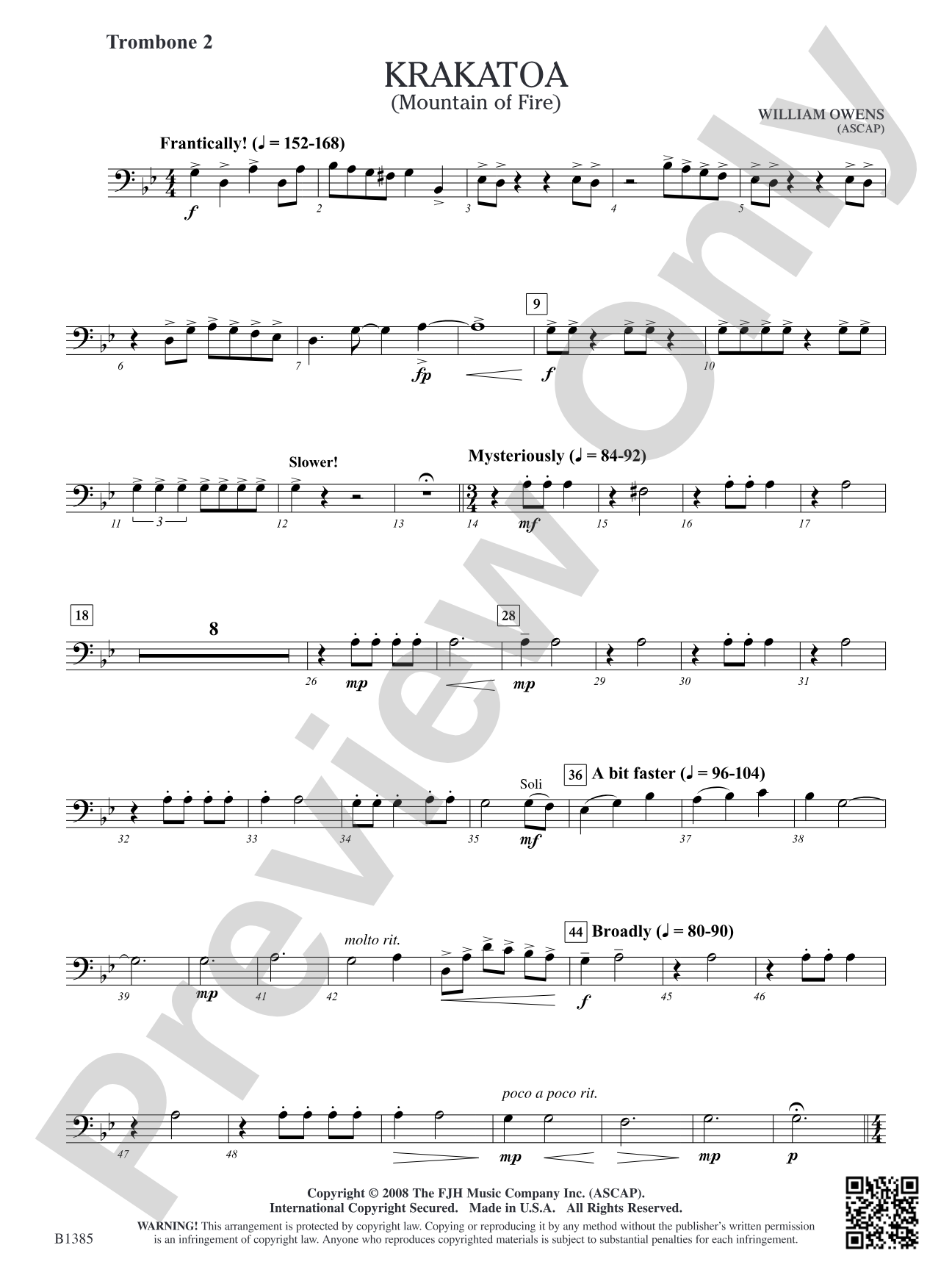
Krakatoa (Mountain of Fire): Trombone 2 Sheet Music Preview

Krakatoa (Mountain of Fire): Trombone 2

Mountain of Fire

By William Owens

Grade: 2.5

Item: 98-PC-DB1385_TN2

Digital Download
$7.00
Description
This stunning and powerful work recalls the massive Krakatoa explosions of 1883 that were heard over 2,000 miles away. The piece begins with an immediate intensity using dissonant ascending notes representing burning lava, while low voices and percussion signify the thunderous blasts. A haunting slow section follows, exuding fear and uneasy anticipation. The music then becomes frantic and highly rhythmic as it leads to the huge eruption, depicted by well-written aleatoric passages that occur over booming bass lines. The "aftermath" is strangely quiet, but soon the angry mountain speaks once more in a powerful and thrilling ending!

Krakatoa (Mountain of Fire): Trombone 2 isn't in MakeMusic Cloud just yet...but it could be. Let us know you'd like to see it, and you'll help shape what comes next. In the meantime, start a free trial and dive into thousands of interactive titles your students can play along with today.

Sample Audio
0:00
0:00
Sample Video
Additional Details
Series: FJH Young Band
Publisher: The FJH Music Company, Inc.
SKU: 98-PC-DB1385_TN2

More about this title

About the Composer: William Owens

William Owens

William Owens has spent three decades composing for young ensembles while building a parallel career as a band director and clinician across North America. A VanderCook College of Music graduate, he has authored over 300 works since 1993, establishing himself as a trusted voice in the young band repertoire through his accessible yet musically substantial writing.

Owens' work has been recognized nationally through commissions from South Plains College, the American Bandmasters Association, and Phi Beta Mu International. He holds membership in ASCAP, TMEA, and the Texas Bandmasters Association, and retired in 2014 after three decades directing in Texas. He currently resides in Fort Worth with his wife Georgia.

Why we love this

Owens captures the visceral drama of a historical catastrophe without requiring advanced technique or extended playing time from your ensemble. The piece builds its impact through orchestration and rhythmic clarity rather than high difficulty, making it an effective festival selection that demonstrates musicianship and ensemble control at grade 2.5.

What to expect

Krakatoa opens with raw geological violence, then pulls back into an unsettling calm where tension simmers just beneath the surface. The final eruption arrives with the force of a natural disaster finally unleashed, leaving your ensemble and audience breathless.

Who it's for

Concert bands at the 2.5 grade level preparing for festival or contest will find a piece that combines accessible instrumentation with genuine dramatic arc. Directors seeking repertoire that engages both audience and performers through storytelling rather than virtuosity will connect with this work.

How to get the most out of it

  • Shape the opening dissonant figures with clear articulation; the intensity comes from precision, not from playing louder.
  • Give the slow section room to breathe. The fear and anticipation Owens writes depend on space and silence between phrases as much as sound.
  • Approach the aleatoric passages as controlled chaos. Balance individual freedom with the steady pulse of the bass lines underneath; these sections reveal whether your ensemble trusts each other.
  • Mark the transition to the final eruption clearly in rehearsal so the sudden energy shift lands with full effect.

How to use it

This work anchors a concert theme exploring nature, history, or natural disasters, and its contest-friendly length fits naturally in a festival program without consuming resources. Consider pairing it with contrasting pieces that allow the drama here to stand in relief.

Skills your students will build

  • Executing aleatoric passages with rhythmic control
  • Balancing dissonant ensemble sonorities
  • Creating dynamic contrast across extended phrases
  • Responding to rapid tempo and character changes
  • Sustaining musical tension during slow passages

You May Also Like