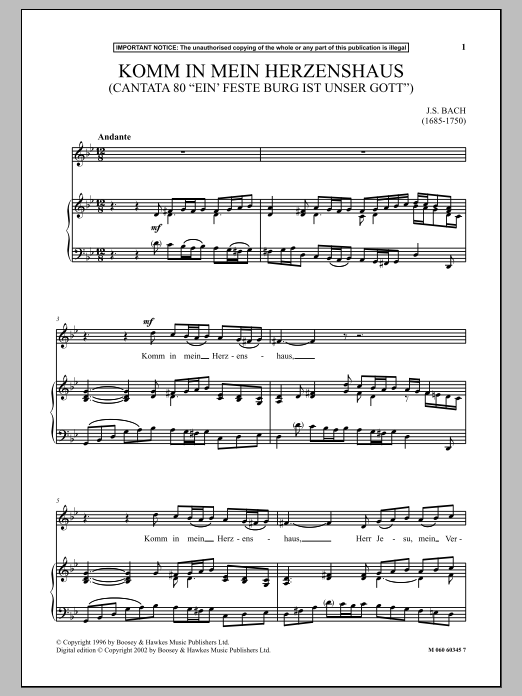
Komm In Mein Herzenshaus (Cantata 80 Ein Feste Burg Ist Unser Gott) Sheet Music Preview

Komm In Mein Herzenshaus (Cantata 80 Ein Feste Burg Ist Unser Gott): Piano Vocal

As performed by Johann Sebastian Bach

Item: 35-DS00238093

Digital Download
$5.99
Description

Komm In Mein Herzenshaus (Cantata 80 Ein Feste Burg Ist Unser Gott): Piano Vocal isn't in MakeMusic Cloud just yet...but it could be. Let us know you'd like to see it, and you'll help shape what comes next. In the meantime, start a free trial and dive into thousands of interactive titles your students can play along with today.

Sample Audio
No sample audio found.
Sample Video
Additional Details
Publisher: Hal Leonard
Page Count: 5
SKU: 35-DS00238093

More about this title

About the Artist: Johann Sebastian Bach

Johann Sebastian Bach (1685–1750) wrote over two hundred cantatas during his tenure as Cantor of St. Thomas Church in Leipzig, creating a body of sacred vocal music unmatched in scope and theological depth. His cantatas blend Lutheran chorale traditions with sophisticated counterpoint and orchestration, making them essential study for understanding Baroque vocal writing and the relationship between text and music.

Why we love this

This aria sits at the intersection of intimacy and architectural rigor. Bach's melody unfolds with an almost conversational quality over the keyboard accompaniment, allowing singers and pianists to shape phrases together without the weight of orchestration. It's a rare opportunity to experience Bach's harmonic language stripped to its essentials, where every voice movement matters.

What to expect

The piece carries a warm, almost hymn-like quality despite its polyphonic sophistication. There's a sense of personal devotion expressed through perfectly balanced voices and thoughtful harmonic motion, inviting both performer and listener into a moment of quiet conviction.

Who it's for

This transcription serves soloists preparing for church services or recitals, advanced vocal students deepening their understanding of Bach's compositional approach, and pianists working on Baroque accompaniment technique. Its modest scoring makes it accessible for both chamber and intimate solo contexts.

How to get the most out of it

  • Bring out the soprano line with gentle legato phrasing; this is not a virtuosic display but an invitation into private devotion.
  • Treat the keyboard part as a dialogue partner rather than mere accompaniment. Its figurations carry harmonic and emotional weight that shapes the singer's choices.
  • Allow the German text to guide your inflection naturally. The rhythm and syntax of Bach's setting reflect the language's contours, not impose over them.

How to use it

Pair this with other Bach cantata movements or chorale settings for a concert exploring his vocal music across different scorings. It also works as a recital opener or interlude, offering singers a chance to demonstrate Baroque style in an intimate, manageable format.

Skills your students will build

  • Baroque phrasing and rhetorical inflection in German text
  • Reading figured bass notation and realizing keyboard accompaniment
  • Balanced voice leading and harmonic analysis in four-part texture
  • Coordinating ensemble communication between solo voice and keyboard

You May Also Like