Kokoleoko (arr. Victor Johnson) Sheet Music Preview

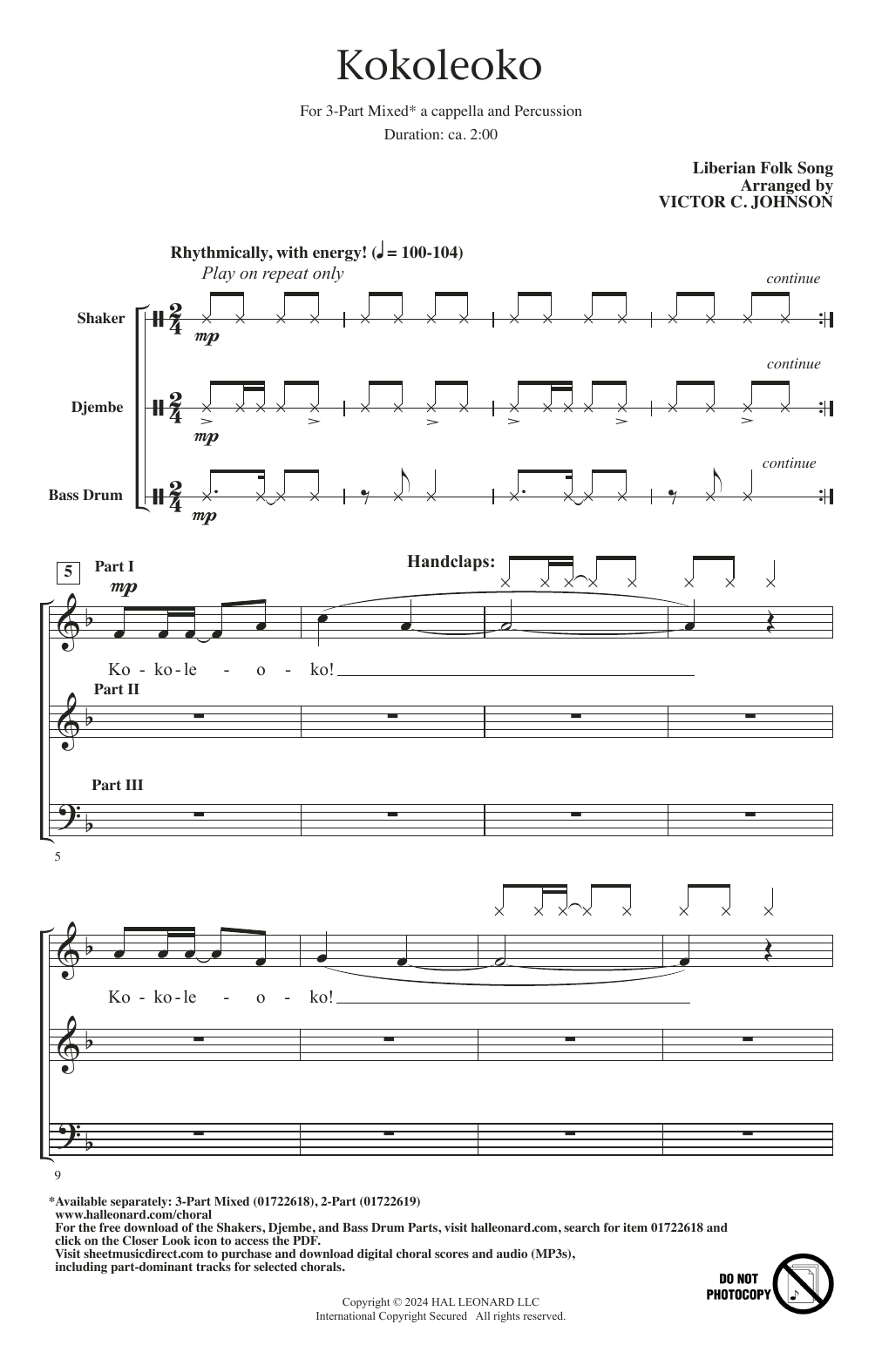
Kokoleoko (arr. Victor Johnson): 3-Part Mixed Choral Octavo

As performed by Liberian Folk Song / Arranged by Victor Johnson

Item: 35-DS01585363

Digital Download
$2.50
Description

Kokoleoko (arr. Victor Johnson): 3-Part Mixed Choral Octavo isn't in MakeMusic Cloud just yet...but it could be. Let us know you'd like to see it, and you'll help shape what comes next. In the meantime, start a free trial and dive into thousands of interactive titles your students can play along with today.

Sample Audio
No sample audio found.
Sample Video
Additional Details
Publisher: Hal Leonard
Page Count: 9
SKU: 35-DS01585363

More about this title

About the Artist: Liberian Folk Song

Liberian folk songs emerge from a rich oral tradition shaped by the diverse ethnic groups of West Africa. These songs carry the voices of communities, passing down stories, work rhythms, and celebrations through generations without written notation. They reflect the musical language of Liberia's people and remain vital expressions of cultural identity and collective memory.

Why we love this

Victor Johnson's arrangement honors the melodic character of this traditional material while making it genuinely singable for young mixed ensembles. The three-part voicing stays transparent enough that rehearsal time focuses on musical communication rather than technical survival, leaving room for the folk tune's warmth to come through.

What to expect

Kokoleoko carries the easy confidence of music meant for group singing. The melody settles comfortably in the voice, inviting participation rather than display, while the a cappella texture creates an intimate, communal quality that draws listeners into the song's world.

Who it's for

Treble, mixed, and early secondary choirs looking for accessible folk material with cultural substance. The nine-page octavo length and three-part texture suit ensembles ranging from high school beginning choirs to community groups seeking arrangements that don't demand soloists or specialized vocal training.

How to get the most out of it

  • Treat the text as rhythmically alive. Folk songs rely on natural speech patterns, so shape phrases around the syllables rather than imposed metric regularity.
  • Balance the parts so the primary melody remains audible without drowning out the supporting voices. This arrangement works best when each line has clarity and purpose.
  • Encourage sustained tone quality even in a cappella singing. Without instrumental support, your singers become the harmonic foundation, so breath management and vowel consistency matter directly to blend.

How to use it

Include this in concerts celebrating world music, cultural awareness, or simply effective storytelling through song. The modest technical demands make it ideal for mid-season programming when you want to shift focus from technique to interpretation and joy. It also pairs naturally with other African or diaspora folk traditions you might program.

Skills your students will build

  • Singing unaccompanied ensemble lines with ensemble blend and intonation control
  • Shaping melodic phrases around text and speech rhythm rather than metric pulse
  • Sustaining tone quality and breath management without instrumental foundation
  • Balancing independent voice parts while maintaining awareness of harmonic function

You May Also Like