
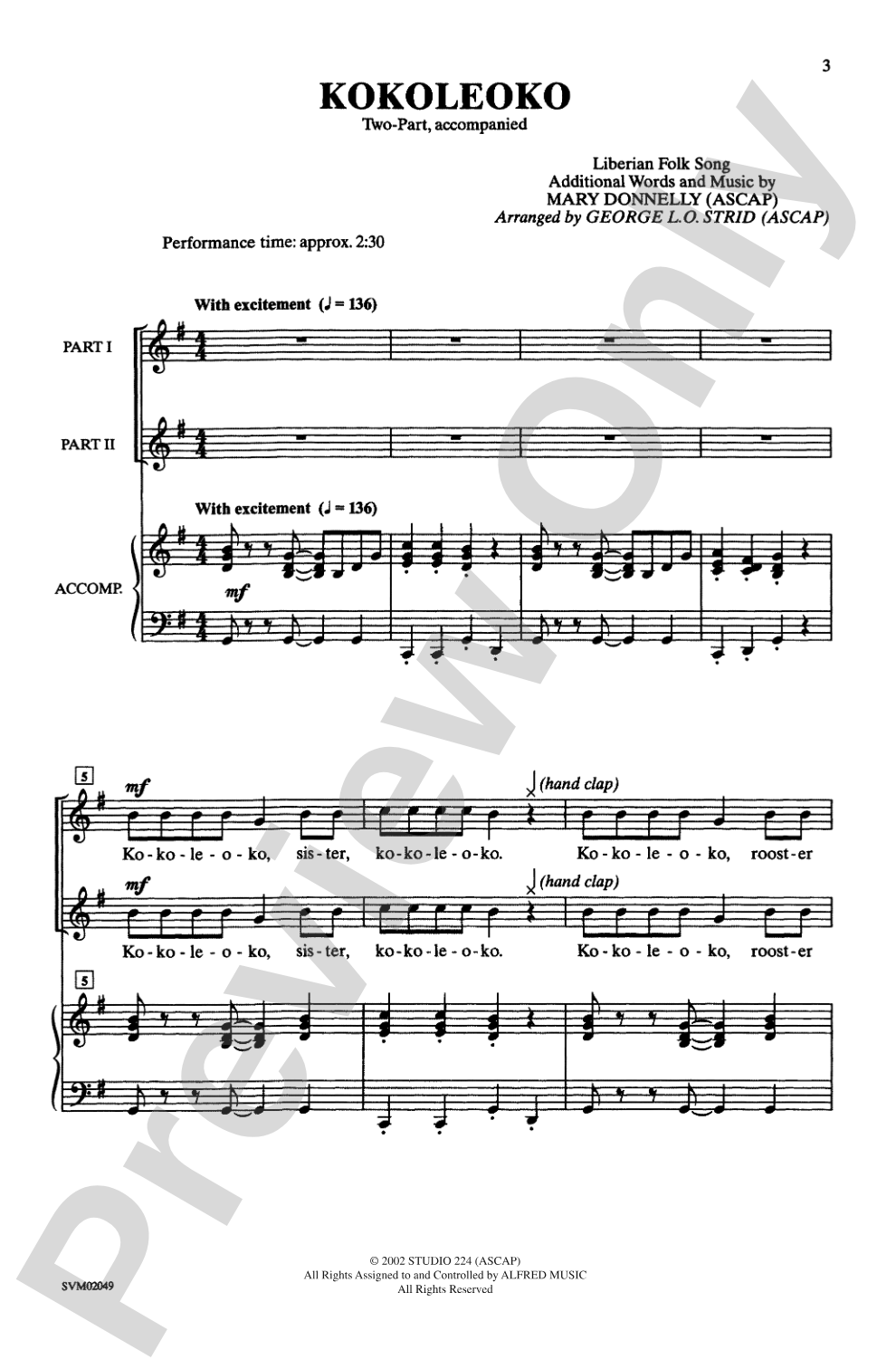
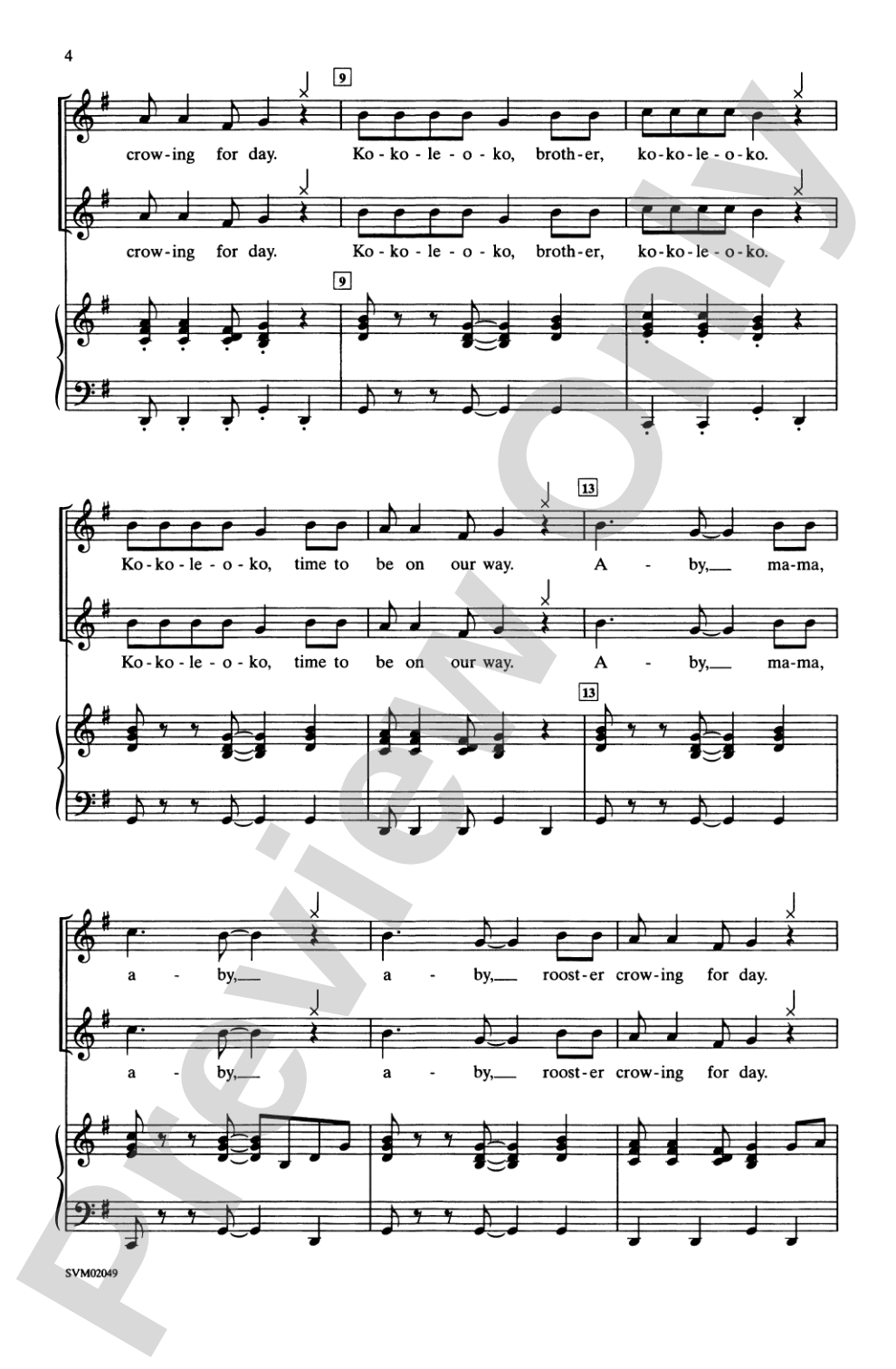

Kokoleoko: 2-Part Choral Octavo
Liberian Folk Song / additional words and music by Mary Donnelly / arr. George L. O. Strid
Level: Moderate
Item: 00-PO-0003085

$2.25
Minimum order quantity: 20 copies
Pickup currently not available
Description
George and Mary have delightfully brought this Liberian folk song to life in a fun and creative setting that students will love to sing and audiences will want to hear over and over again. A must have!


Don't just read it, hear it, play along with it, and watch your students grow with it. In MakeMusic Cloud, Kokoleoko: 2-Part Choral Octavo comes alive with professional accompaniment, adjustable tempo, and built-in practice tools that turn solo practice into real progress.
Open in the Player
Jump straight in and assign it today.
Start Your Free Trial
Open this title and explore the full library in minutes.
Sample Audio
1
Audio File
--:--
0:00
0:00
Sample Video
No sample videos found.
Additional Details
Series:
Alfred Archive Edition: Studio PR Catalog
Publisher:
Alfred Music
Page Count:
12
SKU:
00-PO-0003085
More about this title
About the Composer: Mary Donnelly

Mary Donnelly grew up in Reno, Nevada, and studied English and French at the University of Nevada, Reno. While still an undergraduate, she founded and directed two children's choruses, an experience that led her back to school for music education certification. She earned a Master's Degree in Education from Lesley College in Cambridge, Massachusetts, where she focused on integrating the arts across the curriculum.
Donnelly spent thirty years teaching general music and choir in the Washoe County School District, retiring as an active classroom educator. In 1985, while team-teaching with George Strid, she began a prolific songwriting partnership that has produced over two hundred songs and twenty-five musicals. She holds memberships in ACDA, NEA, and ASCAP, and continues to live in Reno with her husband.
Why we love this
Donnelly and Strid have a gift for honoring folk material while making it immediately accessible to young singers. This arrangement captures the joy and movement of the Liberian source without overwhelming a developing 2-part choir, and the recorded accompaniment option removes barriers for programs without strong piano support.
What to expect
Kokoleoko radiates infectious joy and rhythmic vitality. The arrangement moves with a buoyant, celebratory spirit that feels both playful and rooted in genuine folk idiom, inviting singers to inhabit the music rather than simply perform it.
Who it's for
Middle school choirs and upper elementary ensembles with basic 2-part reading skills and enough experience to sustain musical engagement over a longer piece. Programs seeking culturally authentic repertoire that connects students to global musical traditions without requiring advanced technique.
How to get the most out of it
- Approach the Liberian rhythmic language as its own logic rather than forcing it into familiar metric patterns; let the arrangement guide your singers through its natural phrasing.
- Use the recorded accompaniment to establish the harmonic foundation during early rehearsals, then gradually shift singers' ear to blend with live piano if you add it later.
- Shape dynamic contrast between sections to maintain energy across the 12 pages without letting the piece become relentless; this material rewards subtle shading.
How to use it
Position this as a centerpiece for a world music or cultural celebration concert, where it can anchor a set of folk traditions. Its moderate difficulty and engaging character also make it ideal mid-year repertoire when you want to build ensemble confidence without sacrificing musical substance.
Skills your students will build
- Reading and performing unfamiliar rhythmic patterns in folk-based literature
- Part independence and harmonic awareness in 2-part writing
- Cultural awareness and authentic interpretation of non-Western folk material
- Ensemble blend and balance with contrasting vocal textures