
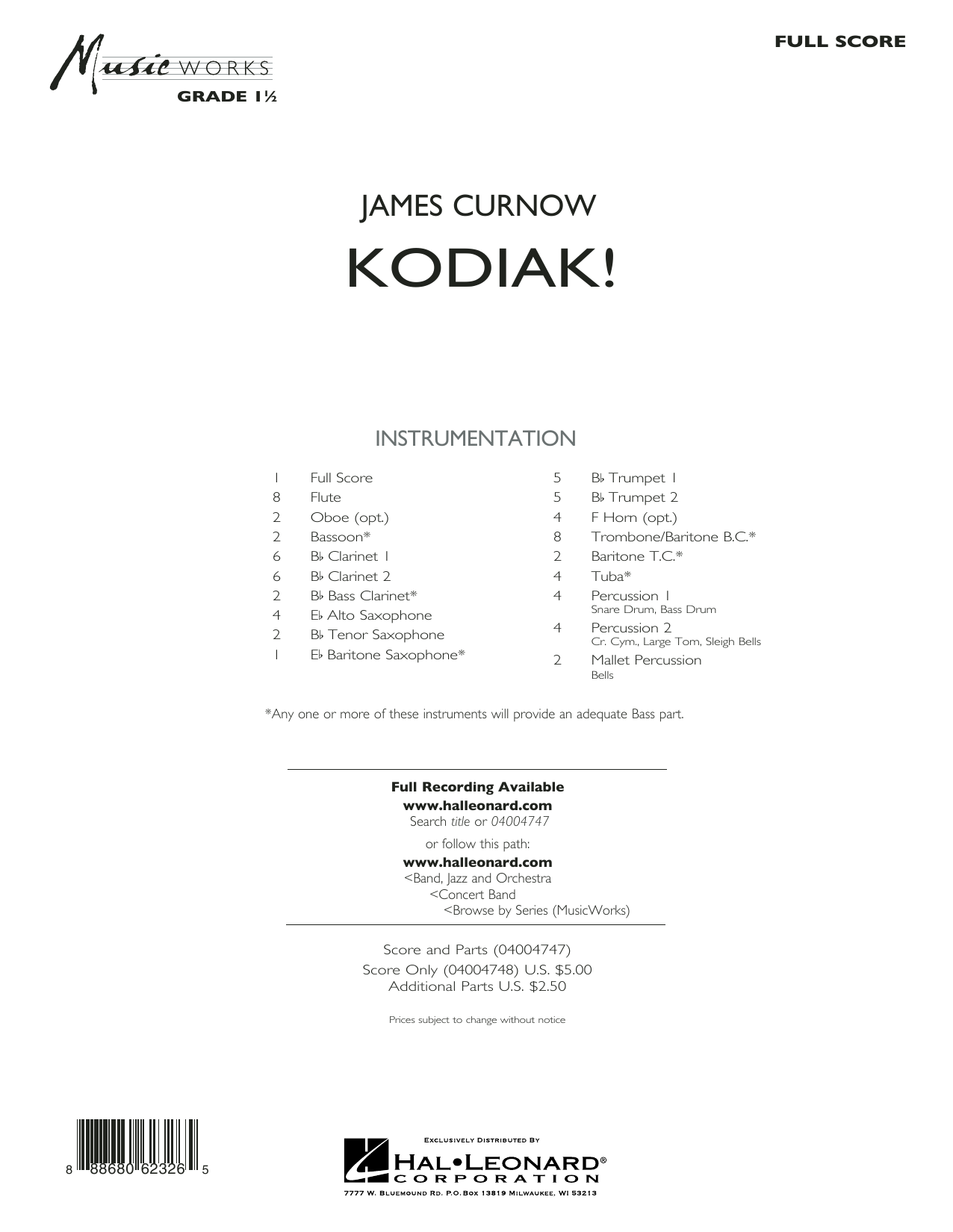

Kodiak!: Concert Band Conductor Score & Parts
By James Curnow
Grade: 1
Item: 35-PK00331814
$45.00
Pickup currently not available
Buy Extra Parts (Digital PDF Download)
| Product | Price | Quantity |
|---|---|---|
| Kodiak! - Conductor Score (Full Score) | $6.00 | |
| Kodiak! - Flute | $6.00 | |
| Kodiak! - Oboe | $6.00 | |
| Kodiak! - Bassoon | $6.00 | |
| Kodiak! - Bb Clarinet 1 | $6.00 | |
| Kodiak! - Bb Clarinet 2 | $6.00 | |
| Kodiak! - Bb Bass Clarinet | $6.00 | |
| Kodiak! - Eb Alto Saxophone | $6.00 | |
| Kodiak! - Bb Tenor Saxophone | $6.00 | |
| Kodiak! - Eb Baritone Saxophone | $6.00 | |
| Kodiak! - Bb Trumpet 1 | $6.00 | |
| Kodiak! - Bb Trumpet 2 | $6.00 | |
| Kodiak! - F Horn | $6.00 | |
| Kodiak! - Trombone/Baritone B.C. | $6.00 | |
| Kodiak! - Baritone T.C. | $6.00 | |
| Kodiak! - Tuba | $6.00 | |
| Kodiak! - Percussion 1 | $6.00 | |
| Kodiak! - Percussion 2 | $6.00 | |
| Kodiak! - Mallet Percussion | $6.00 |
Parts Added to Cart!
Description
Named in honor of the mighty Alaskan grizzly bear, "Kodiak!" is a musical portrait of this beautiful creature and its surroundings - sometimes fierce, sometimes gentle; but always impressive. Listen for the bear's "growl" represented in the bass drum!
Dur: 2:00


Kodiak!: Concert Band Conductor Score & Parts isn't in MakeMusic Cloud just yet...but it could be. Let us know you'd like to see it, and you'll help shape what comes next. In the meantime, start a free trial and dive into thousands of interactive titles your students can play along with today.
Request This Title
Tell us you want it.
Start Your Free Trial
Explore everything that's ready to play right now.
Sample Audio
No sample audio found.
Sample Video
No sample videos found.
Additional Details
Publisher:
Hal Leonard
SKU:
35-PK00331814
More about this title
About the Composer: James Curnow
James Curnow is a prolific composer and arranger who has shaped the concert band repertoire for decades, with an exceptional gift for writing music that engages young musicians while maintaining musical integrity. His compositions span multiple genres and difficulty levels, making him a trusted voice in music education circles who understands what works in the rehearsal room.
Why we love this
Curnow captures the drama and personality of his subject without overcomplicating the writing, giving conductors an accessible entry point into character-driven composition. At Grade 1, this piece proves that musical storytelling doesn't require technical gymnastics; instead, it relies on smart orchestration and moments of genuine contrast that students will recognize and enjoy performing.
What to expect
The piece conjures the Pacific Northwest landscape with moments of power and moments of quiet observation. You hear the animal itself through orchestral color, especially that distinctive bass drum growl, while experiencing the contrasting moods that make the subject compelling rather than one-dimensional.
Who it's for
Beginning concert bands looking for a Grade 1 piece that goes beyond simple note reading to introduce musical character and storytelling. This works equally well for middle school ensembles building their first repertoire list or elementary programs ready for structured concert band performance.
How to get the most out of it
- Shape the bass drum growls with clear articulation and dynamic intention. These moments define the bear's character, so rehearse them separately to ensure they land with personality rather than mere volume.
- Balance the gentle sections by asking students to listen across the ensemble for blend. The contrast between fierce and gentle passages depends on dynamic control, not just note accuracy.
- Establish the tempo early and maintain it confidently. At two minutes, pacing choices become immediately apparent to listeners, so commit to your interpretation during rehearsal.
- Consider the imagery when rehearsing individual sections. Asking clarinet players to imagine the bear moving through the Alaskan landscape often produces more expressive phrasing than discussing dynamics alone.
How to use it
Place this in a family or school assembly concert where younger audiences will connect with the animal subject matter and straightforward musical narrative. It pairs well alongside other Grade 1 character pieces or can anchor a wildlife-themed concert program.
Skills your students will build
- Dynamic contrast (forte passages versus softer sections)
- Listening for orchestration and individual instrumental colors
- Ensemble balance across different registers
- Maintaining steady tempo in a short-form composition
- Expressive interpretation of programmatic music