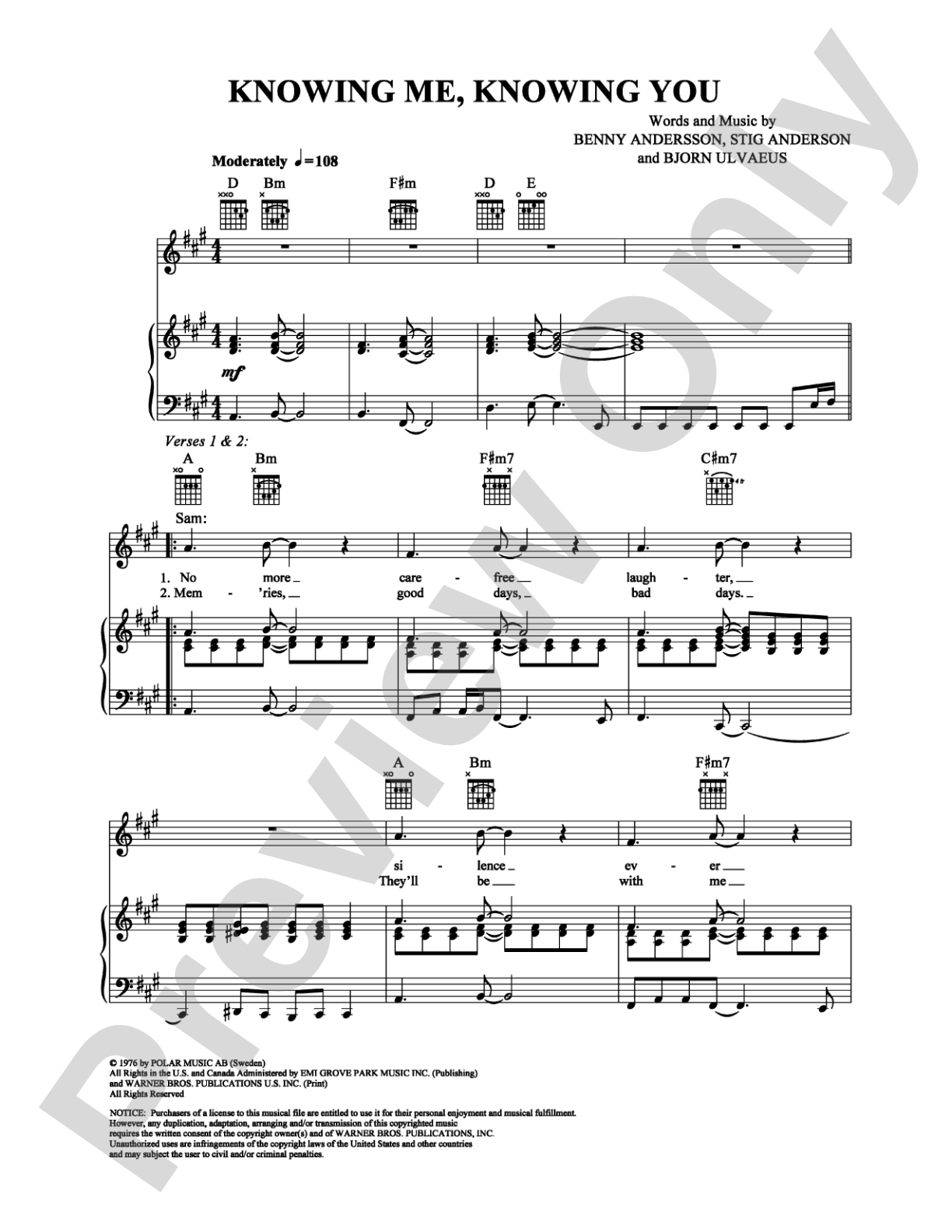
Knowing Me, Knowing You: Piano/Vocal/Chords Digital Sheet Music

Knowing Me, Knowing You: Piano/Vocal/Chords Digital Sheet Music

ABBA, Björn Ulvaeus, Benny Andersson, Stig Anderson

Item: 00-PS-0002376

Digital Download
$3.99
Description

Knowing Me, Knowing You: Piano/Vocal/Chords Digital Sheet Music isn't in MakeMusic Cloud just yet...but it could be. Let us know you'd like to see it, and you'll help shape what comes next. In the meantime, start a free trial and dive into thousands of interactive titles your students can play along with today.

Sample Audio
No sample audio found.
Sample Video
Additional Details
SKU: 00-PS-0002376

More about this title

About the Artist: ABBA

ABBA emerged from Sweden in the 1970s as one of the most commercially successful pop groups of their era. Their carefully crafted arrangements, memorable hooks, and blend of pop sensibility with sophisticated harmonic writing made them studio innovators and live performers of genuine musical substance. The band's catalog remains a goldmine for music educators seeking engaging, well-constructed popular music with solid melodic and harmonic content.

Their songs continue to teach valuable lessons about songwriting craft, arrangement clarity, and how to construct hook-driven music that doesn't sacrifice musicianship. For choral and piano students, ABBA's material offers accessible entry points into contemporary repertoire that serious musicians actually enjoy learning.

Why we love this

ABBA's pop rock style sits at the sweet spot between accessibility and genuine musical substance. The vocal melody is instantly singable, the harmonic movement is clear enough to teach voice leading without oversimplifying, and the arrangement translates beautifully to piano/vocal format without losing its character. This is the kind of contemporary repertoire that engages singers who might otherwise resist traditional choral literature.

What to expect

Warm, accessible, and genuinely catchy without a hint of saccharine quality. The song has an intimate quality in its verses that opens into something larger and more confident in the chorus, creating an emotional arc that feels satisfying to perform. The harmonic language is sophisticated enough to keep musicians engaged while remaining transparent enough that listeners connect immediately.

Who it's for

Pianists and singers preparing recital material, solo performers looking for engaging contemporary repertoire, and voice teachers searching for well-written popular songs that don't compromise musical integrity. Upper-level high school and college-level singers will find rewarding melodic and harmonic content here.

How to get the most out of it

  • Balance the vocal line so the melody stays prominent while the piano provides rhythmic and harmonic support without drowning out the voice
  • Pay attention to the phrasing in the verse sections; ABBA's strength lies in lyrical simplicity, so avoid over-embellishing or over-interpreting what's on the page
  • Lock into the rhythmic pocket early in rehearsal; the groove is central to how this song feels, and a loose rhythm section undermines the arrangement's effectiveness
  • Use dynamics to shape the narrative arc, especially between verse and chorus; the contrast between intimate verses and expansive choruses is what makes this material work

How to use it

Program this as a bridge between classical and contemporary repertoire on a recital, especially effective when placed alongside art songs or other vocal standards. It works equally well as a solo recital piece or paired with other ABBA material for a pop-focused program. Voice students benefit from learning this as a counterpoint to traditional song literature, demonstrating how careful composition and arrangement serve the voice just as effectively in popular music as in classical genres.

Skills your students will build

  • Singing sustained legit tone over rhythmically active piano accompaniment
  • Balancing melody and harmony in contemporary harmonic language
  • Interpreting phrasing and dynamics in a pop-rock context
  • Sight-reading and interpreting chord symbols and lead-sheet notation
  • Understanding arrangement choices and how piano supports the vocal line

You May Also Like