
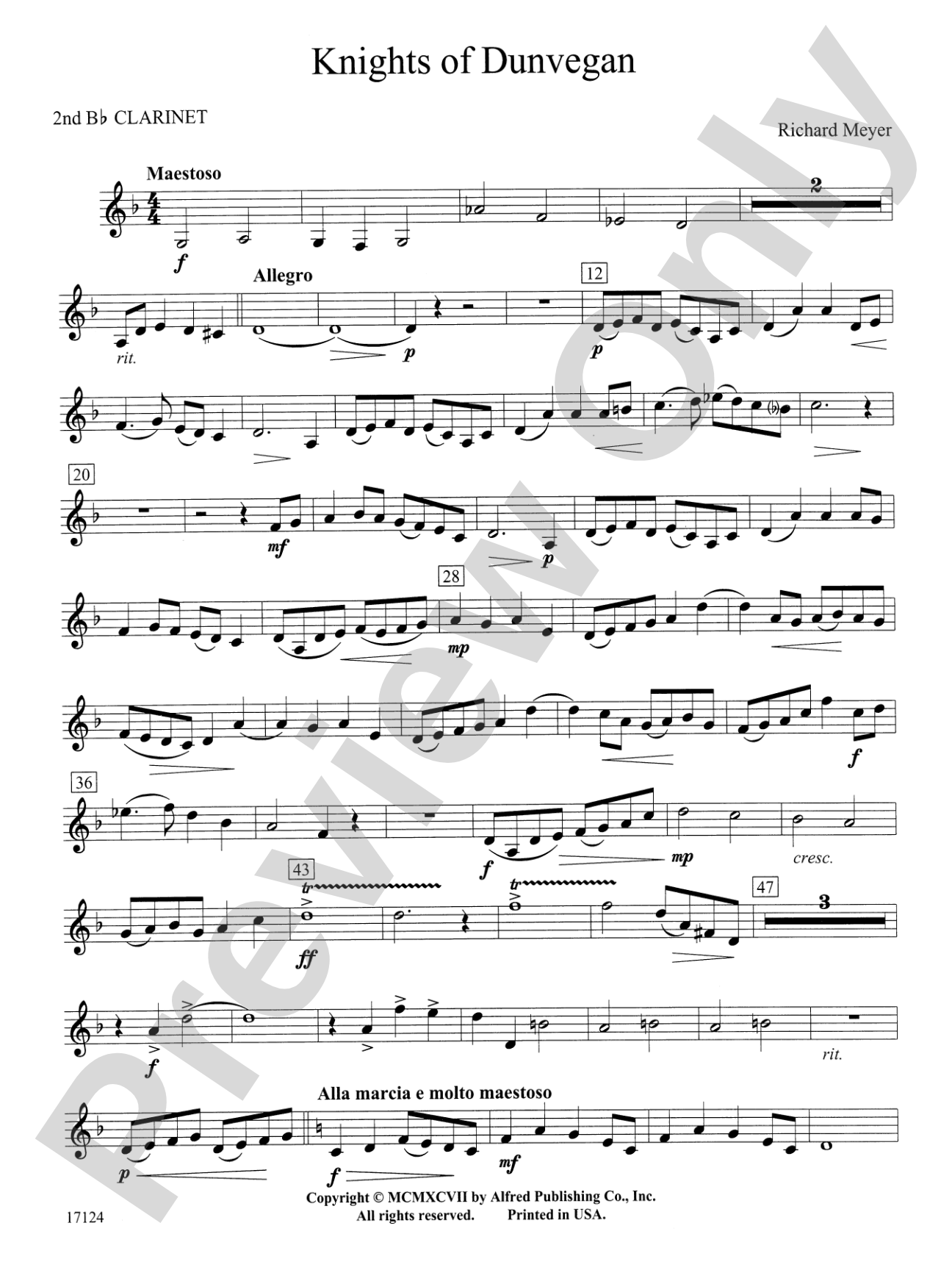

Knights of Dunvegan: 2nd B-flat Clarinet
By Richard Meyer
Grade: 2 (Medium Easy)
Item: 00-PC-0000208_C2
$3.00
Pickup currently not available
Description
Your band and audience will love this original work by Richard Meyer, written with the Scottish castle of Dunvegan in mind. Full of rich, modal harmonies and interesting scoring, there is plenty here to challenge all sections of your band. A perfect piece for contest or festival. (4:15)


Don't just read it, hear it, play along with it, and watch your students grow with it. In MakeMusic Cloud, Knights of Dunvegan: 2nd B-flat Clarinet comes alive with professional accompaniment, adjustable tempo, and built-in practice tools that turn solo practice into real progress.
Open in the Player
Jump straight in and assign it today.
Start Your Free Trial
Open this title and explore the full library in minutes.
Sample Audio
1
Audio File
--:--
0:00
0:00
Sample Video
Additional Details
Series:
Young Symphonic
Publisher:
Alfred Music
Page Count:
256
SKU:
00-PC-0000208_C2
More about this title
About the Composer: Richard Meyer

Richard Meyer brings three decades of classroom experience and a proven track record as a guest conductor and clinician to his prolific composing career. He spent 22 years directing orchestras at Oak Avenue Intermediate School in Temple City, California, expanding the program from 29 students to 200, while simultaneously overseeing the city's elementary string curriculum. In 2009, he created the "Giving Bach" program, an initiative that has received national recognition for using interactive concerts to reach special needs and underserved students across Southern California.
Beyond the classroom, Meyer conducted the Pasadena Youth Symphony Orchestra for 16 years, leading performances across North America, Europe, and Australia. He has appeared as a featured clinician at the A.S.T.A. National Conference, the Texas Orchestra Directors' Association Conference, and string workshops at Ohio State University and other regional venues. As a composer, Meyer has established himself nationally with nearly 200 published works and arrangements; he also served 16 years as string editor for Alfred Publishing Company and co-authored the String Explorer Series and other instructional materials.
Why we love this
Meyer writes with the concert band sound in mind, layering modal harmonies and colorful orchestration across all sections without requiring advanced technical facility. A programmatic title and Scottish setting give students a tangible musical story to engage with, making rehearsals feel purposeful beyond drill work. At Grade 2, this piece offers the kind of musical substance and contest-ready polish that makes a band sound far more developed than its skill level suggests.
What to expect
Knights of Dunvegan conjures a sense of place through sustained modal harmonies and atmospheric scoring that suggests ancient stone and dramatic Scottish landscape. The piece moves between moments of grandeur and introspection, building a narrative arc that feels epic without requiring virtuosic passage work.
Who it's for
Concert bands at the middle school and early high school level will find a piece that demands musicality and rhythmic control without overwhelming technical demands. Directors prepping for contest or festival will appreciate a work that presents as substantial and artfully composed while remaining accessible to developing ensembles.
How to get the most out of it
- Balance the rich harmonic textures by checking that inner voices (alto saxophones, french horns, trombones) can sing their modal lines without being buried beneath louder sections; a few isolated run-throughs of the harmonic framework alone will tighten intonation.
- Shape longer phrases by identifying the peak moment in each section and building toward it, rather than treating eight-bar phrases as separate units; this lifts the piece beyond a series of vignettes.
- Attend to the modal character by keeping the root in the bass clear and resonant, especially in passages where major and minor sonorities overlap; this harmonic ambiguity is what gives the piece its Scottish flavor.
- Use the four-minute-fifteen-second duration as a pacing guide during rehearsal; a run-through at tempo once per week helps the band internalize the arc and stay confident under performance pressure.
How to use it
Program this as an opener or feature piece at a contest or festival, where its distinctive character and manageable length work in your favor. It also serves as an excellent concert selection for spring performances, especially if paired with lighter fare or contemporary works that share its programmatic bent.
Skills your students will build
- Reading and sustaining modal harmonic progressions
- Balancing inner voices in rich chordal textures
- Shaping longer phrases with deliberate dynamic and tonal direction
- Understanding programmatic music and translating imagery into sound
- Responding to conductor cues in a work with shifting tonal centers