
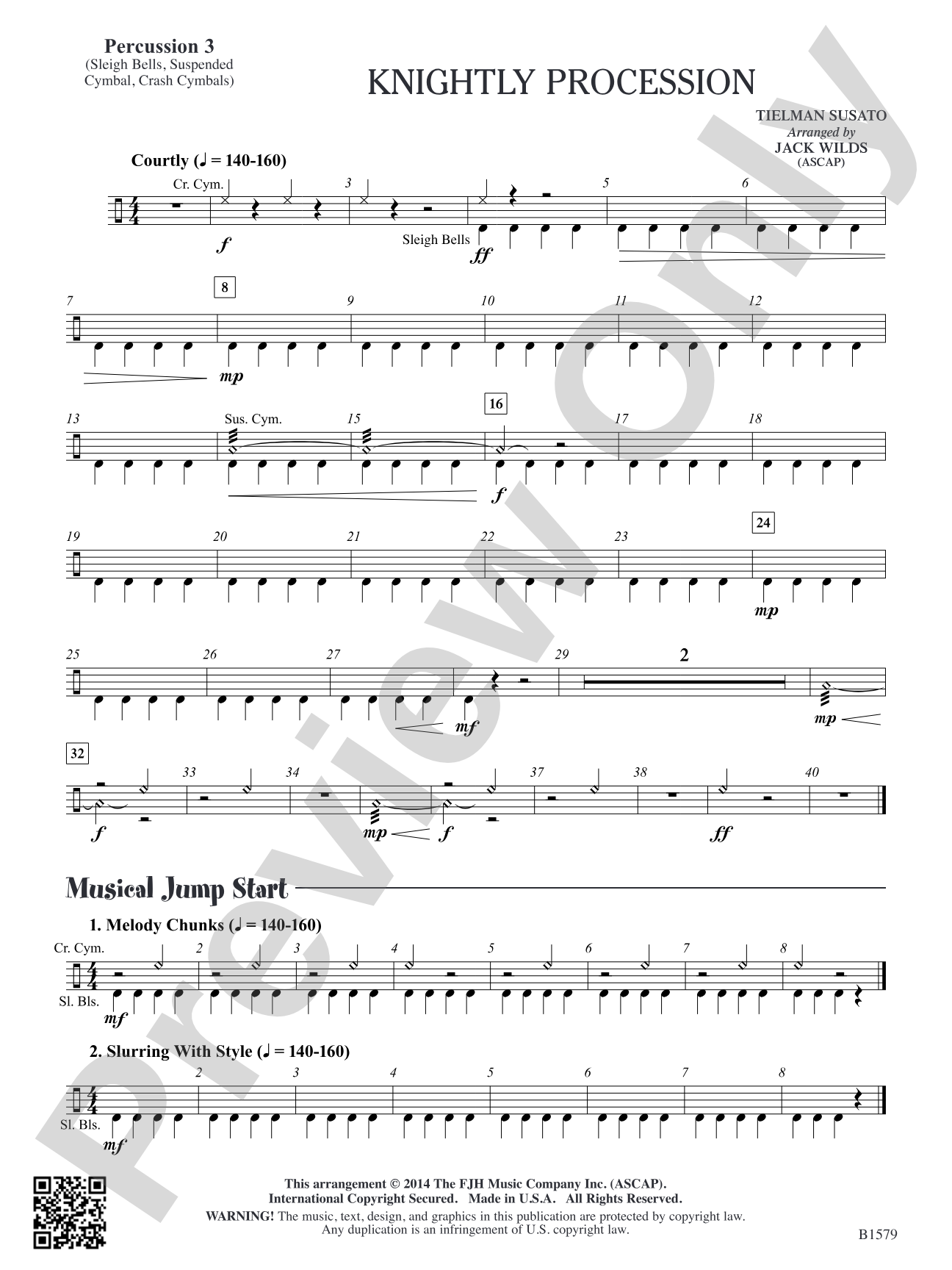

Knightly Procession: Percussion 3
By Jack Wilds
Level:.5
Item: 98-PC-DB1579_PC3
$7.00
Pickup currently not available
Description
Introduce your beginning students to the music of Renaissance composer Tielman Susato, presented here in fanfare style. The melody is passed throughout the ensemble and is presented in a variety of orchestrations, painting a vivid picture of courtiers on parade. Using only six notes in the winds, this piece will surely add an impressive air of stateliness to your next concert!


Don't just read it, hear it, play along with it, and watch your students grow with it. In MakeMusic Cloud, Knightly Procession: Percussion 3 comes alive with professional accompaniment, adjustable tempo, and built-in practice tools that turn solo practice into real progress.
Open in the Player
Jump straight in and assign it today.
Start Your Free Trial
Open this title and explore the full library in minutes.
Sample Audio
1
Audio File
--:--
0:00
0:00
Sample Video
No sample videos found.
Additional Details
Series:
FJH Starter Series
Publisher:
The FJH Music Company, Inc.
SKU:
98-PC-DB1579_PC3
More about this title
About the Composer: Jack Wilds

Jack Wilds writes music that spans the entire human lifespan, from children's choirs through professional ensembles. His compositions draw sustenance from visual art, literature, philosophy, and pure musical thinking, resulting in works that meet performers at their current level while pushing them toward genuine artistry. His chamber music has been championed by the Attacca Quartet, members of the New York Philharmonic and Atlanta Symphony, and university new music ensembles across the country.
As a former public school band director, Wilds has published over 40 works for developing musicians and brings that classroom experience into every score he writes. His wind band compositions appear on festival required repertoire lists worldwide and have been performed at the Midwest Clinic and major educator conferences. He serves as a lecturer in composition, theory, and music technology at Texas State University and as Co-Director of Music at First Presbyterian Church in San Marcos, where he also maintains an active schedule of clinician and adjudicator work.
Why we love this
Wilds has written a piece that sounds far more sophisticated than its technical demands suggest. The fanfare style and parade imagery give students a genuine sense of occasion and pageantry, while the limited six-note range in the winds keeps the mechanics manageable. Your students will play something that feels ceremonial and impressive without wrestling with the instrumental challenges that typically come with that territory.
What to expect
A procession of courtiers passing through a medieval courtyard, with the melody traveling from one group of observers to the next. The fanfare style creates nobility and ritual, while the variety of orchestrations keeps the visual picture constantly shifting, painting an almost cinematic tableau of pageantry.
Who it's for
Beginning concert band students who need substantial repertoire that sounds polished and programmatic. This piece works especially well for ensembles still building fundamental technique and confidence, since the limited note range removes a major technical hurdle while the vivid imagery motivates genuine musicality.
How to get the most out of it
- Shape the melody as it passes between sections rather than treating each statement as a reset. Each new orchestration should feel like a continuation of the same musical idea, just viewed from a different angle.
- Establish a steady, measured pulse that supports the stately character without dragging. Renaissance music benefits from forward momentum even at moderate tempos.
- Balance the supporting parts carefully so the melody remains prominent no matter which section carries it. Encourage non-melody players to think of themselves as part of the pageant backdrop.
How to use it
Program this early in a concert where you want to establish a sense of formal occasion or courtly elegance. It pairs naturally with other Renaissance or early music selections, or it can serve as a compelling opener that sets an artistic tone before moving into contrasting styles. The contest/festival designation makes it equally suitable for competitive performance or festival appearances.
Skills your students will build
- Melodic awareness and the ability to follow when the primary musical idea moves between sections
- Sustained tone production and control of dynamics across a moderate range
- Ensemble balance with six-note vocabulary in the winds
- Interpretation of fanfare style and historical context without extensive technical complication