
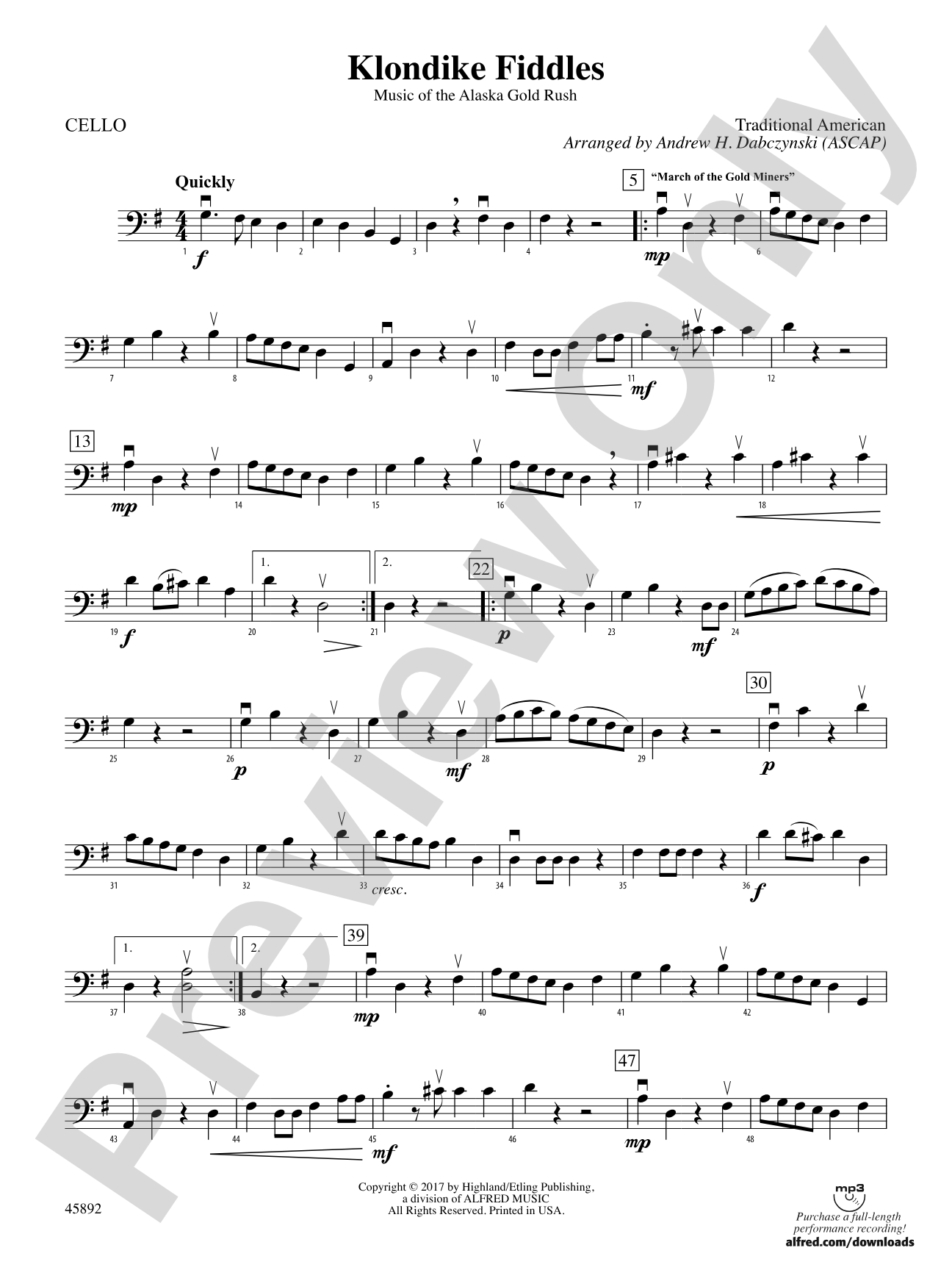

Klondike Fiddles: Cello
Music of the Alaska Gold Rush
Traditional American / arr. Andrew H. Dabczynski
Grade: 2.5
Item: 00-PC-0017690_VC1
$5.99
Pickup currently not available
Description
Imagining the Alaska Klondike gold rush calls up visions of fortune seekers, turn-of-the-century dance halls, and adventure! Klondike Fiddles captures those moods in a medley of two authentic fiddle tunes from that by-gone era by Andrew H. Dabczynski. These delightful melodies---"March of the Gold Miners" and "Crooked Stovepipe"---fall under the fingers of intermediate string students, with interesting parts for all players, "body percussion" sounds, and challenging optional improvisation opportunities. Here's a piece that complements any concert program and will have the players and audience tapping their toes! (3:50)


Don't just read it, hear it, play along with it, and watch your students grow with it. In MakeMusic Cloud, Klondike Fiddles: Cello comes alive with professional accompaniment, adjustable tempo, and built-in practice tools that turn solo practice into real progress.
Open in the Player
Jump straight in and assign it today.
Start Your Free Trial
Open this title and explore the full library in minutes.
Sample Audio
1
Audio File
--:--
0:00
0:00
Sample Video
Additional Details
Series:
Highland/Etling String Alternatives
Publisher:
Alfred Music
Page Count:
128
SKU:
00-PC-0017690_VC1
More about this title
About the Arranger: Andrew H. Dabczynski

Andrew H. Dabczynski is an Emeritus Professor of Music Education at Brigham Young University, where he established the BYU New Horizons Orchestra as both a community ensemble for adult beginning string players and a training laboratory for string educators. His contributions to music education earned him BYU's Joseph E. White Fellowship for Teaching and Learning, and in 2005 and 2014, the Utah chapter of the American String Teachers Association honored him as Higher Education Teacher of the Year and for Outstanding Contributions to Music Education.
Dabczynski's career spans teaching and administrative roles at the Eastman School of Music, the University of Connecticut (where he performed in the graduate string quartet), and public school districts across New York and Michigan. As a performer, he has played viola with the Rochester Philharmonic, Hartford Symphony, Portland Symphony, Kalamazoo Symphony, and Greenwich Symphony, and served six years as violist with the Colden String Quartet at Western Michigan University. His expertise in string pedagogy is evident in the String Explorer method series, which he co-authored for Alfred. A passionate researcher in folk music and ethnomusicology, he has focused his scholarly work on fiddling traditions and how fiddle music transmits across generations.
Why we love this
Dabczynski has crafted an arrangement that honors authentic fiddle traditions while meeting intermediate players exactly where they are technically. The inclusion of body percussion and optional improvisation sections transforms this from a straightforward medley into an engaging, interpretive experience that keeps ensemble members invested in the storytelling.
What to expect
Klondike Fiddles captures the rollicking energy and gritty optimism of frontier life, conjuring dance hall fiddles, muddy streets, and the kind of music that made fortune seekers forget their exhaustion. The medley structure lets the ensemble feel the distinct personality of each tune while the body percussion and optional improvisation elements invite players to become collaborators in the storytelling rather than note-readers.
Who it's for
Intermediate string orchestras seeking repertoire that combines solid technical demands with high engagement and historical context. This piece works for ensembles that have mastered basic intonation and ensemble balance and are ready to tackle rhythmic independence and stylistic nuance.
How to get the most out of it
- Prepare body percussion cues carefully during sectional rehearsals; assign specific players or sections to each sound so the ensemble learns to balance acoustic effects with melodic content.
- Draw attention to the character contrasts between the two tunes. 'March of the Gold Miners' should feel purposeful and driven, while 'Crooked Stovepipe' invites a looser, dance-hall swagger.
- Encourage the ensemble to listen to authentic recordings of these fiddle tunes before rehearsals begin. Hearing the original idiom will inform phrasing, dynamics, and articulation choices.
- If students engage the optional improvisation passages, establish clear harmonic boundaries in rehearsal so improvisers understand the chord changes and other players know when to lock into ensemble rhythm.
How to use it
This piece shines in a concert program that celebrates American musical heritage or explores folk traditions across cultures. Pair it with other fiddle-inspired arrangements or Americana repertoire to create a thematic block, or place it mid-program where its rhythmic vitality and lighter mood offer welcome contrast to more formal classical works.
Skills your students will build
- Stylistic interpretation of folk music idioms
- Rhythmic independence while maintaining ensemble cohesion
- Coordinating non-pitched percussion sounds with melodic content
- Basic improvisation over established harmonic progressions
- Ensemble responsiveness to conductor cues in medley structures