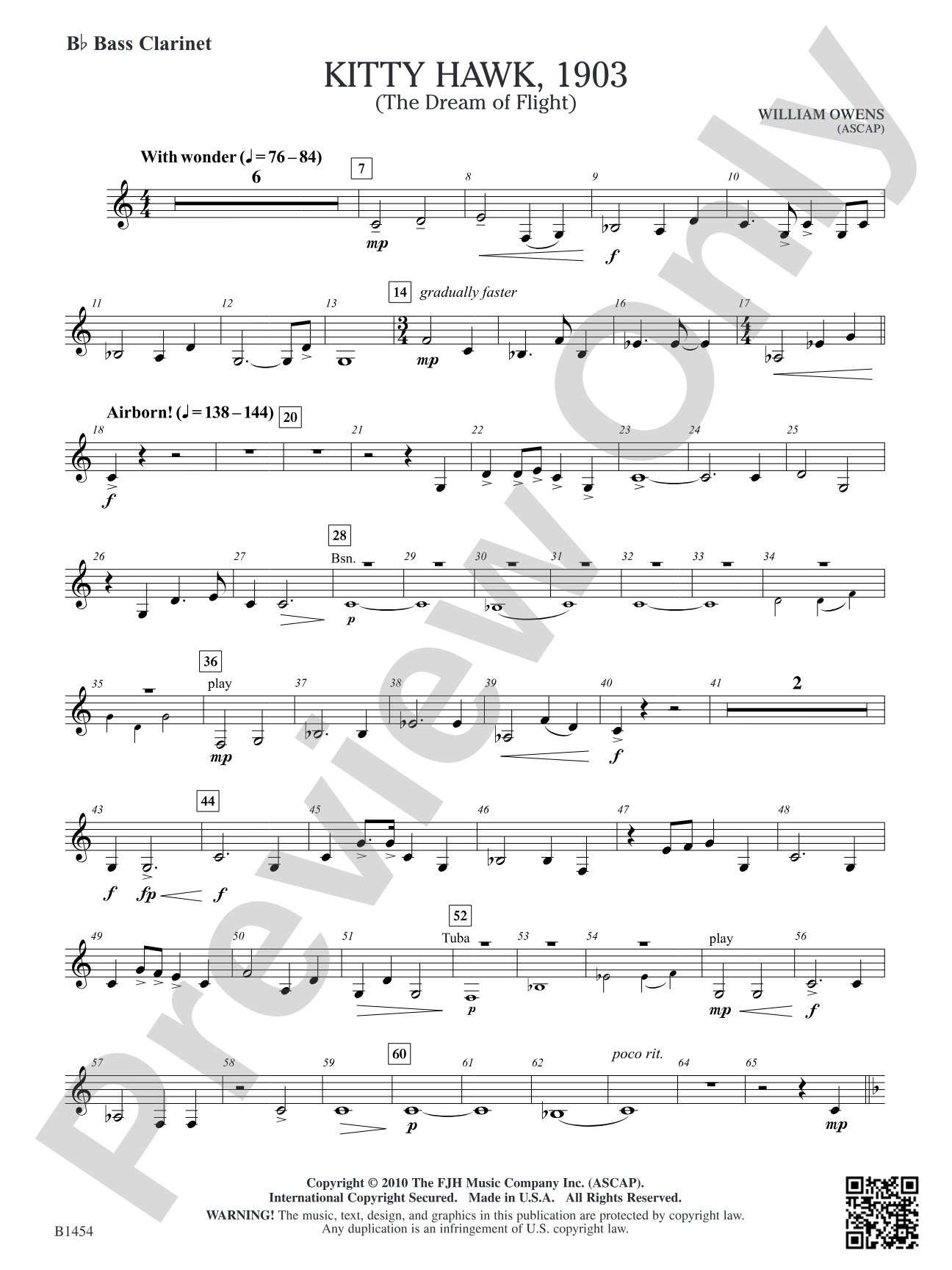
Kitty Hawk, 1903: B-flat Bass Clarinet Sheet Music Preview

Kitty Hawk, 1903: B-flat Bass Clarinet

By William Owens

Grade: 2.5

Item: 98-PC-DB1454_BC

Digital Download
$7.00
Description
The very first groundbreaking flight made by the Wright Brothers at Kitty Hawk comes alive through this stunning programmatic work. Beginning slowly with eager anticipation, the melody soon takes off, giving a truly euphoric feeling of flying. The introspective slow section focuses on Wilbur and Orville themselves before the rousing conclusion. Unique and unparalleled!

Kitty Hawk, 1903: B-flat Bass Clarinet isn't in MakeMusic Cloud just yet...but it could be. Let us know you'd like to see it, and you'll help shape what comes next. In the meantime, start a free trial and dive into thousands of interactive titles your students can play along with today.

Sample Audio
0:00
0:00
Sample Video
Additional Details
Series: FJH Young Band
Publisher: The FJH Music Company, Inc.
SKU: 98-PC-DB1454_BC

More about this title

About the Composer: William Owens

William Owens

William Owens brings three decades of classroom experience to his prolific compositional output. A VanderCook College of Music alumnus and Distinguished Alumnus award recipient, he has created over 300 works for concert band, string orchestra, and chamber ensembles since 1993. His music appears on state required lists and in educational texts nationwide, establishing him as a trusted voice in young band repertoire.

Owens combines his background as a Texas band director with active work as a clinician and conductor throughout North America. His practical approach to writing for developing ensembles reflects deep knowledge of what students can achieve and what they need to grow musically. After 30 years directing bands in Texas, he now focuses full-time on composition while serving the field through professional memberships in ASCAP, TMEA, and Phi Beta Mu International.

Why we love this

Owens captures the historical moment with genuine musical storytelling rather than surface-level programmaticism. The structure unfolds naturally from anticipation through soaring flight to intimate reflection, giving your band a clear dramatic arc to shape without requiring virtuosity beyond Grade 2.5 reach. It's the kind of piece that reminds students why they play band in the first place.

What to expect

The piece mirrors the experience of that first flight: beginning in quiet, restless anticipation before the thrilling sensation of leaving the ground. The middle section pulls inward, honoring the human ingenuity and determination behind the moment, then soars again with the confidence of people who have proven the impossible possible.

Who it's for

Concert bands at the Grade 2 to 2.5 level looking for a programmatic work with genuine substance and historical interest. This piece works equally well for groups building their large ensemble repertoire and for schools that want to program something meaningful beyond traditional marches or light fare.

How to get the most out of it

  • Shape the opening with patience. The "eager anticipation" section needs space and restraint so the melody's takeoff lands with genuine euphoria rather than starting loud and having nowhere to go.
  • Balance the slow middle section carefully; this introspective moment about the Wright brothers themselves can easily sound sluggish if the harmonic movement isn't supported with slight forward motion in the ensemble's collective breath.
  • Let the finale build momentum gradually. Avoid the temptation to rush; a steady, confident acceleration toward the conclusion will feel more triumphant than a sudden tempo shift.

How to use it

Program this as the centerpiece of a concert celebrating American innovation or history. It pairs naturally with patriotic works but stands on stronger musical ground than typical flag-waving repertoire. Consider pairing it with a lighter opening and a rousing traditional finale for a balanced concert arc.

Skills your students will build

  • Sustaining long melodic lines with proper breath support across phrase changes
  • Dynamic shaping and contrast between sections (anticipatory opening, lyrical middle, energetic finale)
  • Ensemble balance and blend in supporting harmonic voices
  • Responding to programmatic intent while maintaining musical integrity
  • Tuning and intonation stability during sustained passages and chord changes

You May Also Like