
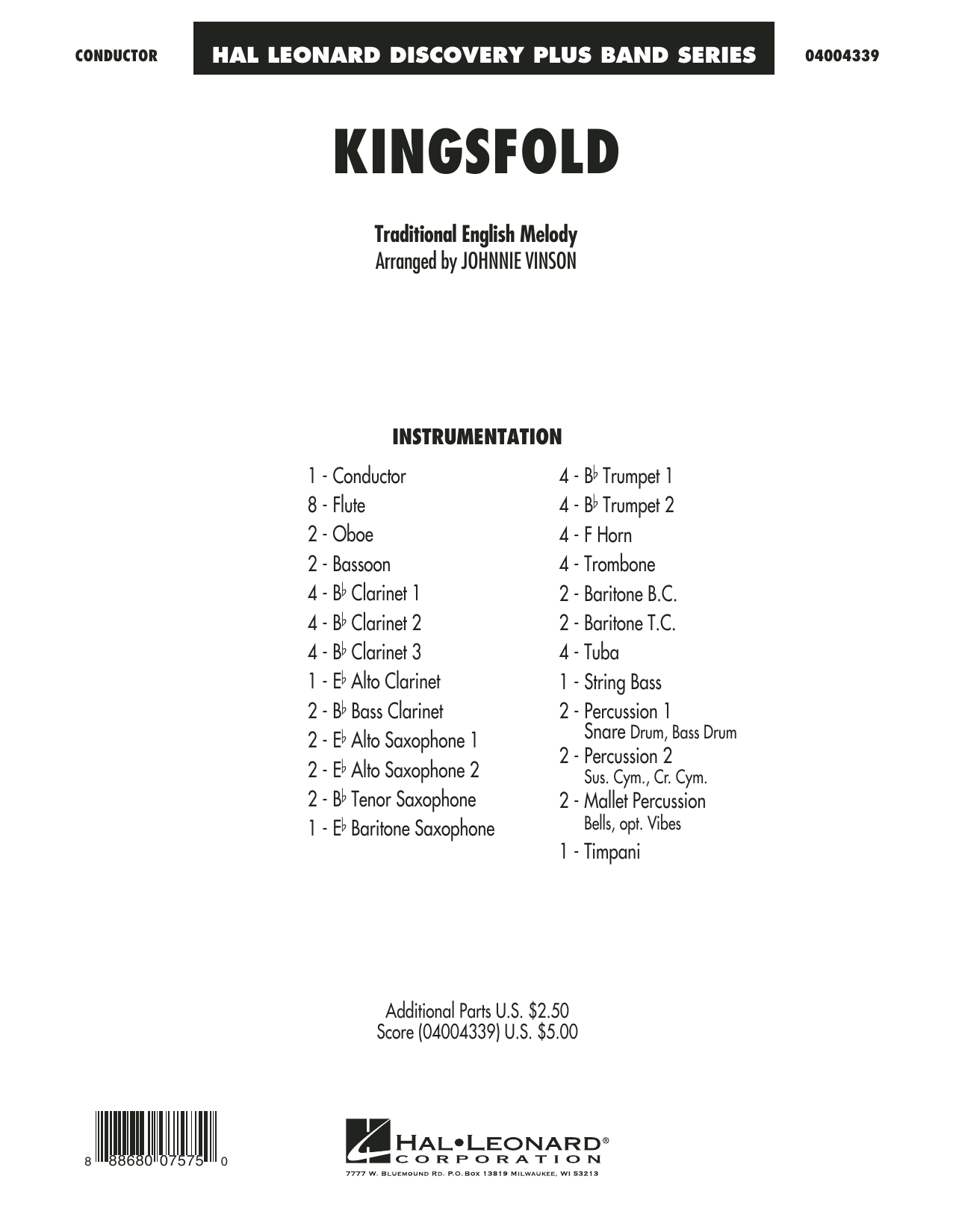

Kingsfold: Concert Band Conductor Score & Parts
As performed by Traditional English Melody / Arranged by Johnnie Vinson
Grade: 2
Item: 35-PK00309774
$45.00
Pickup currently not available
Buy Extra Parts (Digital PDF Download)
| Product | Price | Quantity |
|---|---|---|
| Kingsfold - Conductor Score (Full Score) | $6.00 | |
| Kingsfold - Flute | $6.00 | |
| Kingsfold - Oboe | $6.00 | |
| Kingsfold - Bassoon | $6.00 | |
| Kingsfold - Bb Clarinet 1 | $6.00 | |
| Kingsfold - Bb Clarinet 2 | $6.00 | |
| Kingsfold - Bb Clarinet 3 | $6.00 | |
| Kingsfold - Eb Alto Clarinet | $6.00 | |
| Kingsfold - Bb Bass Clarinet | $6.00 | |
| Kingsfold - Eb Alto Saxophone 1 | $6.00 | |
| Kingsfold - Eb Alto Saxophone 2 | $6.00 | |
| Kingsfold - Bb Tenor Saxophone | $6.00 | |
| Kingsfold - Eb Baritone Saxophone | $6.00 | |
| Kingsfold - Bb Trumpet 1 | $6.00 | |
| Kingsfold - Bb Trumpet 2 | $6.00 | |
| Kingsfold - F Horn | $6.00 | |
| Kingsfold - Trombone | $6.00 | |
| Kingsfold - Baritone B.C. | $6.00 | |
| Kingsfold - Baritone T.C. | $6.00 | |
| Kingsfold - Tuba | $6.00 | |
| Kingsfold - Bass | $6.00 | |
| Kingsfold - Percussion 1 | $6.00 | |
| Kingsfold - Percussion 2 | $6.00 | |
| Kingsfold - Mallet Percussion | $6.00 | |
| Kingsfold - Timpani | $6.00 |
Parts Added to Cart!
Description
The haunting melody of this traditional tune likely dates to the Middle Ages, and was published by British composer Ralph Vaughan Williams in the 1906 English Hymnal. Freely adapted by Johnnie Vinson in this setting for young bands, the minor melody is stated first by low clarinets and horns. The next section introduces an original theme, which is then combined with the first melody in the moving final section. Beautifully paced and scored largely in choral fashion, this is a wonderfully fresh and unique offering for holiday or winter concerts. Dur: 3:15


Kingsfold: Concert Band Conductor Score & Parts isn't in MakeMusic Cloud just yet...but it could be. Let us know you'd like to see it, and you'll help shape what comes next. In the meantime, start a free trial and dive into thousands of interactive titles your students can play along with today.
Request This Title
Tell us you want it.
Start Your Free Trial
Explore everything that's ready to play right now.
Sample Audio
No sample audio found.
Sample Video
No sample videos found.
Additional Details
Publisher:
Hal Leonard
SKU:
35-PK00309774
More about this title
About the Artist: Traditional English Melody
English folk melodies form the backbone of Britain's musical heritage, passed down through centuries of oral tradition and eventually codified in hymnals and collections. The tune Kingsfold emerged from this deep well of communal song, its minor-key simplicity reflecting the meditative qualities valued in English devotional music. When Ralph Vaughan Williams included it in his landmark 1906 English Hymnal, he recognized what makes these melodies endure: their emotional directness and capacity to speak across generations.
Why we love this
Vinson's arrangement respects the tune's inherent gravity while giving young players genuine interpretive work to do. The layering of the original melody with a new thematic idea demonstrates how traditional material can expand without losing its character, making this a smart teaching tool for understanding arrangement principles. For a Grade 2 band, the choral voicing and deliberate pacing reward careful attention to balance and phrase shaping.
What to expect
Quiet dignity and meditative depth. The minor melody unfolds with the simplicity of something remembered rather than invented, while the original countermelody adds contemporary texture without disrupting that contemplative mood. By the final section, both ideas interweave into something both ancient and fresh.
Who it's for
Grade 2 concert bands looking for music that carries weight without excessive technical demands. Directors programming winter or holiday concerts will find this especially valuable, as it offers liturgical resonance without requiring a soloist or specialized ensemble.
How to get the most out of it
- Support the low clarinet and horn statement of the main melody with a steady, singing tone; this introduction sets the emotional foundation for everything that follows
- Shape the original theme in the second section with clear articulation to establish its character before the two ideas interact
- Blend the final section where both themes sound together by listening across the band; minor key voicings can easily muddy if individual lines don't maintain clarity
- Allow the piece to breathe at structural joints; resist the temptation to rush the transitions between sections
How to use it
Pair this with a contrasting holiday selection to create a meaningful arc within a winter concert. Its three-minute span and reflective character work well as a centerpiece between more energetic pieces, or as the opening that establishes an introspective tone for the program.
Skills your students will build
- Singing sustained lines with consistent vibrato and tone quality
- Balancing multiple melodic ideas occurring simultaneously
- Shaping minor key harmonic progressions with sensitivity to voice leading
- Responding to the conductor's pacing and phrase architecture in arrangements with minimal dramatic changes