
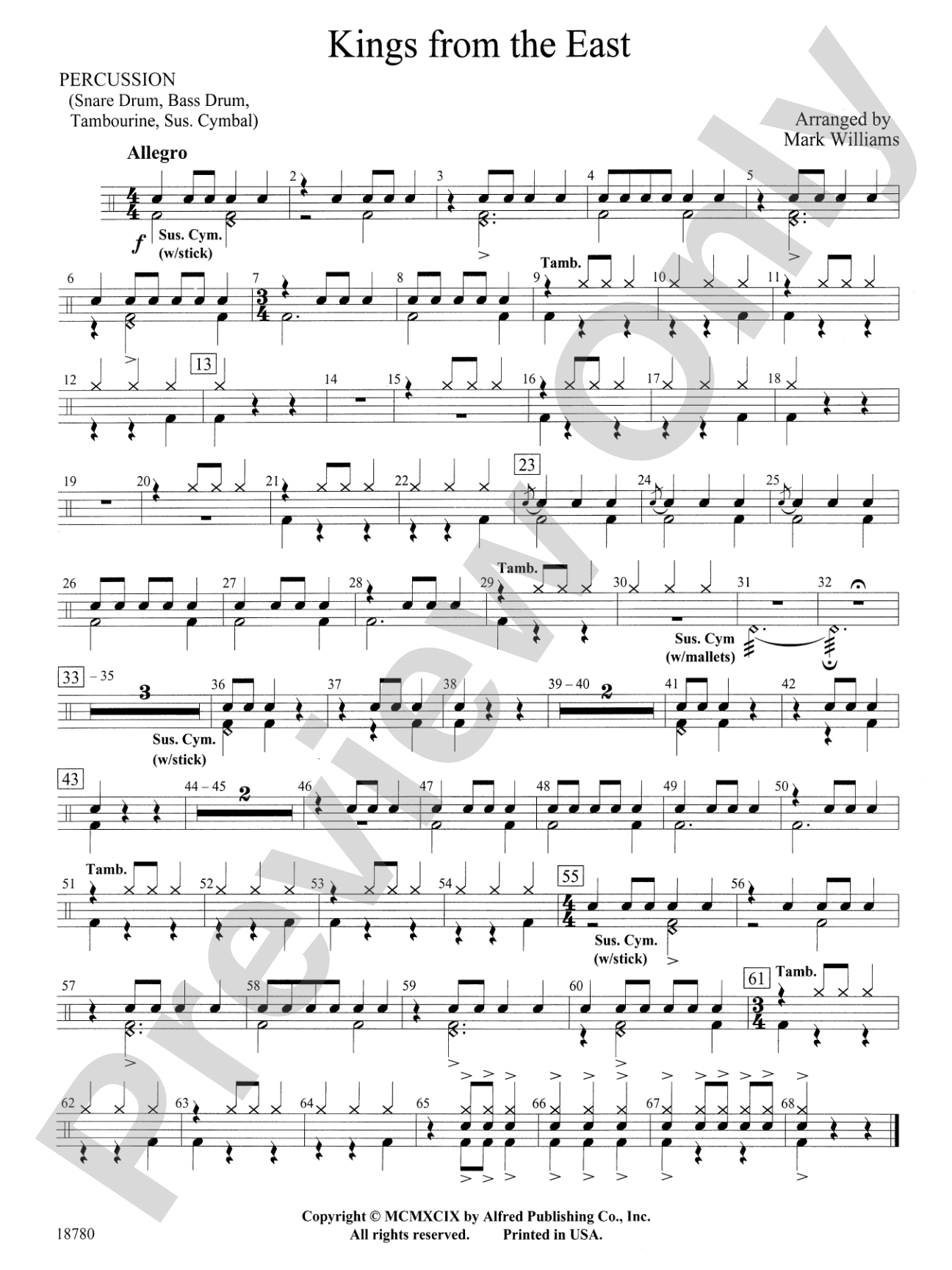

Kings from the East: 1st Percussion
By Mark Williams
Grade: 1 (Very Easy)
Item: 00-PC-0000278_PC1
$3.00
Pickup currently not available
Description
For your next holiday concert, combine the mystery of the East with one of the world's most beloved Christmas carols in this creative depiction of the Three Kings' famous journey. Exotic scales and rich harmonies meet to create a powerful performance experience. This unique arrangement is correlated with Accent on Achievement, Book 1, page 21.


Don't just read it, hear it, play along with it, and watch your students grow with it. In MakeMusic Cloud, Kings from the East: 1st Percussion comes alive with professional accompaniment, adjustable tempo, and built-in practice tools that turn solo practice into real progress.
Open in the Player
Jump straight in and assign it today.
Start Your Free Trial
Open this title and explore the full library in minutes.
Sample Audio
1
Audio File
--:--
0:00
0:00
Sample Video
Additional Details
Series:
Accent on Achievement
Publisher:
Alfred Music
Page Count:
116
SKU:
00-PC-0000278_PC1
More about this title
About the Composer: Mark Williams

Mark Williams shaped school band repertoire through decades of composition and education. A native of Chicago who established his career in Washington state, Williams authored the Accent on Achievement Band Method alongside his prolific output of over 200 published works for band, orchestra, and choir. His teaching focused on elementary band instruction, giving him deep insight into what young musicians need to succeed.
Beyond the classroom, Williams earned recognition as a clinician and guest conductor across North America and Australia. He performed bassoon professionally with the 560th Air Force Band and later served as conductor and artistic director for the Spokane British Brass Band. His accolades include the Western International Band Clinic's Gralia Competition and multiple ASCAP Special Awards, cementing his reputation as a composer who understood both the pedagogical and artistic demands of school music.
Why we love this
Williams crafts an arrangement that doesn't just add festive color to a familiar carol; he uses exotic scales and harmonic richness to create genuine musical intrigue while keeping the technical demands absolutely accessible for emerging bands. At Grade 1, this piece respects young musicians' developing abilities while giving them something genuinely interesting to perform, and the integration with Accent on Achievement Book 1 means it fits seamlessly into your curriculum without extra preparation work.
What to expect
The familiar contours of a beloved carol transform through Williams's lens into something that feels both mysterious and grounded. Exotic scales shimmer beneath rich harmonies, evoking the ancient journey of the Three Kings while maintaining the warmth and accessibility that makes this carol endure across centuries.
Who it's for
Elementary and middle school concert bands ready to expand beyond traditional holiday arrangements. Directors seeking Grade 1 repertoire that respects young musicians' abilities while introducing them to non-traditional harmonic language and structural sophistication.
How to get the most out of it
- Balance the exotic scalar passages so they enhance rather than obscure the recognizable melody; young players often need reminding that decoration serves the main tune, not the reverse.
- Use the contrasting harmonic colors as rehearsal landmarks. When you say 'that section with the unusual chords,' students immediately know which part you mean and can mentally prepare for the shift in sound.
- Allow breath time in phrases where the exotic writing might tempt faster breathing; Grade 1 players benefit from explicit guidance on phrasing within unfamiliar harmonic territory.
- Encourage the ensemble to listen through one complete run-through before offering corrections, especially early in rehearsal; this piece's harmonic language rewards students who understand the arc rather than obsessing over individual notes.
How to use it
Open a winter concert with this piece to signal that your young band brings artistry and imagination to holiday music. Its Grade 1 accessibility makes it an ideal opener that builds audience engagement before deeper repertoire, and its thematic focus on the nativity story pairs naturally with a carol-centered program section.
Skills your students will build
- Playing with unfamiliar harmonic progressions and exotic scales while maintaining intonation
- Balance between foreground (melody) and background (accompaniment) voices
- Sustaining longer phrases without compromising tone quality
- Responding to harmonic color shifts as interpretive cues rather than technical obstacles
- Reading and performing within a systematic method correlated to classroom progress