
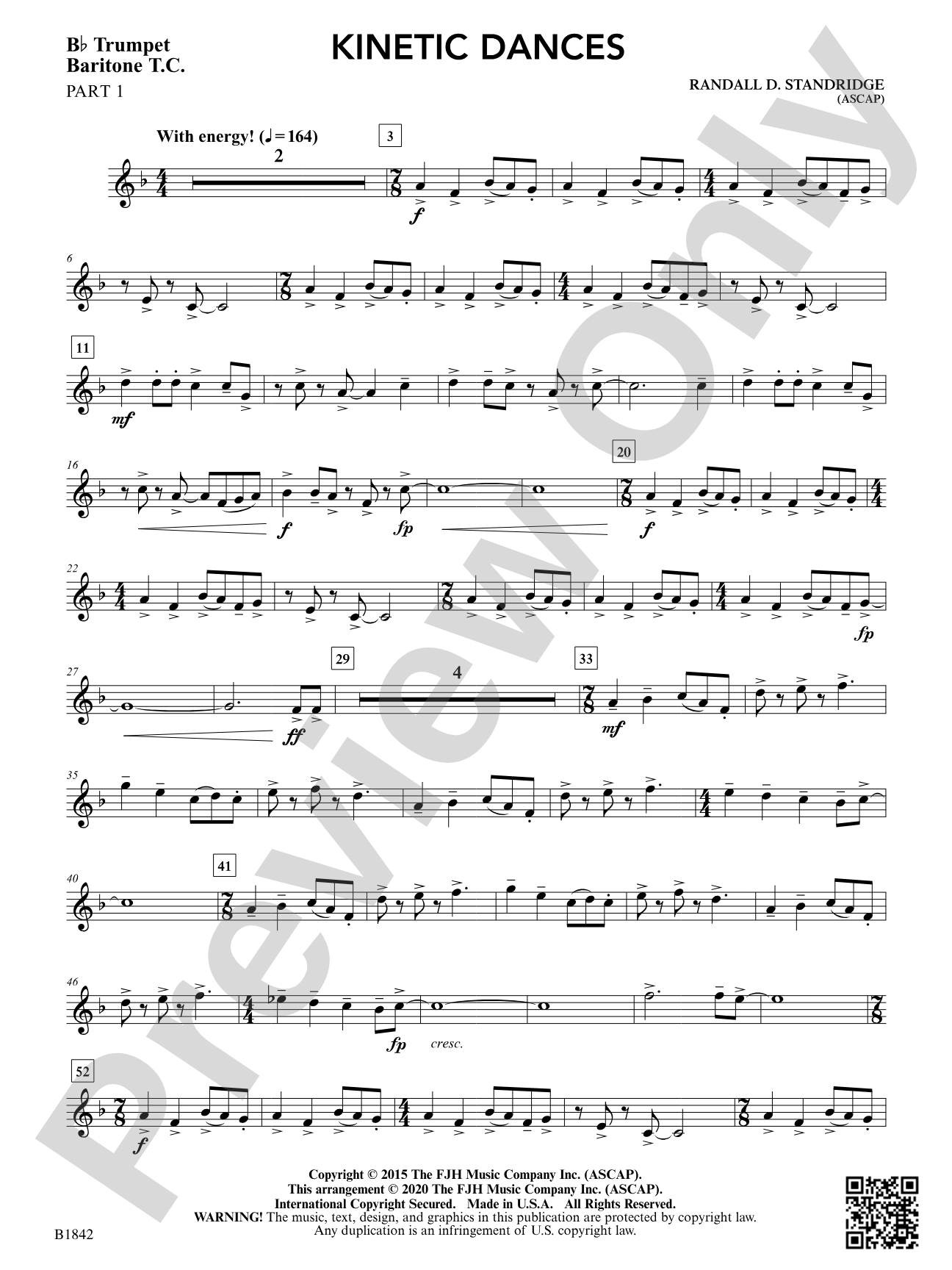

Kinetic Dances: Part 1 - B-flat Trumpet / Baritone T.C.
By Randall D. Standridge
Grade: 3.5
Item: 98-PC-DB1842_PART1_T
$7.00
Pickup currently not available
Description
Experience this high-energy work that uses achievable shifting meters and layered percussion writing to superb effect! The rhythmic excitement builds throughout before reaching a truly thrilling climax. A pops-influenced concert piece that will make an exciting opening or closing statement at your next concert!


Kinetic Dances: Part 1 - B-flat Trumpet / Baritone T.C. isn't in MakeMusic Cloud just yet...but it could be. Let us know you'd like to see it, and you'll help shape what comes next. In the meantime, start a free trial and dive into thousands of interactive titles your students can play along with today.
Request This Title
Tell us you want it.
Start Your Free Trial
Explore everything that's ready to play right now.
Sample Audio
1
Audio File
--:--
0:00
0:00
Sample Video
No sample videos found.
Additional Details
Series:
The ReImagine Initiative
Publisher:
The FJH Music Company, Inc.
SKU:
98-PC-DB1842_PART1_T
Instrumentation:
4-Part Fully Adaptable with Percussion
More about this title
About the Composer: Randall D. Standridge
Randall D. Standridge is a prolific composer whose catalog spans band, orchestra, and chamber music across all performance levels. Known for writing accessible yet musically substantial works, he has built a reputation for understanding the pedagogical and practical needs of school ensembles while never compromising on compositional craft.
Standridge's output includes contest favorites, full-length concert works, and experimental pieces that push performers into new musical territory. His work with the ReImagine Initiative reflects his commitment to flexible instrumentation and innovative scoring that opens repertoire to ensembles with varied instrumental resources.
Why we love this
The shifting meters here feel organic rather than gimmicky, and they drive the propulsive energy forward without requiring your ensemble to tackle complex metric modulation concepts. Standridge writes percussion that matters musically, layering it in ways that add textural interest and rhythmic clarity rather than padding the score. This is the rare Grade 3.5 opener or closer that lands with genuine impact.
What to expect
Kinetic Dances pulses with modern rhythmic drive, the kind of pops-influenced sensibility that appeals to performers and audiences alike. Shifting meters create subtle surprise and forward momentum, while layered percussion writing adds texture that prevents the piece from ever feeling static. The trajectory is purposeful and cumulative, building toward a climax that feels genuinely thrilling rather than manufactured.
Who it's for
This score works for concert bands and flexible ensembles at the 3.5 level seeking a contemporary opener or closer with real kinetic energy. The fully adaptable instrumentation means you can program it whether you have a traditional full band, a mixed band/string group, or something in between. Students who have solid reading skills and comfort with basic rhythmic concepts will thrive here.
How to get the most out of it
- Lock the pulse across sections before adding the meter shifts. Once your ensemble owns the fundamental beat through the simplest passages, the rhythmic transitions will feel intentional rather than chaotic.
- Let the percussion parts breathe. The layered writing creates momentum on its own; avoid the temptation to push the tempo harder as the piece climbs.
- Balance the adaptable parts carefully during early rehearsals. If you're using mixed instrumentation, run through passages in small sections first to confirm each player can hear their harmonic role clearly.
- Trust the climax. The build is gradual and earned; conducting it with restraint through the middle section makes the final statement feel inevitable rather than forced.
How to use it
Open a concert with this if you want to energize the room immediately and signal that your program will be inventive. Conversely, close with it for a contemporary, high-spirited exit that leaves the audience with momentum. Its flexible instrumentation also makes it ideal for festival seasons when you're performing with mixed or reduced ensembles.
Skills your students will build
- Reading and executing shifting meters (mixed simple and compound time)
- Maintaining metric stability while other sections change meter signatures
- Balancing layered percussion parts in ensemble context
- Responding to flexible instrumentation without losing harmonic coherence
- Building and sustaining energy through compositional architecture rather than relying on tempo alone