
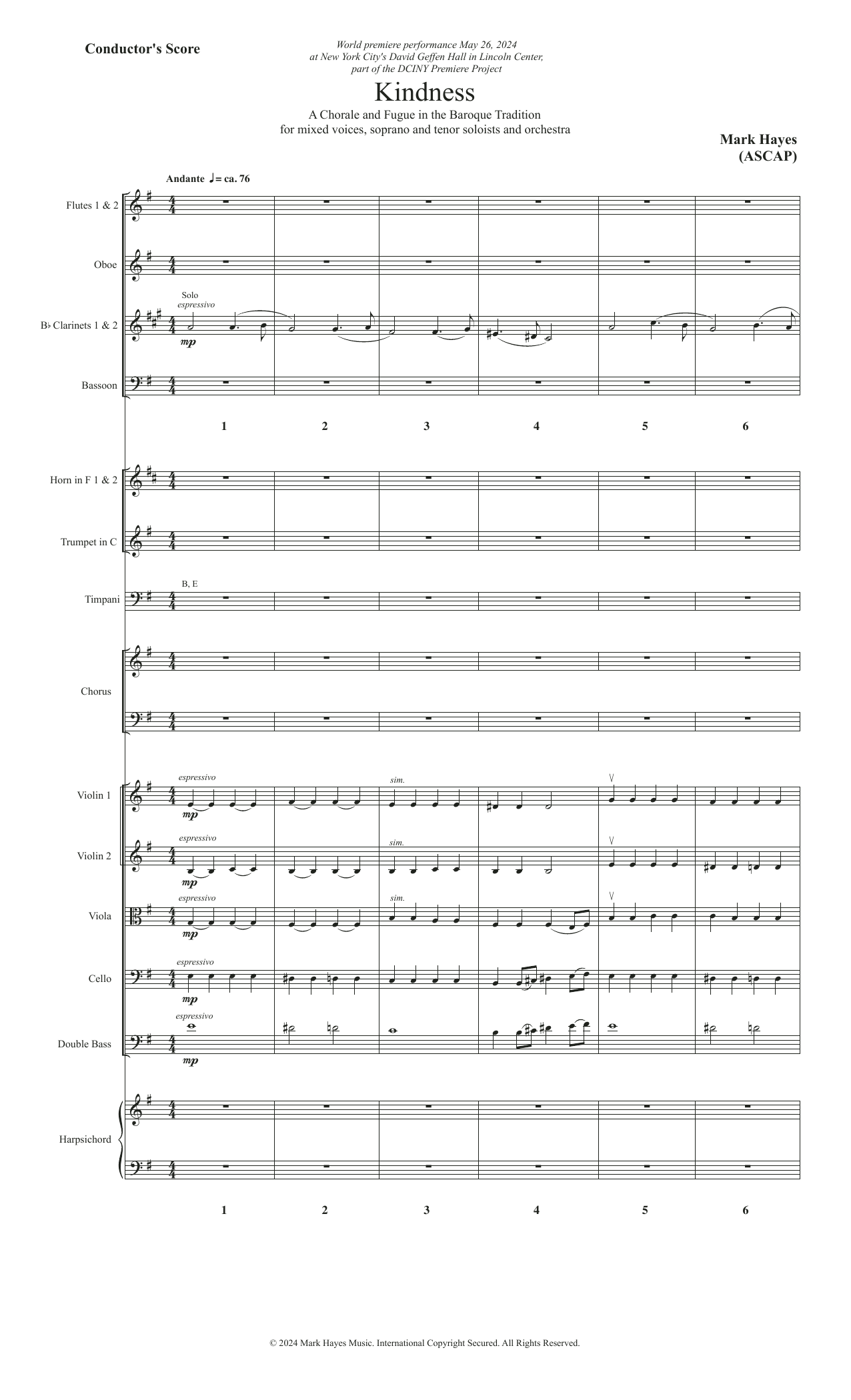

Kindness (Orchestra): Choral Instrumental Pak
By Mark Hayes
Item: 35-PK01480129
$299.95
One moment…
Description
If you enjoy singing Baroque music and value the importance of kindness, courage and compassion, this new 30 minute through-composed work by Mark Hayes for chorus, soprano and tenor soloists and orchestra is for you.Drawing from the writings of ancient and contemporary authors, the original text of "Kindness," written by Hayes, seeks to answer the question, "How then shall we live, especially in a world that seems so dysfunctional?" The answer: live with kindness, courage and compassion. When we are joined as one in our pursuit of these values, we can make a lasting impact. To quote Margaret Mead, "Never underestimate the ability of a small group of committed individuals to change the world." "Kindness" is set in the Baroque tradition and features an original chorale tune with three separate texts, a fugue, both conventional and retrograde, recitative-like sections for the soprano and tenor soloists and extensive instrumental interludes. As a nod to Baroque masters such as Johann Sebastian Bach and George Frideric Handel, Hayes included passages imitating "Jesu, Joy of Man's Desiring" and "Hallelujah Chorus." This work is perfect for high school and college choirs as well as community and church choirs. The text is intentionally not sacred, rather universal in its appeal. Imagine how the music and message of this work could join a community together in the pursuit of kindness, courage and compassion. It's what the world needs.. now.


Kindness (Orchestra): Choral Instrumental Pak isn't in MakeMusic Cloud just yet...but it could be. Let us know you'd like to see it, and you'll help shape what comes next. In the meantime, start a free trial and dive into thousands of interactive titles your students can play along with today.
Request This Title
Tell us you want it.
Start Your Free Trial
Explore everything that's ready to play right now.
Sample Audio
No sample audio found.
Sample Video
No sample videos found.
Additional Details
Publisher:
Hal Leonard
SKU:
35-PK01480129
More about this title
About the Composer: Mark Hayes

Mark Hayes brings together a prolific output of over 1,750 published compositions with deep expertise across multiple musical disciplines. A summa cum laude graduate in Piano Performance from Baylor University, he has established himself as a concert pianist, conductor, and orchestrator of international standing. His work has been premiered at major venues including Lincoln Center, Carnegie Hall, and the National Cathedral, and in 2010 Baylor University honored him with the Award for Exemplary Leadership in Christian Music.
Beyond his choral and orchestral contributions, Hayes has demonstrated remarkable range as a composer and arranger. He has orchestrated musical theater works, served as a record producer, and maintained an especially strong commitment to piano composition with over 100 books in print spanning gospel, classical, jazz, and Broadway idioms. Based in Kansas City, Missouri, his mission centers on creating accessible, beautiful music across genres and skill levels.
Why we love this
Hayes constructs a substantial 30-minute work that tackles weightier thematic material without requiring specialized knowledge of religious texts or practice traditions. The through-composed structure with its mix of choral writing, soloistic passages, and orchestral interludes keeps ensemble and audience engaged throughout, while the Baroque scaffolding makes the piece both musically coherent and immediately recognizable. For programs seeking to commission ensemble and community investment in a shared message, this work's universal text about kindness and courage gives choirs a rare opportunity to perform music with genuine contemporary relevance.
What to expect
The score unfolds with the structural logic and harmonic language of Baroque music, yet the text grounds it firmly in contemporary concerns about how we should live together. Passages of contrapuntal richness give way to moments of direct simplicity, creating a dynamic emotional arc that feels both timeless and urgent. The orchestration provides architectural support while the vocal writing ranges from choral grandeur to intimate soloistic dialogue.
Who it's for
High school and college choirs seeking a substantial contemporary work with accessible musicianship demands will find this score rewarding. Community and church choirs looking to explore Baroque compositional language without performing historical sacred literature can use this as an entry point. Directors assembling a concert program around themes of social responsibility and shared values will discover a cohesive, full-length work that engages ensemble and audience alike.
How to get the most out of it
- Balance the soprano and tenor soloists carefully during recitative-like sections; these moments benefit from clarity and individual character rather than dramatic projection.
- The chorale tune appears with three different texts throughout the work. Establish its identity firmly in your ensemble's voices during early rehearsals so subsequent variations feel like deepening rather than repetition.
- Attend to the orchestral interludes as structural anchors. They create breathing room within the through-composed form and give singers mental reset points.
- The passages echoing Baroque masters work best when your ensemble has internalized the rhetorical style of the period; highlight the text's emotional content rather than oversinging the idiom.
How to use it
Consider programming this as a complete concert work on its own or as the centerpiece of a program exploring kindness, community, and civic engagement. Its length and Baroque framework allow it to anchor a concert featuring complementary secular choral literature or orchestral works. The thematic clarity makes it ideal for spring semester programming when concert themes often shift toward forward-looking, community-centered messages.
Skills your students will build
- Baroque harmonic language and voice leading conventions
- Fugal writing and contrapuntal techniques in contemporary contexts
- Coordinate soprano and tenor soloists within large ensemble textures
- Sight-reading mixed meter changes and recitative-like rhythmic freedom
- Sustaining focused ensemble sound across 30 minutes of through-composed material
- Text interpretation with historical style and contemporary relevance