
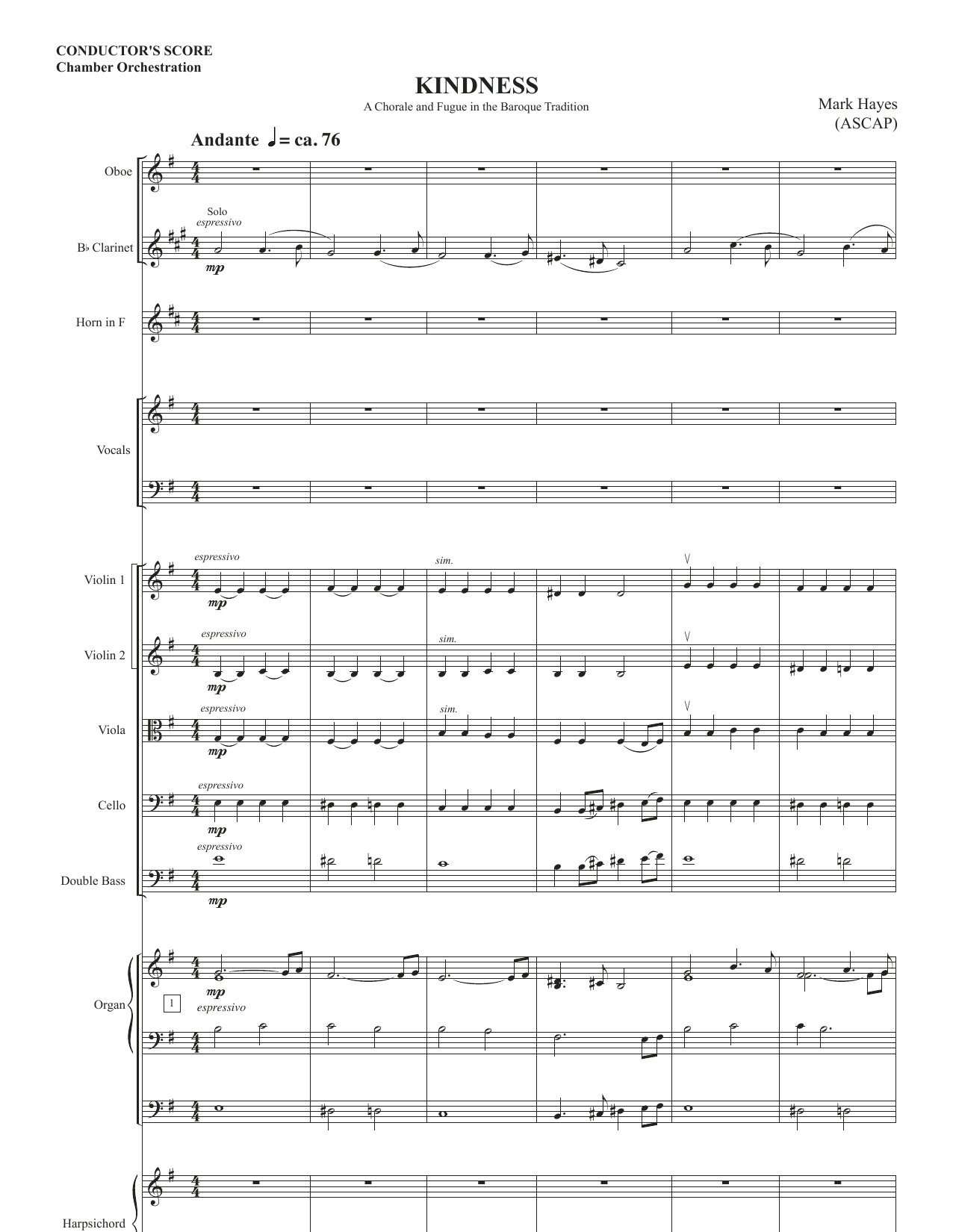

Kindness (Chamber Orchestra): Choral Instrumental Pak
By Mark Hayes
Item: 35-PK01640871
$149.95
One moment…
Description
If you enjoy singing Baroque music and value the importance of kindness, courage and compassion, this new 30 minute through-composed work by Mark Hayes for chorus, soprano and tenor soloists and orchestra is for you. Drawing from the writings of ancient and contemporary authors, the original text of "Kindness," written by Hayes, seeks to answer the question, "How then shall we live, especially in a world that seems so dysfunctional?" The answer: live with kindness, courage and compassion. When we are joined as one in our pursuit of these values, we can make a lasting impact. To quote Margaret Mead, "Never underestimate the ability of a small group of committed individuals to change the world." "Kindness" is set in the Baroque tradition and features an original chorale tune with three separate texts, a fugue, both conventional and retrograde, recitative-like sections for the soprano and tenor soloists and extensive instrumental interludes. As a nod to Baroque masters such as Johann Sebastian Bach and George Frideric Handel, Hayes included passages imitating "Jesu, Joy of Man's Desiring" and "Hallelujah Chorus." This work is perfect for high school and college choirs as well as community and church choirs. The text is intentionally not sacred, rather universal in its appeal. Imagine how the music and message of this work could join a community together in the pursuit of kindness, courage and compassion. It's what the world needs.. now.


Kindness (Chamber Orchestra): Choral Instrumental Pak isn't in MakeMusic Cloud just yet...but it could be. Let us know you'd like to see it, and you'll help shape what comes next. In the meantime, start a free trial and dive into thousands of interactive titles your students can play along with today.
Request This Title
Tell us you want it.
Start Your Free Trial
Explore everything that's ready to play right now.
Sample Audio
No sample audio found.
Sample Video
No sample videos found.
Additional Details
Publisher:
Hal Leonard
SKU:
35-PK01640871
More about this title
About the Composer: Mark Hayes
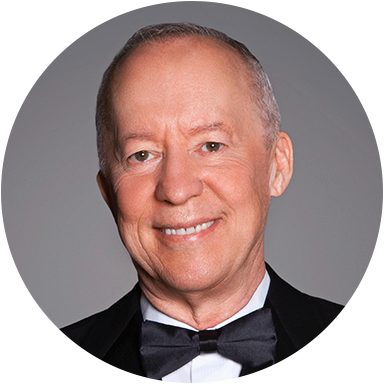
Mark Hayes has established himself as a prolific composer and conductor with over 1,750 published works across concert, sacred, and theatrical genres. A summa cum laude graduate in piano performance from Baylor University, he has conducted at prestigious venues including Lincoln Center, the National Cathedral, and Carnegie Hall, premiering major works like his Requiem in Rome and commissioning projects for institutions worldwide. Beyond his choral and orchestral output, Hayes maintains a deep commitment to piano composition, with more than 100 books spanning gospel, classical, jazz, and musical theatre idioms.
His career reflects a rare versatility that moves seamlessly between artistic disciplines. As both orchestrator and record producer, Hayes has contributed to theatrical productions winning festival recognition, while simultaneously pursuing guest conducting opportunities and composing commissions that span continents. In 2010, Baylor University recognized his leadership in Christian music, a distinction that underscores his influence within the education and performance communities.
Why we love this
Hayes constructs this 30-minute work with architectural sophistication that respects both Baroque tradition and contemporary choral pedagogy. The through-composed structure incorporates fugues (in both conventional and retrograde forms), a chorale tune with three distinct texts, and soloistic recitative passages, creating natural teaching moments for students encountering these forms in context rather than isolation. Most importantly, the universalist text transforms what could be a generic motivational piece into something your ensemble will genuinely want to perform and your audience will leave thinking about.
What to expect
This work inhabits the world of Bach and Handel while speaking directly to contemporary concerns about how we live together. The Baroque architecture provides elegant scaffolding for a conversation about kindness and courage that feels neither preachy nor antiquated, with orchestral interludes offering moments of quiet reflection between choral proclamations.
Who it's for
High school and college choirs seeking a substantial work with philosophical weight will find in Kindness a 30-minute commitment that justifies its length through musical substance, not filler. Community choirs and church ensembles drawn to Baroque style and contemporary relevance will appreciate both the stylistic authenticity and the secular, inclusive text that speaks to universal human values rather than denominational doctrine.
How to get the most out of it
- Balance the soprano and tenor soloists against the full ensemble during their recitative-like passages; these moments function as musical punctuation, not competition for focus.
- Rehearse the fugal sections by voice part in isolation first, then layer them systematically rather than attempting tutti entries too early.
- The instrumental interludes are not filler; treat them as structural anchors that give singers time to reset between text sections while maintaining architectural momentum.
- Highlight the moments imitating 'Jesu, Joy of Man's Desiring' and the 'Hallelujah Chorus' as harmonic landmarks that audiences will recognize, but let them emerge naturally rather than pointing them out.
How to use it
Consider this for a concert that explores faith, community, or social values without requiring sacred repertoire as a frame. The 30-minute length makes it suitable as the centerpiece of a program built around works addressing human connection, or as a standalone concert that stands entirely on its musical and textual merit. Its through-composed design means it works best as a complete performance rather than carved into smaller sections.
Skills your students will build
- Baroque counterpoint and fugue writing in performance context
- Balancing dialogue between solo voices and ensemble
- Coordination with orchestra in recitative-style passages
- Reading retrograde fugal material
- Long-form interpretive phrasing across 30-minute through-composed structure
- Text expression grounded in universal rather than sacred language