
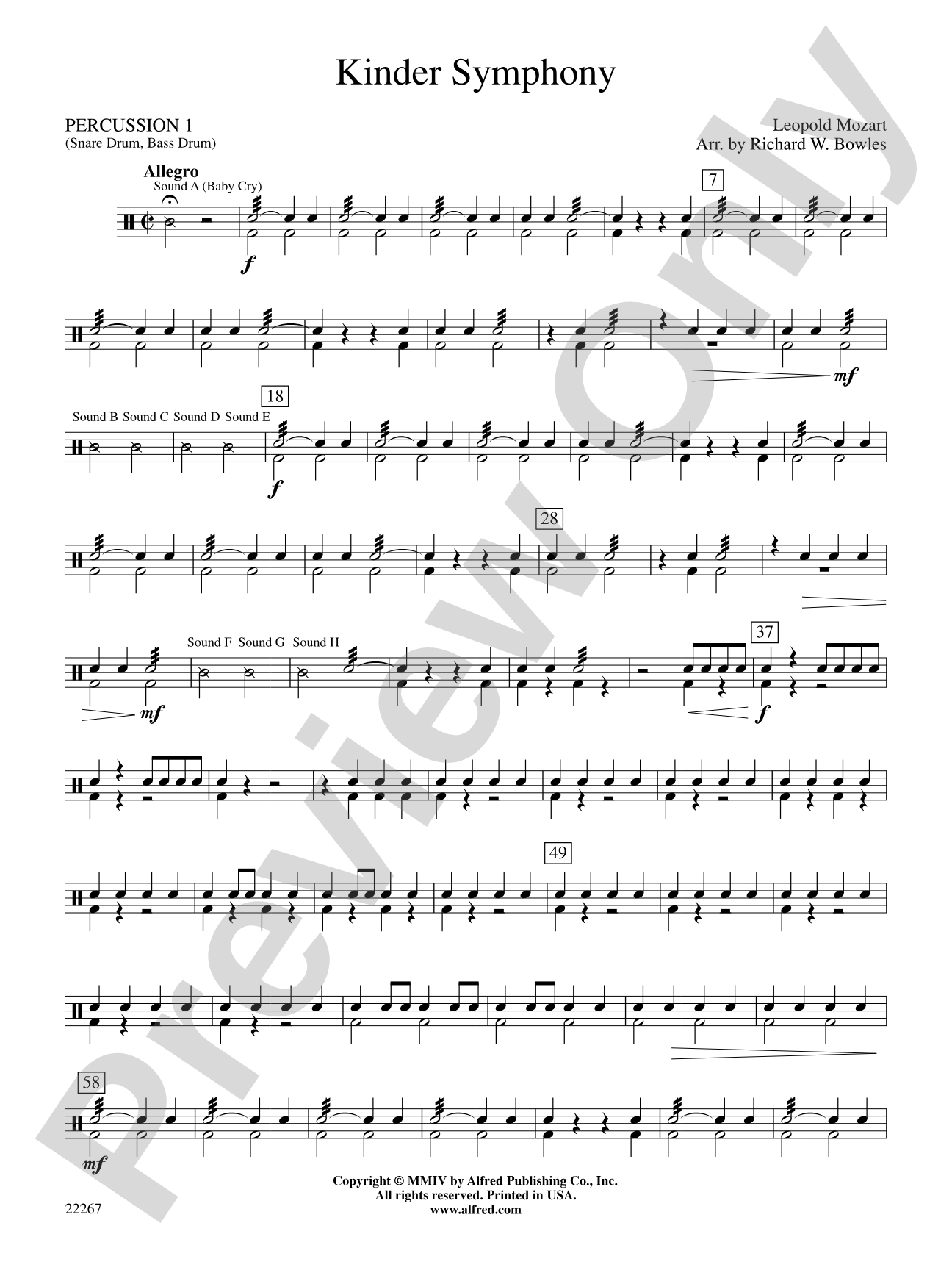

Kinder Symphony: 1st Percussion
By Leopold Mozart / arr. Richard W. Bowles
Grade: 2 (Medium Easy)
Item: 00-PC-0000521_PC1
$3.00
Pickup currently not available
Description
Leopold Mozart wrote his Kinder Symphony ("Children's Symphony") to charm young people especially. This arrangement incorporates the two main melodies in the original symphony and reduces their length to about four minutes. As in the original, there are "holes" where various sounds, other than musical, should be sounded. Before playing Kinder Symphony, the "sounds" will need to be assigned. This will be great fun for your audiences as well as players.


Don't just read it, hear it, play along with it, and watch your students grow with it. In MakeMusic Cloud, Kinder Symphony: 1st Percussion comes alive with professional accompaniment, adjustable tempo, and built-in practice tools that turn solo practice into real progress.
Open in the Player
Jump straight in and assign it today.
Start Your Free Trial
Open this title and explore the full library in minutes.
Sample Audio
1
Audio File
--:--
0:00
0:00
Sample Video
No sample videos found.
Additional Details
Series:
Young Symphonic
Publisher:
Alfred Music
SKU:
00-PC-0000521_PC1
More about this title
About the Composer: Leopold Mozart
Leopold Mozart (1719-1787) was a respected violin virtuoso, composer, and pedagogue who shaped the musical training of his era. As the father of Wolfgang Amadeus Mozart, he authored one of the first systematic violin methods and composed prolifically for chamber ensembles, orchestras, and educational settings. His works reveal a gift for clear melodic writing and structural clarity that made them ideal for both teaching and public performance.
The Kinder Symphony exemplifies Leopold's understanding of what engages young musicians and audiences alike. He wrote it with playfulness and wit, embedding unexpected sounds and effects that transform a concert into a theatrical experience. This work sits at the intersection of his roles as composer, educator, and entertainer—three vocations he pursued with equal distinction.
Why we love this
This arrangement brings genuine character to Grade 2 programming without sacrificing musical substance. The embedded "sound effects" passages create natural points for student creativity and audience engagement, turning a concert moment into something your ensemble will remember rehearsing. Bowles's reduction respects the original's charm while fitting squarely into what young bands can execute convincingly.
What to expect
Elegant and sprightly, with an 18th-century grace that never feels precious. The main melodies have the hummable quality of a well-crafted theme, and the orchestral color suggests a miniature court concert. When the sound effects arrive, the mood shifts from refined to playful—a tonal contrast that's deliberate and delightful.
Who it's for
Concert bands in grades 2-3 preparing a program that balances accessibility with musical substance. Students new to ensemble reading benefit from the straightforward melodies and clear structural repetition, while directors gain a repertoire piece that entertains without talking down to the audience.
How to get the most out of it
- Assign the sound effects to specific students well ahead of performance time. Use kazoos, cowbells, bird whistles, or whatever props suit your ensemble and venue; the comedy lands when these moments feel intentional rather than improvised.
- Keep the main melodies singing and clear through the accompaniment. The attraction of this piece hinges on recognizing Leopold's tuneful writing, so balance your section work to let those lines breathe.
- Work the rhythm section separately on the passages surrounding each sound cue. The band needs confidence in their musical foundation so the "interruptions" feel like punctuation, not disruptions.
- Tempo should feel buoyant and conversational rather than driving. This music invites the audience in; a slightly relaxed pulse gives performers and listeners time to enjoy the surprises.
How to use it
Open a family concert or young people's concert with this piece to establish a warm, approachable tone. It works equally well mid-program as a palate cleanser after a more serious work, and its brevity makes it suitable for community events where time is limited. The theatrical elements give the audience permission to relax and enjoy themselves.
Skills your students will build
- Playing sustained lyrical lines with consistent tone and phrasing
- Responding to conductor cues that coordinate ensemble entrances after rests
- Balancing individual responsibility (sound effects) within collaborative ensemble work
- Reading and executing Grade 2 concert band notation across all sections