
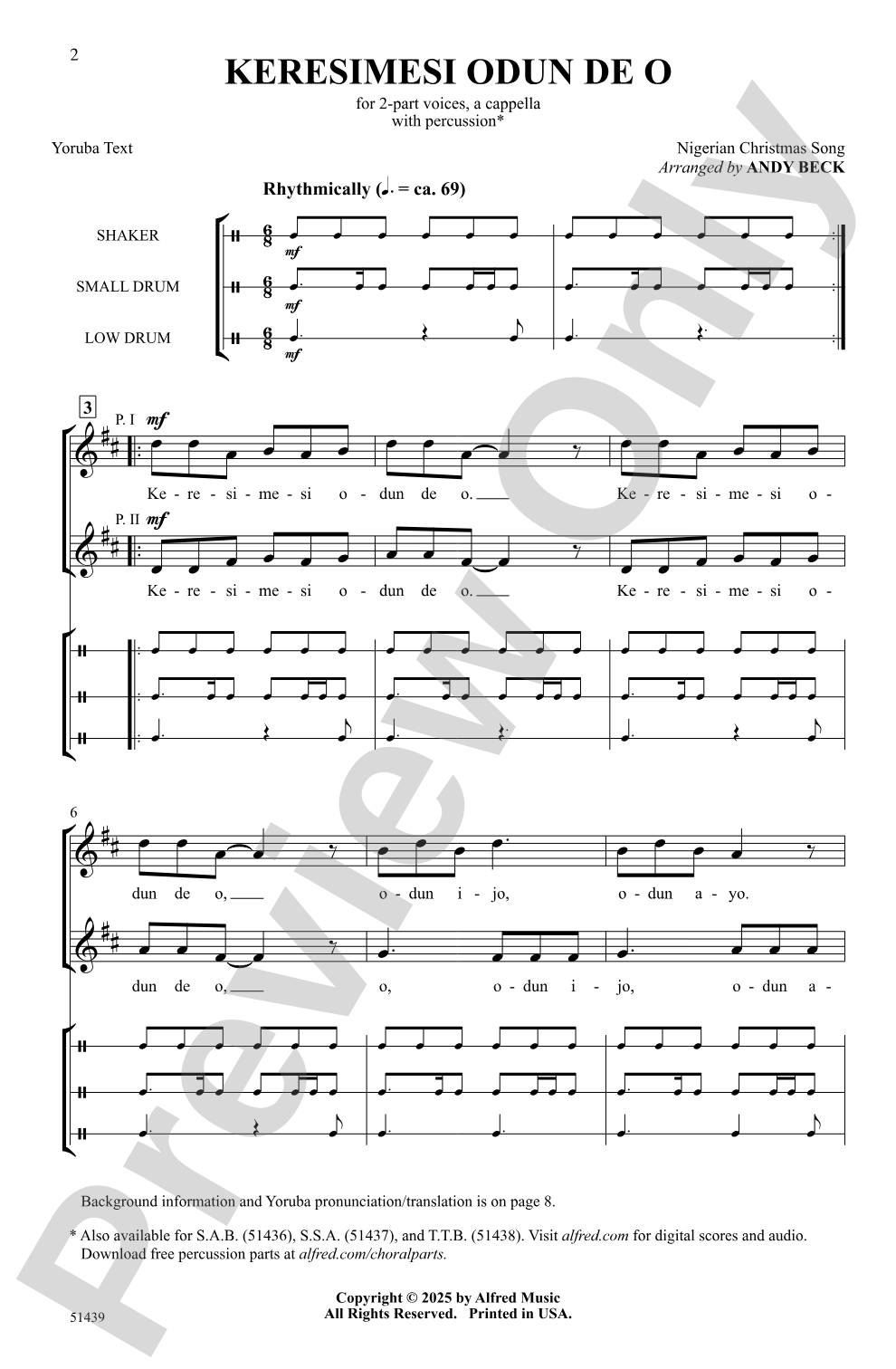
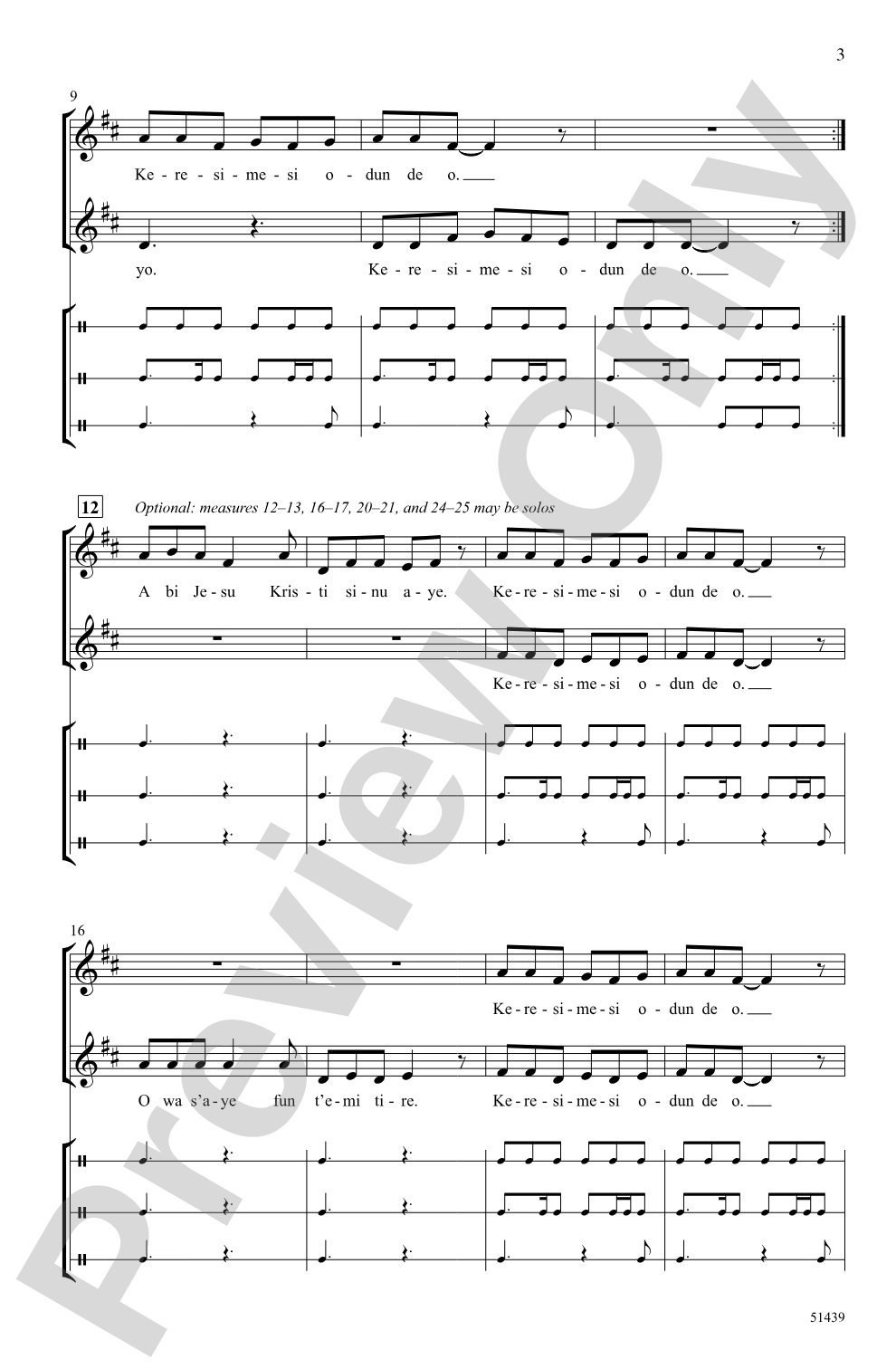

Keresimesi Odun De O: 2-Part a cappella Choral Octavo
Nigerian Christmas Song / arr. Andy Beck
Item: 00-PO-0007455
$2.30
Minimum order quantity: 20 copies
Pickup currently not available
Related Items
Keresimesi Odun De O: SAB a cappella Choral Octavo |
$2.30
|
View | |
Keresimesi Odun De O: SSA a cappella Choral Octavo |
$2.30
|
View | |
Keresimesi Odun De O: TTB a cappella Choral Octavo |
$2.30
|
View | |
Keresimesi Odun De O: SAB a cappella Choral Octavo |
$2.30
|
View | |
Keresimesi Odun De O: SSA a cappella Choral Octavo |
$2.30
|
View | |
Keresimesi Odun De O: TTB a cappella Choral Octavo |
$2.30
|
View | |
Keresimesi Odun De O: 2-Part a cappella Choral Octavo |
$2.30
|
View |
Description
This Christmas song comes from the Yoruba-speaking region of Nigeria. Bright and joyful, this a cappella treatment features rich stacked harmonies, optional solos, and lively percussion parts, characteristic of traditional Yoruba music. Four smartly crafted voicings bring this festive choral staple to smaller groups. A pronunciation and translation guide for the text is included.


Keresimesi Odun De O: 2-Part a cappella Choral Octavo isn't in MakeMusic Cloud just yet...but it could be. Let us know you'd like to see it, and you'll help shape what comes next. In the meantime, start a free trial and dive into thousands of interactive titles your students can play along with today.
Request This Title
Tell us you want it.
Start Your Free Trial
Explore everything that's ready to play right now.
Sample Audio
1
Audio File
--:--
0:00
0:00
Sample Video
Additional Details
Series:
Alfred Choral Designs
Publisher:
Alfred Music
Page Count:
12
SKU:
00-PO-0007455
Instrumentation:
Shaker, Small Drum, Low Drum
More about this title
About the Arranger: Andy Beck

Andy Beck leads the choral publications department at Alfred Music, where he has shaped the catalog for decades. His compositional and arranging output exceeds 450 works in print, spanning choral literature, vocal pedagogy resources, and stage musicals performed by singers worldwide.
Beyond publishing, Beck maintains an active career as a guest conductor, clinician, and adjudicator for state honor choirs and all-state ensembles across the Southeast. He holds degrees in Music Education from Ithaca College and Northwest Missouri State University, and he brings that educational commitment into every score he touches. As a performing tenor with the North Carolina Master Chorale Chamber Choir and a studio vocalist since 1992, Beck writes from the inside out, understanding both what singers need and what audiences respond to.
Why we love this
Beck's arrangement captures the warmth and rhythmic vitality of the original while staying within the technical reach of emerging singers. The stacked harmonies feel sophisticated rather than burdensome, and the optional solos give strong singers room to shine without requiring anyone to carry the piece alone. Percussion parts add authentic texture without demanding specialized players, making this genuinely performable by smaller choirs that still want to sing something with real musical substance.
What to expect
Bright and generous, with the kind of melodic openness you hear in traditional African music. The stacked harmonies create warmth that grows as singers settle into the parts, and the percussion parts pulse underneath like a heartbeat, grounding everything in dance and celebration. There's joy here that feels earned, not forced.
Who it's for
Smaller choirs, community singing groups, and developing ensembles looking for repertoire with cultural authenticity and musical substance. Any group singing Christmas music is likely looking for something beyond the expected favorites; this Yoruba carol offers both freshness and accessibility without sacrificing artistry.
How to get the most out of it
- Establish a steady internal pulse before adding the shaker and drum parts. The percussion should feel like it's supporting the choir's rhythm, not competing for attention.
- Work the pronunciation guide early. When singers own the language and text, their energy and commitment lift dramatically.
- Layer the harmonies slowly. Build from the melody, then add the second part, then add percussion. This prevents one element from overshadowing another.
- Keep the tempo conversational and celebratory rather than rushed. This is a joyful song, not a frantic one.
How to use it
Program this in a Christmas concert to diversify your repertoire and introduce singers and audiences to world music traditions. It pairs beautifully alongside European carols, creating a program that reflects the breadth of how Christmas is celebrated across cultures. The piece's festive character also works well in community events, interfaith services, or seasonal celebrations where you want something uplifting and accessible.
Skills your students will build
- Reading and performing two-part harmony with independence
- Singing text with authentic Yoruba pronunciation and rhythmic inflection
- Coordinating with percussion parts while maintaining vocal line integrity
- Building confidence in optional solo passages
- Understanding cultural context and oral music traditions