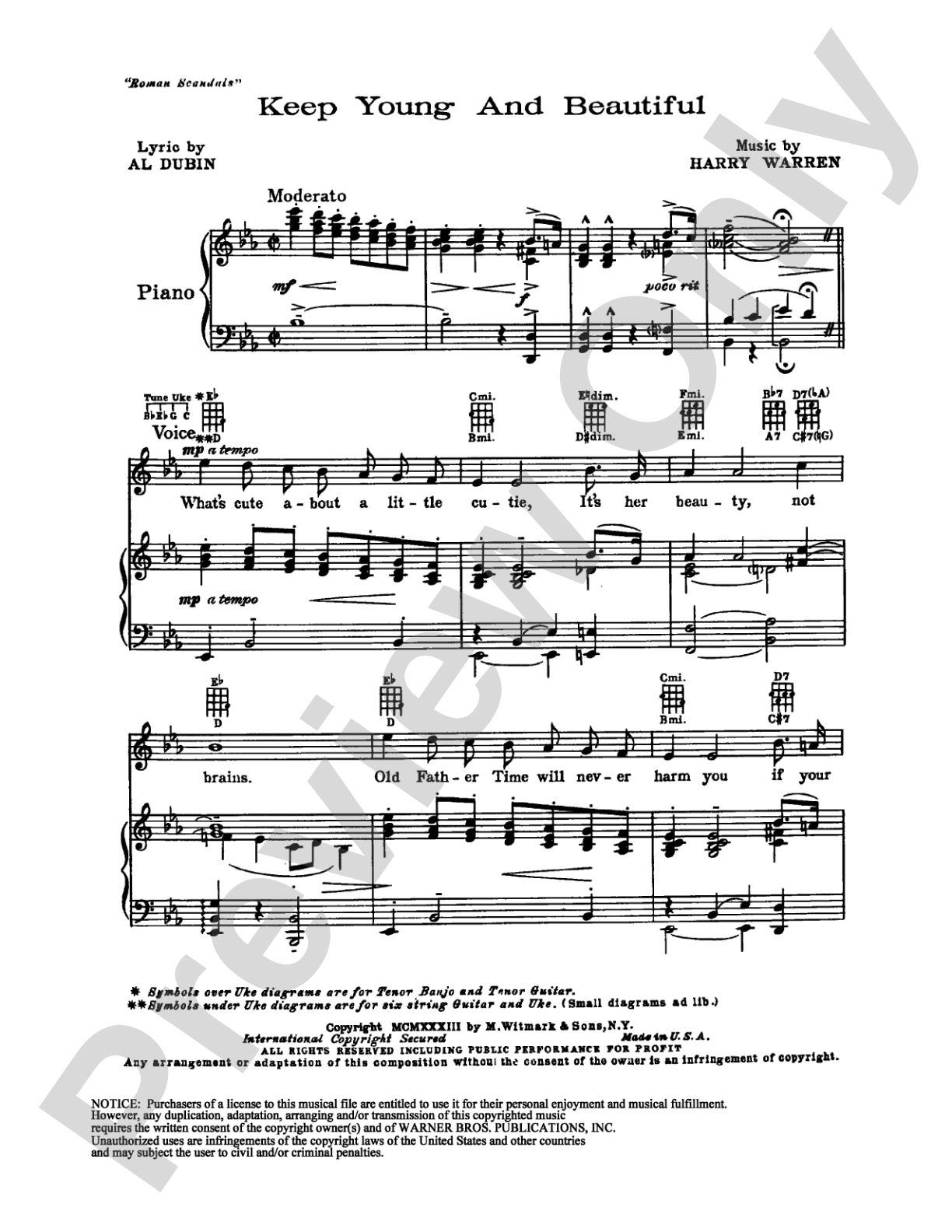
Keep Young and Beautiful: Piano/Vocal/Chords Digital Sheet Music

Keep Young and Beautiful: Piano/Vocal/Chords Digital Sheet Music

Harry Warren, Eddie Cantor

Item: 00-PS-0002070

Digital Download
$3.99
Description

Keep Young and Beautiful: Piano/Vocal/Chords Digital Sheet Music isn't in MakeMusic Cloud just yet...but it could be. Let us know you'd like to see it, and you'll help shape what comes next. In the meantime, start a free trial and dive into thousands of interactive titles your students can play along with today.

Sample Audio
No sample audio found.
Sample Video
Additional Details
SKU: 00-PS-0002070

More about this title

About the Artist: Eddie Cantor

Eddie Cantor (1892, 1964) was a vaudeville star, Broadway headliner, and early film personality whose energetic comedic timing and distinctive vocal style made him one of the most recognizable entertainers of the 1920s and 1930s. His catalog of novelty and novelty-tinged songs became standards of the era, and his influence on American popular song and performance extends well beyond his own recordings.

Why we love this

This piece captures the charm and accessibility of early twentieth-century popular song, making it ideal for teaching singers how to interpret standards with character and style. The straightforward piano/vocal/chords format works beautifully in educational settings where singers benefit from learning how to work with a pianist or from understanding song structure through basic harmonic progression.

What to expect

The piece radiates the optimistic energy and light humor characteristic of early twentieth-century entertainment music. Its melody bounces with the kind of charm that made Cantor a star on stage and on record, inviting singers to bring personality and warmth to every phrase.

Who it's for

Singers performing in recital or educational contexts will find this piece accessible and rewarding to learn. It works particularly well for students exploring the jazz standards and popular song repertoire that forms a bridge between classical vocal training and contemporary styles.

How to get the most out of it

  • Lean into the conversational phrasing rather than oversinging; let the lyrics and rhythm carry the comedy naturally.
  • The rhythmic precision matters here, lock the accompaniment's tempo so the vocal line can dance freely around it.
  • Shape the dynamics to highlight lyrical content; what sounds throwaway often lands funniest when sung with confidence, not irony.

How to use it

Include this in a recital program focused on American standards or the Great American Songbook; it pairs well with other popular songs from the 1920s-1930s era. It also serves as an excellent teaching piece for students learning to work with chord symbols and developing their interpretation of songs designed for theatrical performance.

Skills your students will build

  • Reading and interpreting chord symbols
  • Stylistically informed phrasing in early twentieth-century popular song
  • Coordination between vocalist and pianist using lead sheet style notation
  • Character and comedic interpretation in sung performance

You May Also Like