Kashmir: 2nd B-flat Clarinet Sheet Music Preview

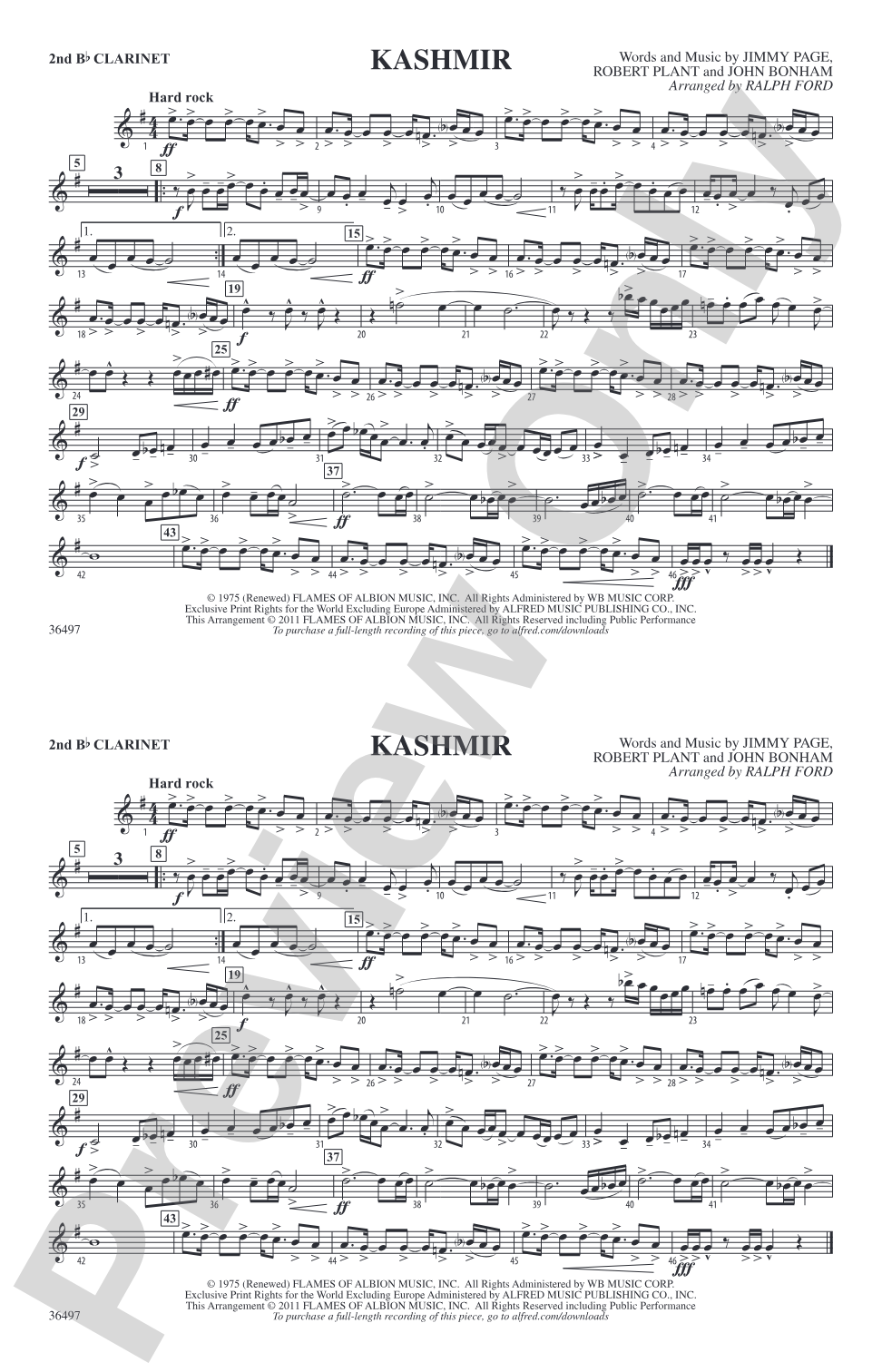
Kashmir: 2nd B-flat Clarinet

Words and music by Jimmy Page, Robert Plant, and John Bonham [Led Zeppelin] / arr. Ralph Ford

Grade: 3

Item: 00-PC-0018265_C2

Digital Download
$3.00
Description
Widely considered one of the greatest rock songs of all time, this classic tune from the legendary group Led Zeppelin contains many innovative rhythmic and harmonic effects. Veteran arranger Ralph Ford has captured all of the excitement and drive of the original. This is not one to miss! (2:16)

Don't just read it, hear it, play along with it, and watch your students grow with it. In MakeMusic Cloud, Kashmir: 2nd B-flat Clarinet comes alive with professional accompaniment, adjustable tempo, and built-in practice tools that turn solo practice into real progress.

Sample Audio
0:00
0:00
Sample Video
Additional Details
Series: Premier Series for Marching Band
Publisher: Alfred Music
Page Count: 122
SKU: 00-PC-0018265_C2

More about this title

About the Composer: Jimmy Page

Jimmy Page is a guitarist and composer whose innovations in electric guitar technique and studio production fundamentally shaped rock music. His work with Led Zeppelin from 1968 onward established him as a visionary in songwriting, arrangement, and orchestration within the rock idiom. Page's ability to layer complex harmonic and rhythmic ideas into songs that remain accessible and powerful makes his compositions ideal subjects for educational band arrangements.

Why we love this

Ralph Ford's arrangement captures the hypnotic drive and harmonic sophistication that make Kashmir endure without sacrificing the piece's rock identity or accessibility for Grade 3 musicians. This is a marching band arrangement that respects both the original's architectural ambition and the ensemble's capabilities, giving students a chance to perform genuine contemporary literature rather than a simplified adaptation.

What to expect

Hypnotic and propulsive. The piece creates a trance-like groove anchored by an insistent bass line and rhythmic motifs that build intensity without relying on constant acceleration. Harmonic colors shift subtly beneath a memorable melodic line, evoking the original's sense of inexorable forward motion and Eastern-tinged mystery.

Who it's for

Marching bands at Grade 3 level seeking repertoire that challenges musicianship while remaining within technical reach. Directors who want to program rock literature that carries genuine artistic substance and demonstrates to students that the marching arts encompass living, evolving musical genres.

How to get the most out of it

  • Anchor the low brass and bass line to establish the relentless rhythmic foundation; this piece's hypnotic quality depends on precision in the accompaniment figures as much as the melodic sections.
  • Balance the melodic layers carefully so that countermelodies and harmony parts support rather than compete with the main theme; the arrangement's richness comes from clarity of texture.
  • Maintain consistent dynamic control through the repetitive sections; resist the impulse to gradually crescendo, as the piece builds intensity through rhythmic and harmonic development rather than volume alone.
  • Shape phrases by emphasizing the harmonic changes rather than relying on artificial swells; let the chord movements drive the musical forward momentum.

How to use it

Program this as a contemporary anchor in a show that explores the intersection of classical structure and rock idiom, or use it to bridge a set that moves from traditional marching repertoire into modern popular music. The 2:16 duration makes it an ideal closer or standalone feature that holds audience attention without exhausting your field.

Skills your students will build

  • Sustaining consistent rhythmic precision in repetitive patterns across extended phrases
  • Balancing and blending harmonic layers to support melodic content
  • Reading and executing the complex harmonic movement characteristic of rock composition
  • Responding to dynamic and textural cues rather than constant crescendo as a primary musical tool
  • Performing contemporary composed music with the same musicianship expected in classical repertoire

You May Also Like