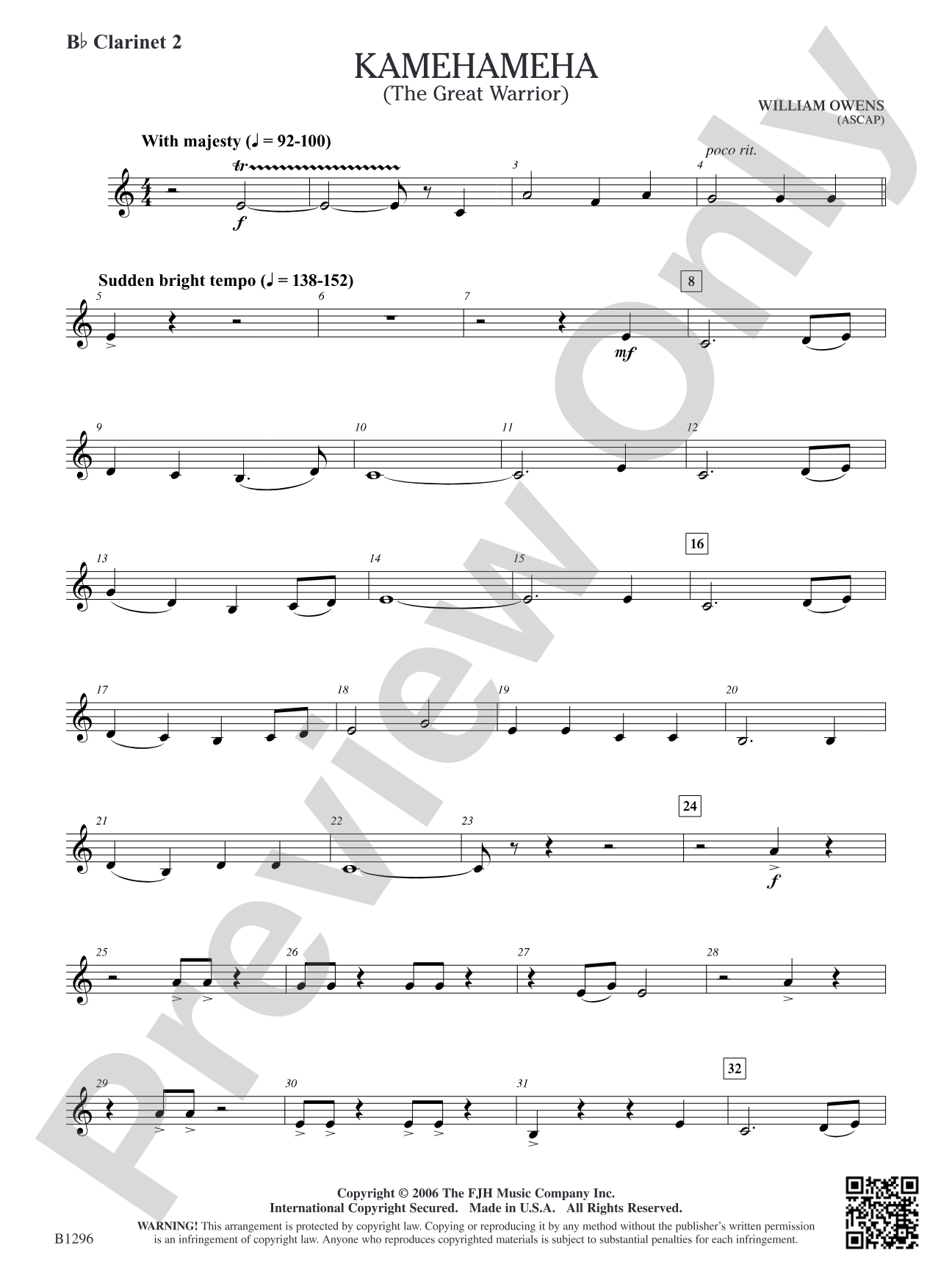
Kamehameha (The Great Warrior): B-flat Clarinet 2 Sheet Music Preview

Kamehameha (The Great Warrior): B-flat Clarinet 2

The Great Warrior

By William Owens

Grade: 2

Item: 98-PC-DB1296_C2

Digital Download
$7.00
Description
Relive the legend of Kamehameha, the warrior-king of Hawaii who came to power in the late-eighteenth century. A bold and powerful introduction signifies the declaration of war. Driven by percussion, the ensuing woodwind melody provides the framework for the piece. After the music slows briefly, the mighty army prepares for its next conquest, and the music comes to a rousing conclusion as the great king fearlessly leads his army to victory!

Kamehameha (The Great Warrior): B-flat Clarinet 2 isn't in MakeMusic Cloud just yet...but it could be. Let us know you'd like to see it, and you'll help shape what comes next. In the meantime, start a free trial and dive into thousands of interactive titles your students can play along with today.

Sample Audio
0:00
0:00
Sample Video
Additional Details
Series: FJH Young Band
Publisher: The FJH Music Company, Inc.
SKU: 98-PC-DB1296_C2

More about this title

About the Composer: William Owens

William Owens

William Owens has spent his career writing music that works in the rehearsal room. A VanderCook College graduate and 30-year band director in Texas, he understands what young ensembles need: accessible writing that doesn't sacrifice musicality or engagement. Since 1993, he has composed over 300 works for concert band, string orchestra, and chamber groups.

His output has become foundational to young band programming across the country. ASCAP-affiliated and decorated with commissions from major music organizations, Owens earned recognition as a Distinguished Alumnus of his alma mater and received the Texas Bandmasters Association's Meritorious Achievement Award. He retired from classroom teaching in 2014 and currently resides in Fort Worth, Texas.

Why we love this

Owens captures narrative momentum without overcomplicating the instrumental writing. The piece follows a clear dramatic arc, declaration of war, driven development, brief repose, triumphant finale, which gives student musicians a real story to shape rather than just notes to play. At Grade 2, the percussion-driven energy keeps sections engaged while the woodwind melody gives you something substantive to build around.

What to expect

Bold and propulsive, driven by percussion that propels the action forward. The woodwind melody has a stately quality, suggesting both ceremony and strength, before the music pulls back momentarily, almost as if the army is regrouping, and then surges toward its climax with unflinching momentum.

Who it's for

Concert bands at the Grade 2 level who want to explore multicultural content with genuine musical substance. This works equally well for students advancing through fundamental technical skills and for programs seeking pieces that engage audiences without requiring advanced facility.

How to get the most out of it

  • Set the intro tempo so the bold declaration lands with impact. This opening establishes whether the audience leans in or settles back, so clarity matters more than rush.
  • Balance the woodwind melody against the percussion foundation. The rhythm section should propel without drowning out the tune; think of them as scaffolding, not a wall.
  • Mark the transition into the slower section deliberately. Conductors sometimes rush this moment by accident; let the tempo shift read as a genuine breath before the army's next move.
  • Build the final section gradually so the conclusion feels inevitable, not sudden. This is where every section's energy becomes visible.

How to use it

Program this as a centerpiece for a concert section exploring world cultures or historical narratives through music. The moderate length and clear dramatic shape make it ideal for educational programming where you want the piece to speak for itself without extensive context-setting. It also performs well at festivals and contests where impact and clarity matter.

Skills your students will build

  • Sectional balance and blend across woodwind and percussion textures
  • Following large-scale form changes (introduction, melody, repose, finale)
  • Responding to conductor gesture during tempo transitions
  • Building dynamic intensity toward a climactic conclusion
  • Sustaining ensemble energy through rhythmically driven passages

You May Also Like