
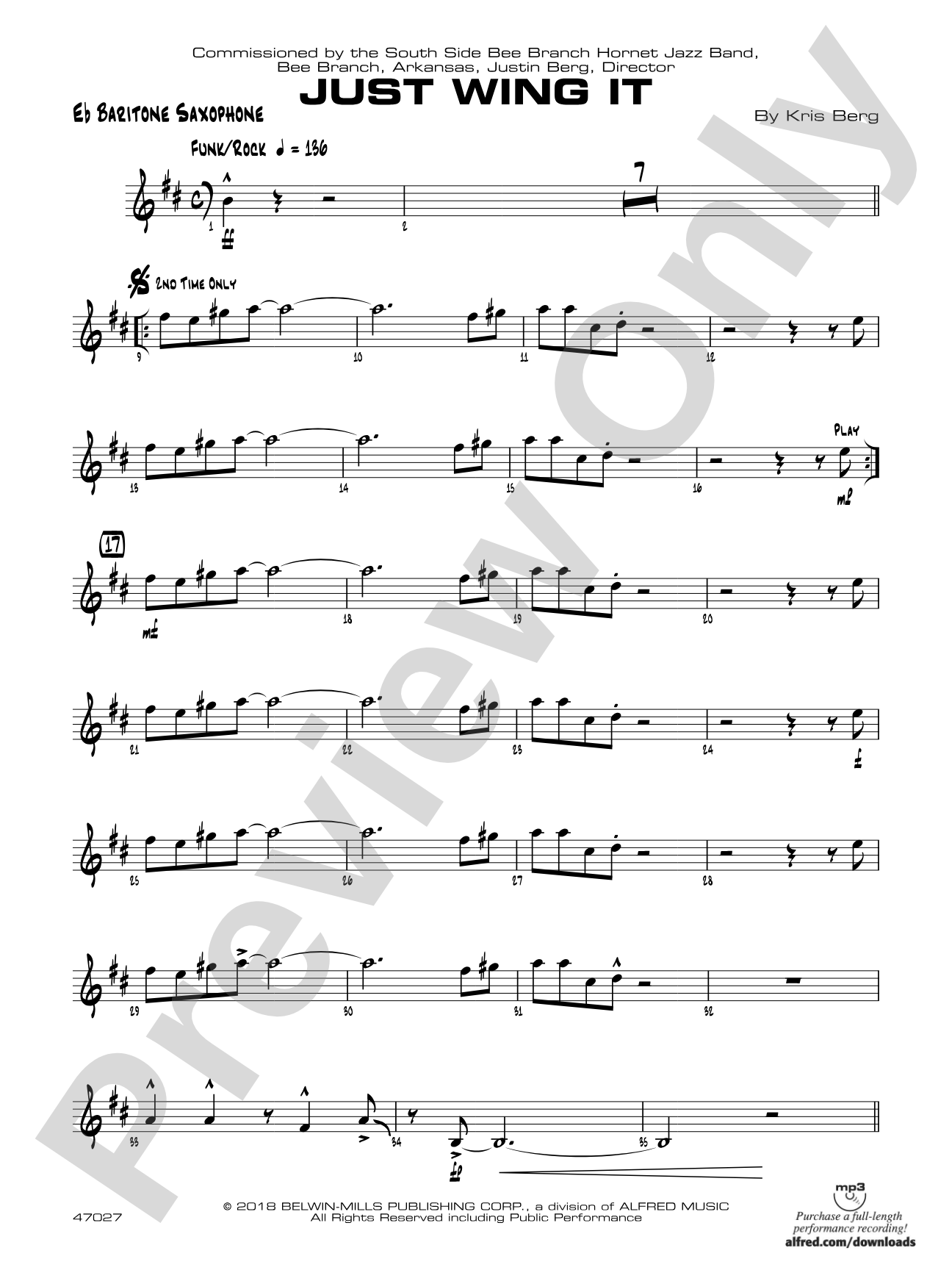

Just Wing It: E-flat Baritone Saxophone
By Kris Berg
Grade: 2.5 (Medium Easy)
Item: 00-PC-0017866_BTX
$3.00
Pickup currently not available
Description
Oh yeah, it's time for another "chicken" flavored chart! This one is definitely funky and more accessible than previous "chicken" charts. Lead trumpet range is only to written G on top of the staff, and written-out solos are provided for alto and trumpet. Also, with only two chords in the solo section, it is ideal for young players to work on improvising. Tempo is around 136 BPM.


Don't just read it, hear it, play along with it, and watch your students grow with it. In MakeMusic Cloud, Just Wing It: E-flat Baritone Saxophone comes alive with professional accompaniment, adjustable tempo, and built-in practice tools that turn solo practice into real progress.
Open in the Player
Jump straight in and assign it today.
Start Your Free Trial
Open this title and explore the full library in minutes.
Sample Audio
1
Audio File
--:--
0:00
0:00
Sample Video
Additional Details
Series:
Young Jazz Ensemble
Publisher:
Alfred Music
Page Count:
92
SKU:
00-PC-0017866_BTX
More about this title
About the Composer: Kris Berg

Kris Berg directs the Jazz Studies program at Collin County Community College in Texas, where he earned both his bachelor's and master's degrees in jazz studies from the University of North Texas. His big band charts have circulated globally through performances and recordings, and he serves as a prolific arranger and composer for Belwin Jazz under Alfred Publishing.
Beyond the page, Berg remains deeply invested in developing young musicians. He founded and directs both the Collin Jazz Fest and the Texas All-Star Jazz Camp, and his ensembles have received repeated invitations to perform at the Montreux Jazz Festival. As a clinician and artist for Yamaha Corporation of America, he has shared stages with jazz luminaries including Kurt Elling, Randy Brecker, Peter Erskine, Bob Mintzer, and Clark Terry. He is also the author of Bass Lines in Minutes, a resource widely adopted in jazz curricula.
Why we love this
Berg's "chicken" charts have become repertoire staples for good reason, and this one strikes the balance every director wants: accessible without feeling babyish. The restrained lead trumpet range and written-out solos scaffold students into improvisation beautifully, while the two-chord solo section removes harmonic obstacles and lets young players focus on phrasing, feel, and swing. You'll actually want to program this.
What to expect
Groovy, approachable, and genuinely fun to play. The funk pocket is relaxed and swinging rather than aggressive, and the written-out solos give the ensemble a jumping-off point that doesn't intimidate. When the rhythm section locks in, the whole piece has that irresistible bounce that reminds everyone why they wanted to play jazz in the first place.
Who it's for
Grade 2.5 jazz ensembles and younger high school groups seeking accessible funk charts with real improvisation opportunities. This works for players new to jazz vocabulary as well as developing soloists who need scaffolding before tackling denser harmonic territory.
How to get the most out of it
- Establish the funky pocket before rehearsing solos. Lock the rhythm section on the bass line and kick drum coordination; the groove carries everything else.
- Have rhythm players (piano, bass, drums) walk through the changes separately before combining with the front line. Two chords means no harmonic surprises, but intonation and ensemble synchronization still demand attention.
- Encourage alto and trumpet soloists to sing through their written-out solos first, then gradually introduce rhythmic variation and bends. This builds ownership before they improvise.
- Keep energy consistent at 136 BPM. Young ensembles often drag the tempo when soloing, which flattens the funk. Use a metronome or click track in early rehearsals.
How to use it
Place this as a centerpiece on a jazz concert where you're balancing newer learners with more experienced players. It pairs well before or after a ballad to keep energy varied across the set. It's also an excellent choice for jazz assembly performances or pep band moments where accessibility and crowd appeal matter equally.
Skills your students will build
- Improvisation over a simple two-chord vamp
- Reading and executing written jazz solos with articulation and style
- Swing feel and pocket playing in a funky context
- Blend and balance in a jazz ensemble texture
- Lead trumpet range and control (written to G above the staff)