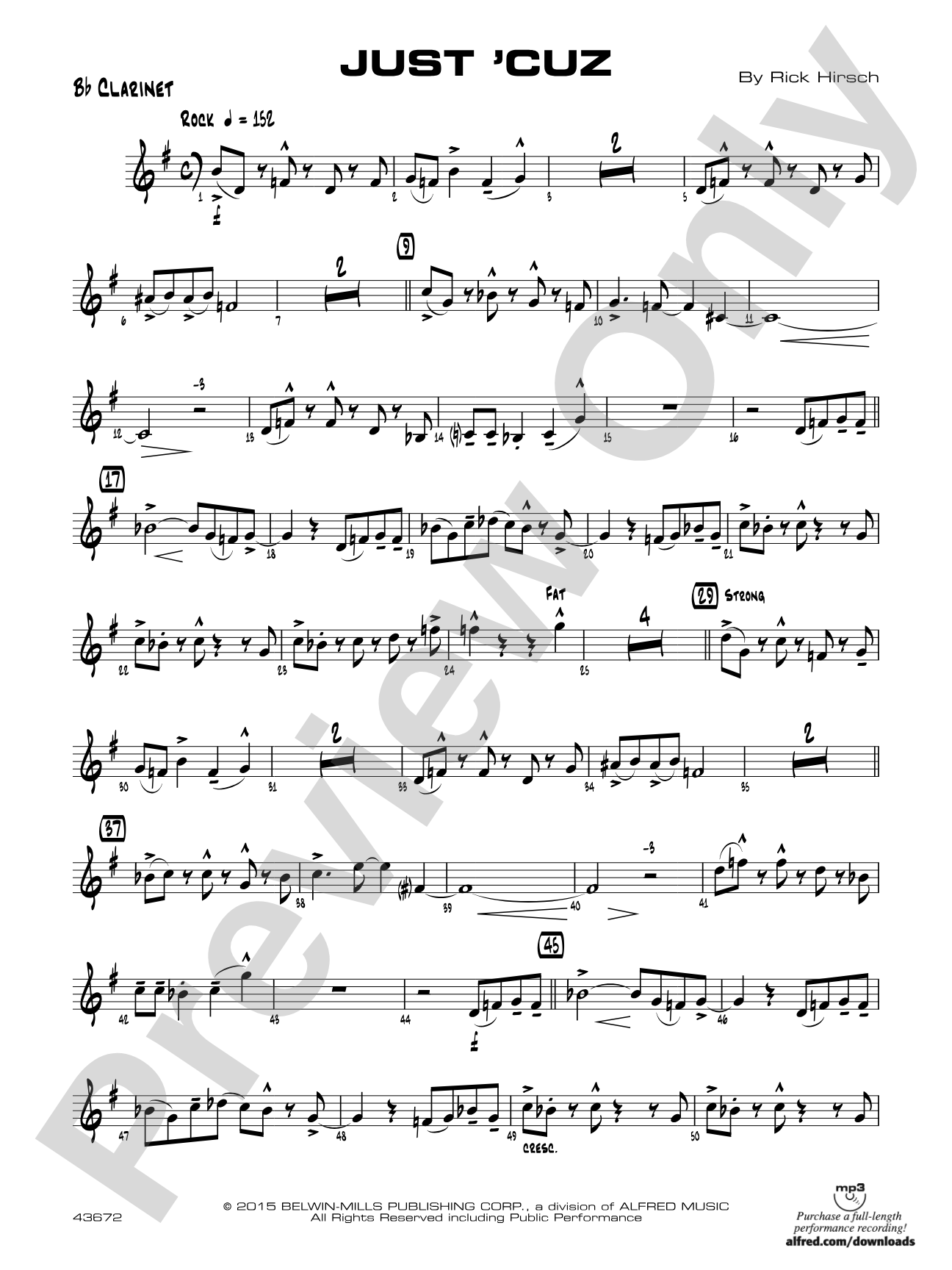
Just 'Cuz: 1st B-flat Clarinet Sheet Music Preview

Just 'Cuz: 1st B-flat Clarinet

By Rick Hirsch

Grade: 2 (Medium Easy)

Item: 00-PC-0016812_C1

Digital Download
$3.00
Description
"Just 'Cuz" is a catchy rock chart played around 132 BPM with the trumpet 1 range to written G on top of the staff. Solos are written out for any sax and any brass instrument. This chart is very flexible and great fun to play! (3:27)

Don't just read it, hear it, play along with it, and watch your students grow with it. In MakeMusic Cloud, Just 'Cuz: 1st B-flat Clarinet comes alive with professional accompaniment, adjustable tempo, and built-in practice tools that turn solo practice into real progress.

Sample Audio
0:00
0:00
Sample Video
Additional Details
Series: Young Jazz Ensemble
Publisher: Alfred Music
Page Count: 102
SKU: 00-PC-0016812_C1

More about this title

About the Composer: Rick Hirsch

Rick Hirsch

Rick Hirsch earned degrees from UMass Amherst and Northern Illinois University, launching his career as a personal music copyist for legendary figures Bob Mintzer and Toshiko Akiyoshi. His compositional work has been performed by jazz luminaries including Yusef Lateef and Eddie Henderson, and he has written for ensembles ranging from the Capitol Quartet to Penn State's Blue Band. Hirsch served on the music faculty at Penn State University and remains active as a guest conductor for All-State and District Jazz Bands across the country.

In 2017, Rick Hirsch's BIG OL' BAND released their debut album, Pocono Git-Down, which shines a spotlight on vibrant jazz communities thriving outside major metropolitan areas. His dual expertise as both composer and arranger, combined with decades of experience in professional jazz settings, informs every chart he creates for student ensembles.

Why we love this

Hirsch writes with an ear for what actually sounds good at this level. The rock groove sits naturally for developing musicians, and the written solos give everyone a clear target rather than asking inexperienced improvisers to navigate uncharted waters. At three and a half minutes, the piece maintains energy without wearing out your section leaders.

What to expect

A groove-centered rock tune with genuine swing flavor. The catchy melody sits comfortably in the middle register, and the forward momentum keeps the energy high without demanding virtuosic passage work. It feels like a tune everyone will want to play again immediately after the final chorus.

Who it's for

Grade 2 jazz ensembles looking for a straightforward, fun chart that builds confidence without overwhelming less experienced players. The written solos and flexible instrumentation make it accessible whether you have a full section roster or need to adapt on the fly.

How to get the most out of it

  • Lock the rhythm section on the backbeat. The groove at 132 BPM depends on crisp snare placement and a solid walking or comping foundation from bass and piano.
  • Balance the written solos so they sit as conversational statements rather than feature moments. Each soloist should sound like they're part of the ensemble discussion, not stepping out for a spotlight.
  • Use the flexible voicing options to adjust the chart for your personnel. If you're short a sax, the written parts allow the brass instruments to carry the harmonic weight without strain.
  • Keep the articulation light and bouncy in the ensemble passages. This rock chart breathes better when the band plays with swing eighth notes rather than a heavy, straight-eighths feel.

How to use it

This works as an excellent opener or closer for a jazz concert, providing a high-energy moment that engages the audience while staying well within your ensemble's technical capacity. It also pairs naturally with a ballad or slightly more advanced swing chart, giving your program shape and contrast without requiring vastly different skill sets.

Skills your students will build

  • Reading jazz articulations and phrasing at tempo
  • Understanding comping and rhythm section responsibilities in a rock groove
  • Interpreting and performing written solo passages with appropriate jazz feel
  • Balancing ensemble and solo textures in a jazz context
  • Maintaining a steady swing eighth-note feel while responding to rock rhythms

You May Also Like