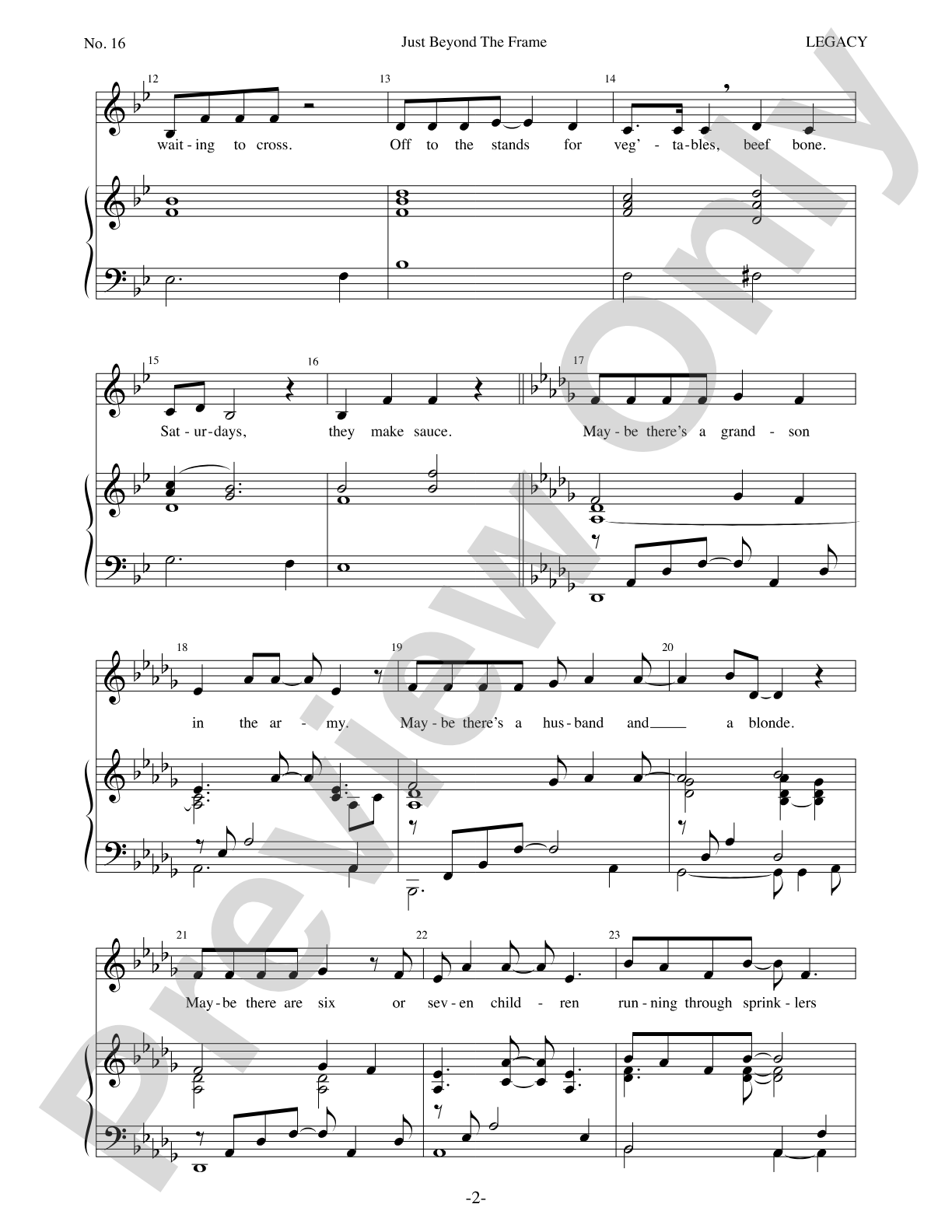
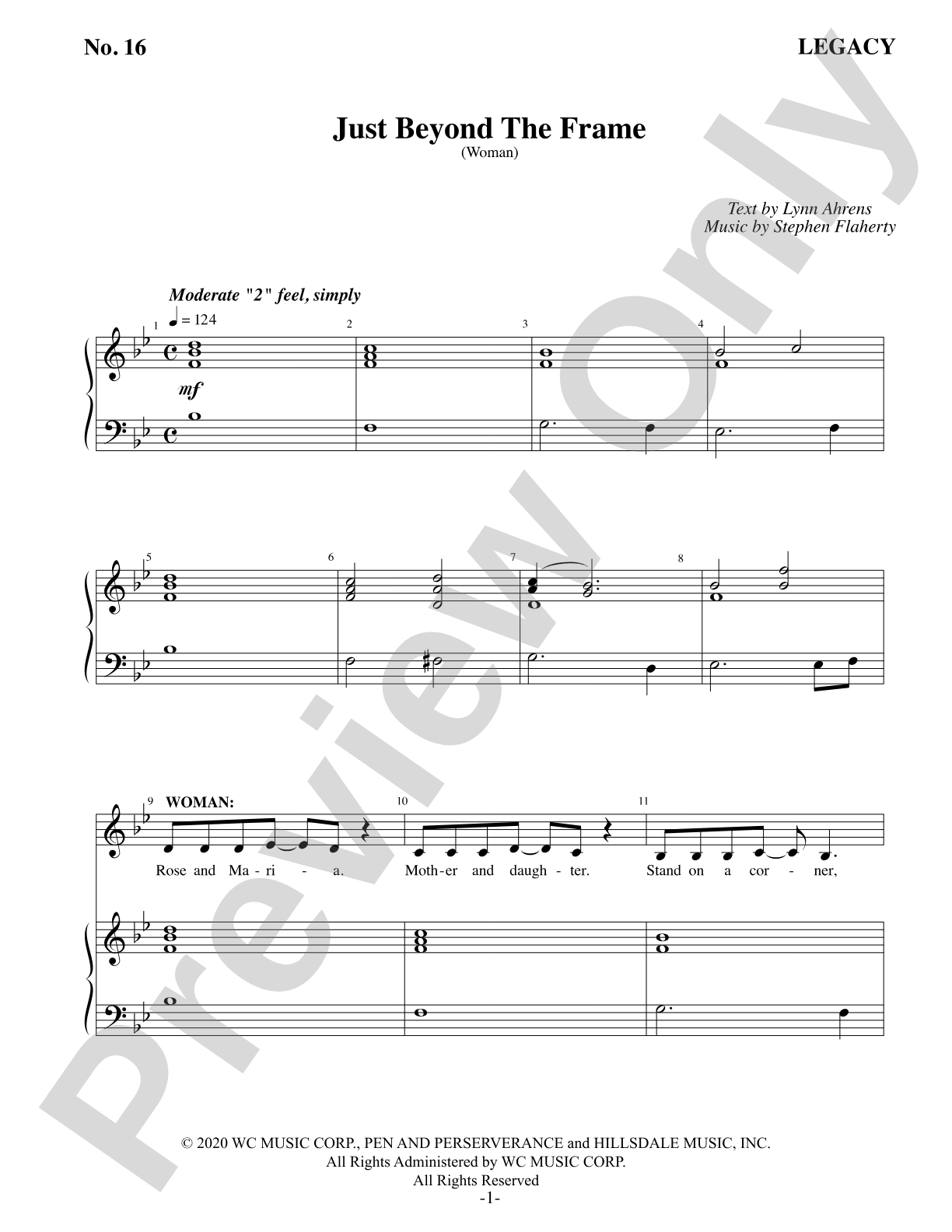
Just Beyond The Frame Sheet Music Preview

Just Beyond The Frame: Piano/Vocal

Music by Stephen Flaherty / Lyrics by Lynn Ahrens

Item: 00-PS-0016347

Digital Download
$3.99

One moment…

Description
From the song cycle A Boy with a Camera on the album Legacy by Flaherty & Ahrens. A Boy with a Camera is inspired by photographs of New York City taken by Ahrens' father in the '40s and '50s.

Just Beyond The Frame: Piano/Vocal isn't in MakeMusic Cloud just yet...but it could be. Let us know you'd like to see it, and you'll help shape what comes next. In the meantime, start a free trial and dive into thousands of interactive titles your students can play along with today.

Sample Audio
No sample audio found.
Sample Video
Additional Details
SKU: 00-PS-0016347

More about this title

About the Composer: Stephen Flaherty

Stephen Flaherty is a composer whose theatrical work spans Broadway, film, and concert music. His collaborations with lyricist Lynn Ahrens have produced scores for Ragtime, Anastasia, and Natasha, Pierre & The Great Comet, establishing him as a master of lyrical melody and emotional storytelling through music.

Beyond the stage, Flaherty has composed concert works, orchestral pieces, and art songs that showcase his gift for turning intimate moments into fully realized musical landscapes. His work consistently demonstrates how melody can anchor both large theatrical gestures and quiet, introspective moments.

Why we love this

This song carries the visual poetry of mid-century New York photography into sound, giving singers a deeply introspective character piece that doesn't require operatic virtuosity but demands emotional transparency. The piano writing complements rather than overwhelms the vocal line, making it accessible for advanced students and recital singers who want to explore art song repertoire with contemporary sensibility.

What to expect

The song evokes the quietness of viewing old photographs: there's nostalgia and longing, but also a kind of acceptance about time's passage and what memory can and cannot hold. The harmony suggests impressionism, with gentle shifts in color that mirror the black and white images that inspired it.

Who it's for

This piece suits advanced high school singers, college voice students, and adult amateur singers developing their recital repertoire. Pianists accompanying vocalists will find it a rewarding collaboration that requires both technical fluency and interpretive sensitivity.

How to get the most out of it

  • Let the piano establish the atmospheric quality of the photographs before the voice enters; resist rushing into the vocal melody and allow space for the image to form.
  • Shape the vocal phrases as if you're describing what exists just outside the frame; subtle dynamic shaping will serve the lyrical content more than pushing volume.
  • Balance the piano texture by bringing out inner voices and countermelodies rather than doubling the vocal line; this creates conversational intimacy between voice and instrument.
  • Attend to the rhythmic precision in the piano part, which provides harmonic anchoring for a melody that often floats freely above it.

How to use it

Program this as part of a recital exploring American song or contemporary art song, or as a solo moment within a larger concert that needs a contemplative turning point. Its moderate length and introspective character make it ideal for an intimate setting where the audience can lean in and listen closely.

Skills your students will build

  • Sustaining legit vocal tone across a wide range without vibrato becoming oversized
  • Interpreting contemporary poetry through melody
  • Coordinating vocal phrasing with piano accompaniment that doesn't always align metrically
  • Creating emotional nuance through dynamics and breath rather than extreme vocal variation

You May Also Like