
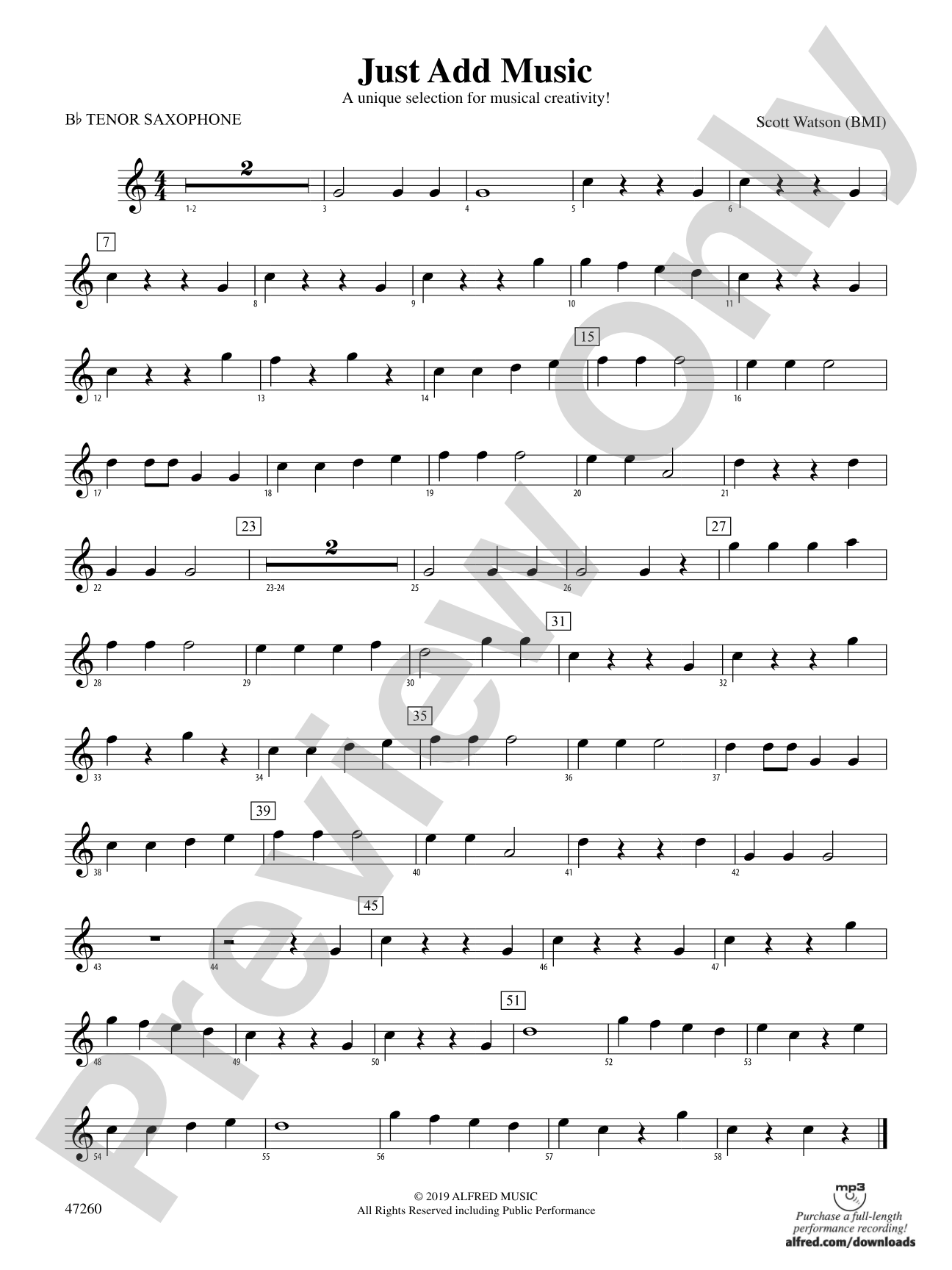

Just Add Music: B-flat Tenor Saxophone
By Scott Watson
Grade: 1 (Very Easy)
Item: 00-PC-0017874_TX1
$3.00
Pickup currently not available
Description
This piece provides notes and rhythms but no tempo, character, dynamics, or articulations. Enter into the creative process by discussing, auditioning, and choosing musical expressions, all while learning in a fun, hands-on way. (Correlates with Sound Innovations for Concert Band, Book 1, Level 3).


Don't just read it, hear it, play along with it, and watch your students grow with it. In MakeMusic Cloud, Just Add Music: B-flat Tenor Saxophone comes alive with professional accompaniment, adjustable tempo, and built-in practice tools that turn solo practice into real progress.
Open in the Player
Jump straight in and assign it today.
Start Your Free Trial
Open this title and explore the full library in minutes.
Sample Audio
1
Audio File
--:--
0:00
0:00
Sample Video
Additional Details
Series:
Sound Innovations for Concert Band
Publisher:
Alfred Music
Page Count:
134
SKU:
00-PC-0017874_TX1
More about this title
About the Composer: Scott Watson

Scott Watson has spent four decades shaping young musicians as a classroom teacher, building an elementary and high school band program in the Parkland School District (Allentown, PA) before moving into higher education. He now serves as Associate Professor of Music at Cairn University while maintaining a prolific composing career that spans more than 120 published works for concert band, string orchestra, and chamber ensembles.
Watson's compositions reflect a rare balance between contemporary concert music aesthetics and deep knowledge of what works in the ensemble classroom. His music has appeared at major American venues including the Academy of Music in Philadelphia and the White House, and he regularly conducts clinics and guest-leads honor bands. He is also the author of Using Technology to Unlock Musical Creativity (Oxford University Press, 2011), bringing the same creative thinking to music education that defines his concert works.
Why we love this
Watson has designed this piece specifically to flip the teaching model on its head. Rather than handing students a finished orchestration with every interpretive choice locked in, he gives them the skeleton and invites them to build the music together. Directors will appreciate how this activates ensemble discussion and decision-making at the Grade 1 level, turning rehearsal into genuine creative work instead of passive note-following.
What to expect
A collaborative sketch that comes alive through ensemble voice. The piece feels unfinished in the best way, like sheet music that's been waiting for your band to complete it. There's lightness and room to breathe, with space for your students' ideas to take shape.
Who it's for
This is written for Grade 1 concert bands ready to think beyond note-reading. Your ensemble should have basic ensemble discipline and can focus on musical decisions rather than survival. It works equally well for beginning bands with strong fundamentals or more experienced ensembles you want to stretch creatively.
How to get the most out of it
- Have the ensemble listen to several recordings or performances of well-known Grade 1-2 pieces before your first rehearsal. This builds a reference library of how tempo, character, and dynamics shape the same melodic material in different ways.
- Start by establishing consensus on the broadest musical questions first (Is this march-like or lyrical? Bright or warm?) before diving into individual measure-by-measure choices about articulation and dynamics.
- Record rehearsals as you work through interpretive choices. Playing back a full-band run with one set of decisions, then a second run with different choices, lets students hear the real impact of their collective choices.
- Assign small conductor teams or section leaders to propose musical ideas before you rehearse them full ensemble. This distributes creative ownership and surfaces ideas you might not have heard otherwise.
How to use it
Use this early in the season as a teaching tool that runs parallel to your technical repertoire. It works well alongside Sound Innovations Book 1 Level 3, giving students a tangible reason to care about expression and interpretation. Save the premiere performance for an informal concert or assembly where the focus can be on the creative process rather than polish.
Skills your students will build
- Making interpretive choices as an ensemble (tempo, dynamics, character, articulation)
- Listening analytically to hear how musical decisions change the same melodic content
- Collaborating on artistic decisions and building consensus
- Understanding the relationship between notation and performance intent
- Building ownership of repertoire through creative input