
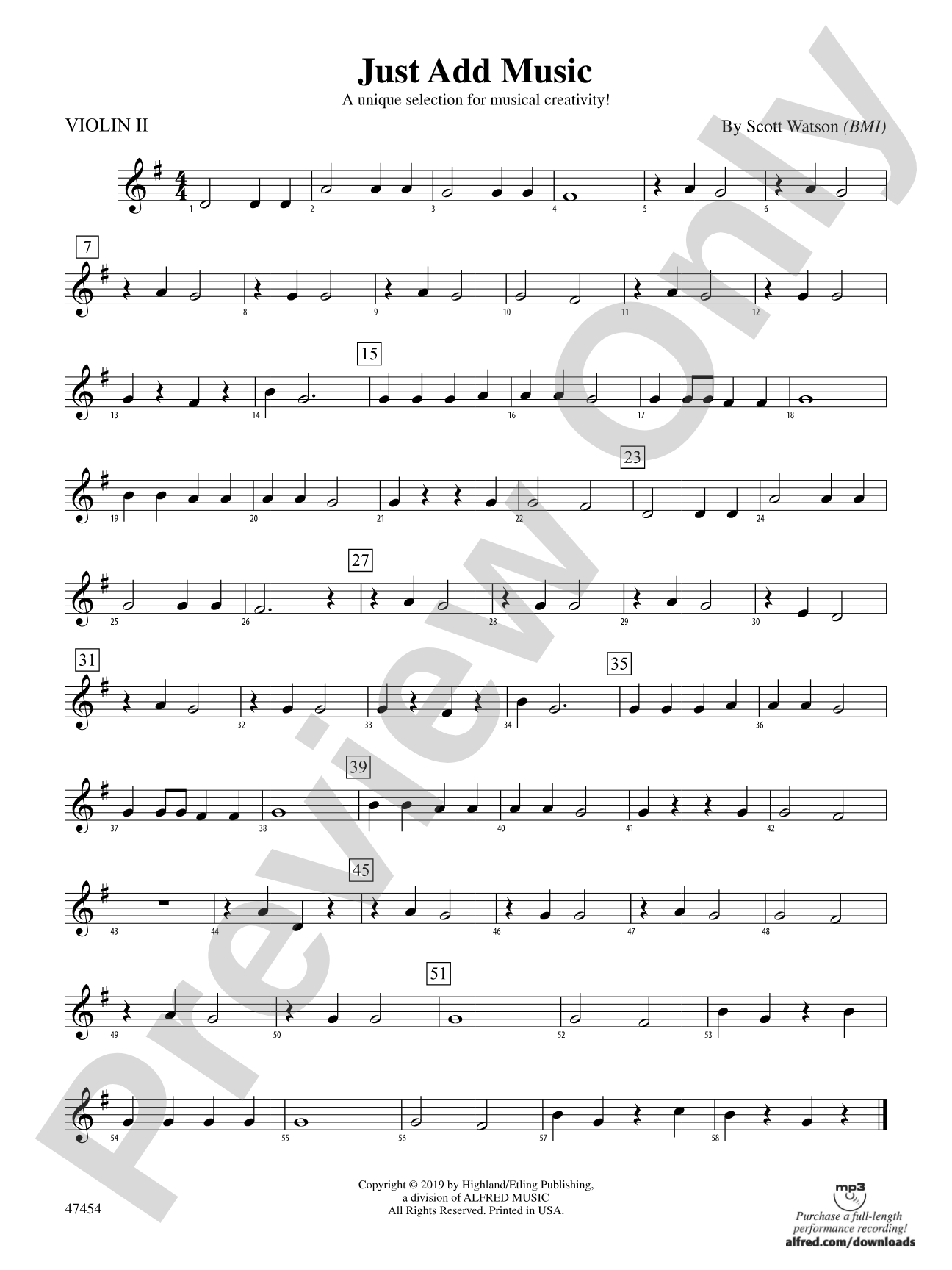

Just Add Music: 2nd Violin
A Unique Selection for Musical Creativity!
By Scott Watson
Grade: 1
Item: 00-PC-0017983_VN2
$5.99
Pickup currently not available
Description
This work contains notes and rhythms in the printed music---but no tempo indication or expressive markings (such as dynamics or articulations). Those missing items are the "music" that you, the teacher, along with the ensemble will select and pencil into the music to make this piece uniquely reflect your ensemble! All the notes and rhythms you need for a great concert selection are included in this recipe for hands-on learning and creativity. (Correlates with Sound Innovations for String orchestra, Book 1, level 1).


Don't just read it, hear it, play along with it, and watch your students grow with it. In MakeMusic Cloud, Just Add Music: 2nd Violin comes alive with professional accompaniment, adjustable tempo, and built-in practice tools that turn solo practice into real progress.
Open in the Player
Jump straight in and assign it today.
Start Your Free Trial
Open this title and explore the full library in minutes.
Sample Audio
1
Audio File
--:--
0:00
0:00
Sample Video
Additional Details
Series:
Sound Innovations for String Orchestra
Publisher:
Alfred Music
Page Count:
88
SKU:
00-PC-0017983_VN2
More about this title
About the Composer: Scott Watson

Scott Watson has spent four decades shaping young musicians, first as the high school band director and then as coordinator of an entire district's elementary strings and band program in Allentown, Pennsylvania. His perspective bridges two worlds: the contemporary classical concert stage (where his work has appeared at venues like the Academy of Music and the White House) and the public school classroom, where he learned what actually engages students and builds real musicianship.
Now an Associate Professor at Cairn University, Watson channels that dual experience into his compositional voice. His catalog of more than 120 published works reflects both rigorous musical thinking and a genuine understanding of what works in rehearsal. He is the author of Using Technology to Unlock Musical Creativity, published by Oxford University Press, and serves as an exclusive composer and clinician for Alfred Publications.
Why we love this
This piece inverts the typical conductor's job in the most productive way. Instead of fighting against predetermined dynamics and articulations that don't fit your ensemble's strengths, you and your students build the musical interpretation from the ground up. The result feels genuinely collaborative, and students who pencil in their own crescendos remember them in performance.
What to expect
Straightforward and energetic, with the kind of uncomplicated charm that leaves room for an ensemble's personality to shine through. There's clarity in every line, but the piece itself remains a canvas waiting for your orchestra's voice.
Who it's for
String orchestras at the beginning of their journey who need solid rhythmic and melodic content paired with pedagogical purpose. Teachers looking to deepen student engagement with the score itself will find this approach shifts responsibility from passive reading to active musicianship.
How to get the most out of it
- Map out the full interpretation in rehearsal before assigning parts. Have the ensemble suggest where energy should peak and where to pull back; this transforms a single reading into a teaching moment about form and phrasing.
- Consider penciling in markings lightly at first, then erasing and trying alternatives. This experimentation phase builds aural discernment in ways that passive reading never does.
- Use the ensemble's own sonic qualities to guide choices. A violin section with warm tone but less projection may thrive with sustained dynamics rather than sharp attacks.
How to use it
Open a fall concert with this piece as a statement about your program's collaborative culture. Pair it with a fully-composed work on the same program to highlight what students gain when they make interpretive choices versus when they follow a composer's exact blueprint.
Skills your students will build
- Reading rhythmic notation without tempo or metronome cues
- Collaborative decision-making about musical shape and phrasing
- Understanding the relationship between dynamics, articulation, and ensemble blend
- Score annotation and marking practices used by professional musicians
- Analyzing form to determine where expressive emphasis belongs