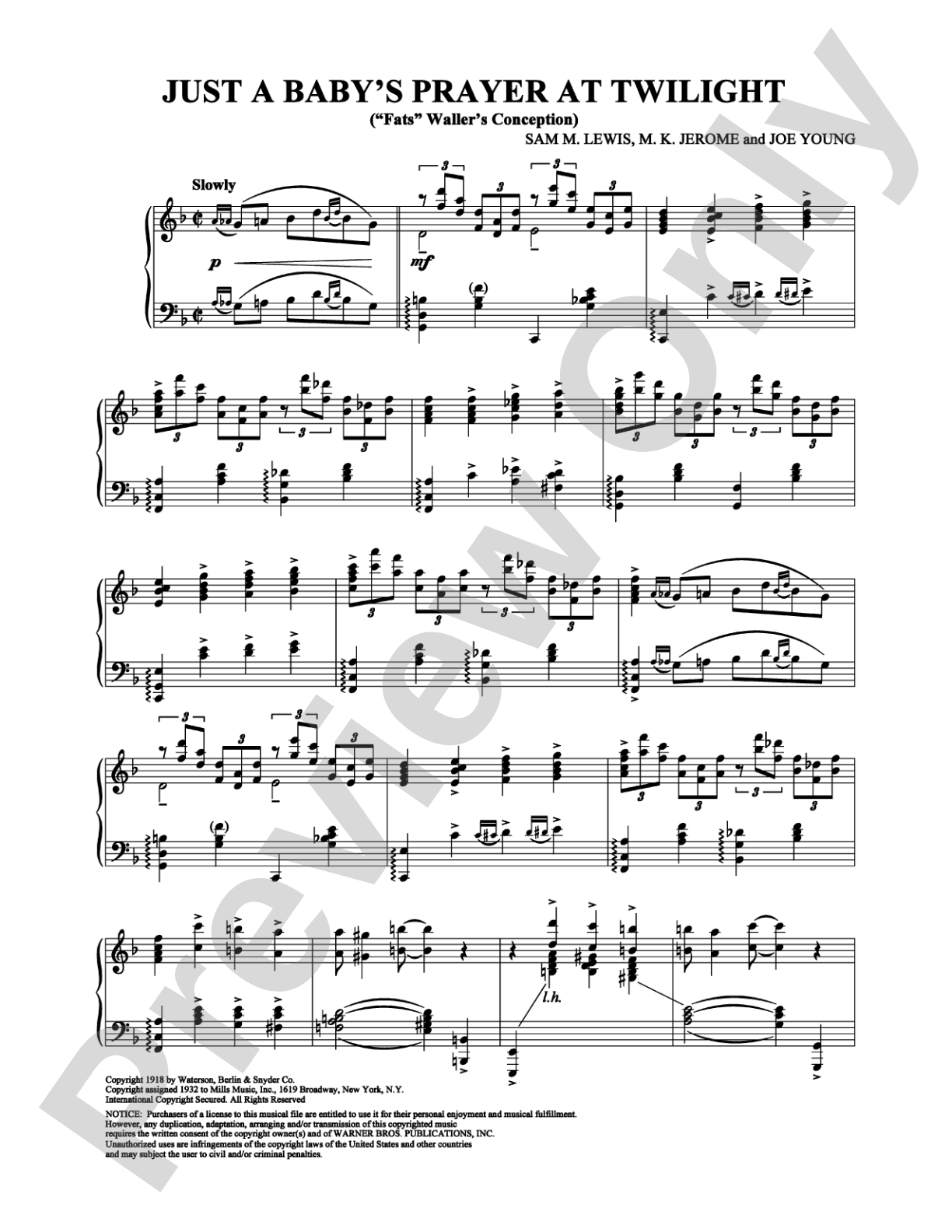
Just a Baby's Prayer at Twilight (''Fats'' Waller's Conception): Piano Digital Sheet Music

Just a Baby's Prayer at Twilight (''Fats'' Waller's Conception): Piano Digital Sheet Music

Sam M. Lewis, Joe Young, M. K. Jerome

Item: 00-PS-0000979

Digital Download
$3.99
Description

Just a Baby's Prayer at Twilight (''Fats'' Waller's Conception): Piano Digital Sheet Music isn't in MakeMusic Cloud just yet...but it could be. Let us know you'd like to see it, and you'll help shape what comes next. In the meantime, start a free trial and dive into thousands of interactive titles your students can play along with today.

Sample Audio
No sample audio found.
Sample Video
Additional Details
SKU: 00-PS-0000979

More about this title

About the Creator: Thomas "Fats" Waller

Thomas "Fats" Waller (1904, 1943) was a pianist, organist, composer, and entertainer whose influence on jazz and popular music remains immense. His approach to the piano combined stride technique mastery with wit, irreverence, and an infectious sense of swing that made him one of the most recorded artists of the 1930s.

Waller's conception of "Just a Baby's Prayer at Twilight" showcases his gift for reimagining standards with harmonic sophistication and rhythmic drive. He recorded multiple versions of this song, each revealing different layers of his arranging intelligence and his ability to make familiar melodies sound fresh and urgent.

Why we love this

This arrangement captures the urbane wit and harmonic sophistication that defined Waller's approach to the standard. The piano writing sits squarely in the jazz idiom without requiring advanced stride technique, making it accessible for intermediate players who want to sound authoritative in a jazz context.

What to expect

Tender and reflective, with the gentle melancholy of a lullaby filtered through the sophisticated harmonies of the jazz era. The piece balances emotional intimacy with the rhythmic ease of a seasoned pianist settling into their instrument.

Who it's for

Intermediate to advanced jazz pianists seeking repertoire that sits comfortably within the American songbook tradition. Players who appreciate the harmonic depth of 1930s jazz standards and want to develop their sense of swing phrasing and stride vocabulary.

How to get the most out of it

  • Anchor the left hand groove first. Get comfortable with the bass and chord foundation before layering melody, so the harmonic language reads clearly.
  • Let the melody breathe. Jazz standards live in the space between notes; avoid rushing through phrases even when the tempo suggests momentum.
  • Listen to Waller's recordings for phrasing and timing, but find your own voice. His conception is a starting point, not a script to replicate exactly.

How to use it

Feature this in a jazz recital alongside other standards from the same period, or use it as a palette cleanser between more rhythmically driven contemporary pieces. It works well as a solo feature in a mixed jazz ensemble concert or as an elegant opener that establishes your pianist's musicality.

Skills your students will build

  • Reading jazz chord symbols and realizing harmonies specific to the standards tradition
  • Developing swing phrasing and rubato within a notated arrangement
  • Building left-hand independence and bass line execution under chord changes
  • Interpreting dynamics and touch to convey lyrical narrative in a jazz context

You May Also Like