Jupiter, the Bringer of Jollity: Cello Sheet Music Preview

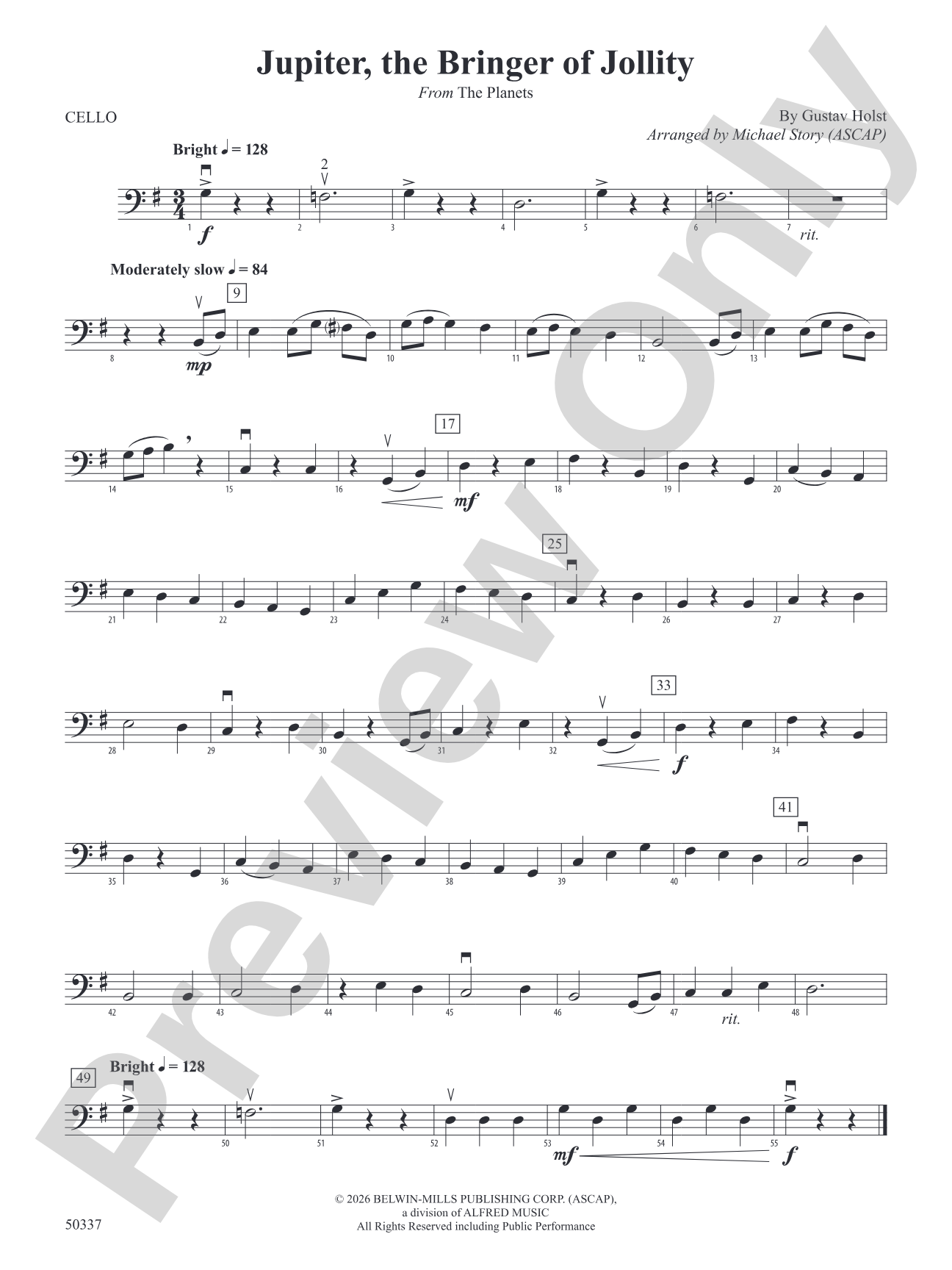
Jupiter, the Bringer of Jollity: Cello

From The Planets

By Gustav Holst / arr. Michael Story

Grade: 1.5

Item: 00-PC-0019663_VC1

Digital Download
$3.00
Description
Written in 1914–1916, Gustav Holst's The Planets is undoubtedly one of the most important compositions of the 20th century. Michael Story has crafted an easy but effective arrangement of the beautiful melody from Jupiter for your beginning string or full orchestra. 

Jupiter, the Bringer of Jollity: Cello isn't in MakeMusic Cloud just yet...but it could be. Let us know you'd like to see it, and you'll help shape what comes next. In the meantime, start a free trial and dive into thousands of interactive titles your students can play along with today.

Sample Audio
0:00
0:00
Sample Video
Additional Details
Series: Belwin Beginning Full Orchestra
Publisher: Alfred Music
SKU: 00-PC-0019663_VC1

More about this title

About the Composer: Gustav Holst

Gustav Holst (1874–1934) was a British composer whose orchestral works remain cornerstones of the concert repertoire. The Planets, written during World War I, stands as his masterpiece; each movement personifies a celestial body through distinctive harmonic language and orchestration. Holst's gift for memorable melody and structural clarity made his music accessible to performers at all levels while maintaining artistic substance.

Why we love this

Michael Story's arrangement preserves the unmistakable character of Holst's iconic melody while genuinely serving beginning orchestras. At Grade 1.5, this sits at the exact sweet spot where students aren't sight-reading note-by-note but still experience the thrill of playing a recognizable, substantial piece. The arrangement proves that accessibility and authenticity aren't opposites.

What to expect

Warm, stately, and optimistic. The familiar melody unfolds with the kind of generous, golden quality that makes audiences lean forward in their seats. Even at an accessible level, the arrangement captures something majestic about Holst's vision.

Who it's for

Beginning orchestras and full bands in middle school or early high school that want to program something immediately recognizable and rewarding. This works equally well for concert orchestras, festival performances, or students experiencing large ensemble music for the first time.

How to get the most out of it

  • Balance the melody across your first violins and principal woodwinds so the famous tune projects clearly without requiring unnatural dynamic peaks from younger players.
  • Shape the lyrical phrases with gentle swells rather than dramatic crescendos; Holst's melody sings best when given room to breathe.
  • Establish a steady, unhurried tempo that allows the full ensemble to lock together rhythmically before pushing for expressive refinement.

How to use it

This arrangement slots naturally into spring concerts, festival competitions, or pops-style programming where a piece of genuine substance will land with audiences. It also makes an excellent centerpiece for demonstrating that Grade 1.5 doesn't mean simple or forgettable.

Skills your students will build

  • Sustaining long melodic lines with consistent tone across a section
  • Balancing between melody and accompaniment roles within the ensemble
  • Reading and executing dynamic nuance (crescendos and decrescendos) at tempo
  • Coordinating entrances and cutoffs across multiple instrumental families

You May Also Like