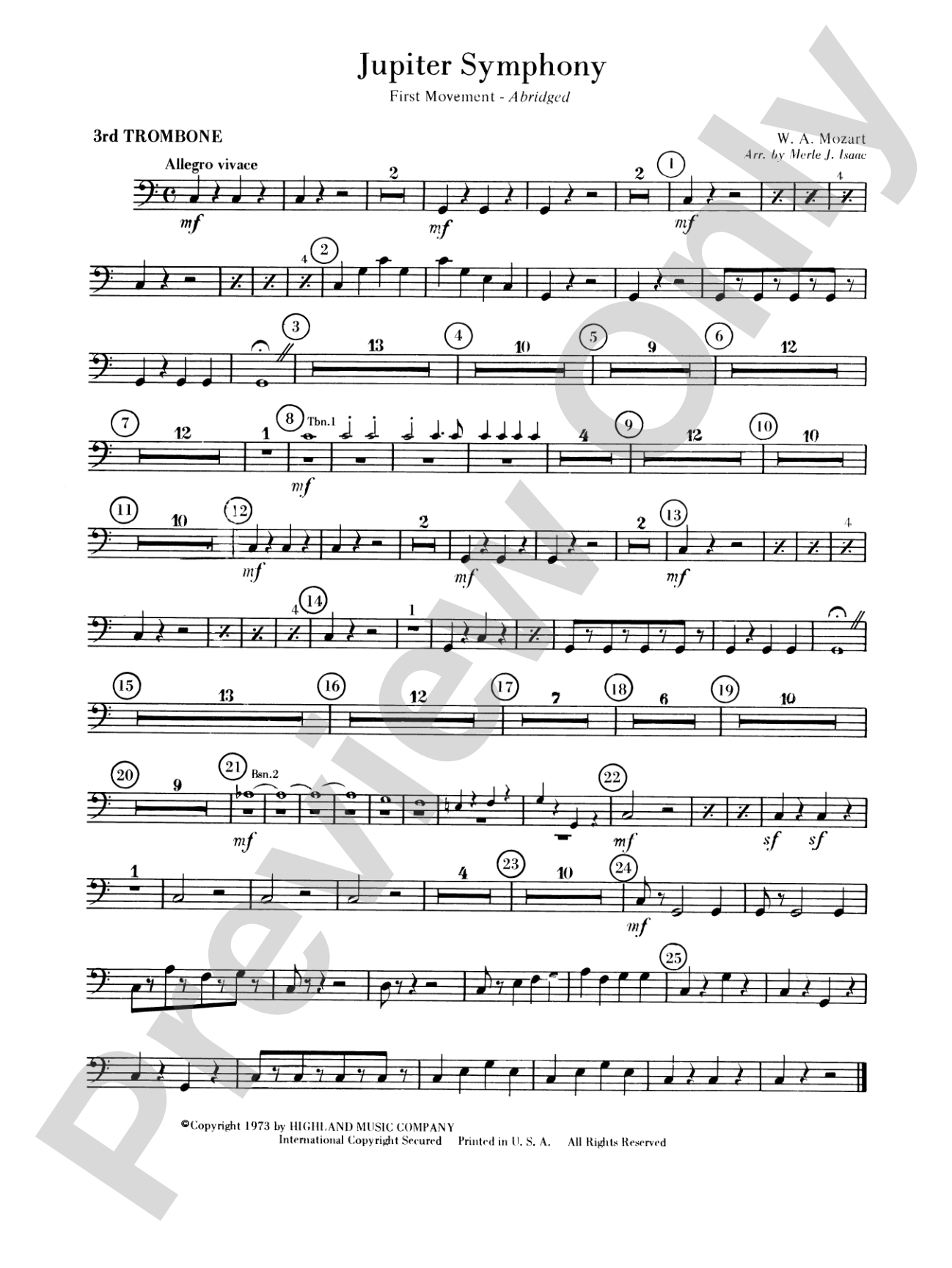
Jupiter Symphony, 1st Movement: 3rd Trombone Sheet Music Preview

Jupiter Symphony, 1st Movement: 3rd Trombone

By Wolfgang Amadeus Mozart / arr. Merle J. Isaac

Grade: 3

Item: 00-PC-0000044_TN3

Digital Download
$3.00
Description

Don't just read it, hear it, play along with it, and watch your students grow with it. In MakeMusic Cloud, Jupiter Symphony, 1st Movement: 3rd Trombone comes alive with professional accompaniment, adjustable tempo, and built-in practice tools that turn solo practice into real progress.

Sample Audio
No sample audio found.
Sample Video
Additional Details
Series: Highland/Etling Full Orchestra
Publisher: Alfred Music
Page Count: 191
SKU: 00-PC-0000044_TN3

More about this title

About the Composer: Wolfgang Amadeus Mozart

Wolfgang Amadeus Mozart (1756–1791) was an Austrian composer whose output spanned every major genre of his time. He wrote over 600 works across symphonies, concertos, operas, chamber music, and sacred music, often while traveling throughout Europe as a child prodigy and later as a sought-after composer. Mozart's music balances structural clarity with emotional depth, making his works enduring touchstones for orchestral training and concert repertoire.

For music educators, Mozart's symphonies remain invaluable teaching tools. His orchestration is transparent enough to hear individual lines clearly, yet complex enough to challenge young musicians. The Jupiter Symphony stands among his final and most ambitious works, offering students a direct connection to one of Western music's greatest composers.

Why we love this

This Merle Isaac arrangement opens the Jupiter Symphony's architectural brilliance to Grade 3 orchestras without compromising its essential character. Directors can build ensemble confidence with genuine Mozart rather than simplified alternatives, and students encounter the real work they'll revisit at higher levels throughout their musical lives.

What to expect

The opening theme unfolds with aristocratic grace, light and purposeful, before the full orchestra enters with controlled energy. Underneath runs the steady heartbeat of classical form: clear themes, logical key relationships, and balanced phrasing that feels inevitable yet fresh. This is music that breathes within its own structure.

Who it's for

Orchestra directors working with Grade 3 ensembles who want to program authentic Mozart with transparency and integrity. Advanced middle school and early high school orchestras benefit from engaging with this masterwork at an accessible level that preserves its compositional sophistication.

How to get the most out of it

  • Balance the opening theme between first violins and lower voices so the melody sings above the accompaniment; young orchestras often bury this signature idea.
  • Establish a steady, singing pulse in the Allegro vivace that doesn't rush; the classical proportion of this movement depends on rhythmic security across all sections.
  • Listen carefully to the transitions between themes and key areas; these shifts define the form and help students understand sonata structure in action.
  • Shape the full-orchestra passages with subtle dynamic nuance rather than uniformly loud playing; Mozart's orchestration rewards clarity over volume.

How to use it

Program this as an anchor piece for a classical concert or as the centerpiece of a unit on sonata form and orchestral development. It pairs naturally with other classical symphonic movements or shorter classical works, offering audiences a direct connection to the repertoire symphonic orchestras perform at the professional level.

Skills your students will build

  • Reading a full orchestral score and understanding how individual parts contribute to the whole
  • Understanding sonata form through active performance (exposition, development, recapitulation)
  • Balancing melodic lines against accompaniment figures across different instrumental choirs
  • Sustaining accurate intonation and rhythmic precision in quick-moving classical passagework
  • Responding to subtle dynamic and articulation changes that define classical style

You May Also Like