Jupiter (from The Planets): E-flat Baritone Saxophone Sheet Music Preview

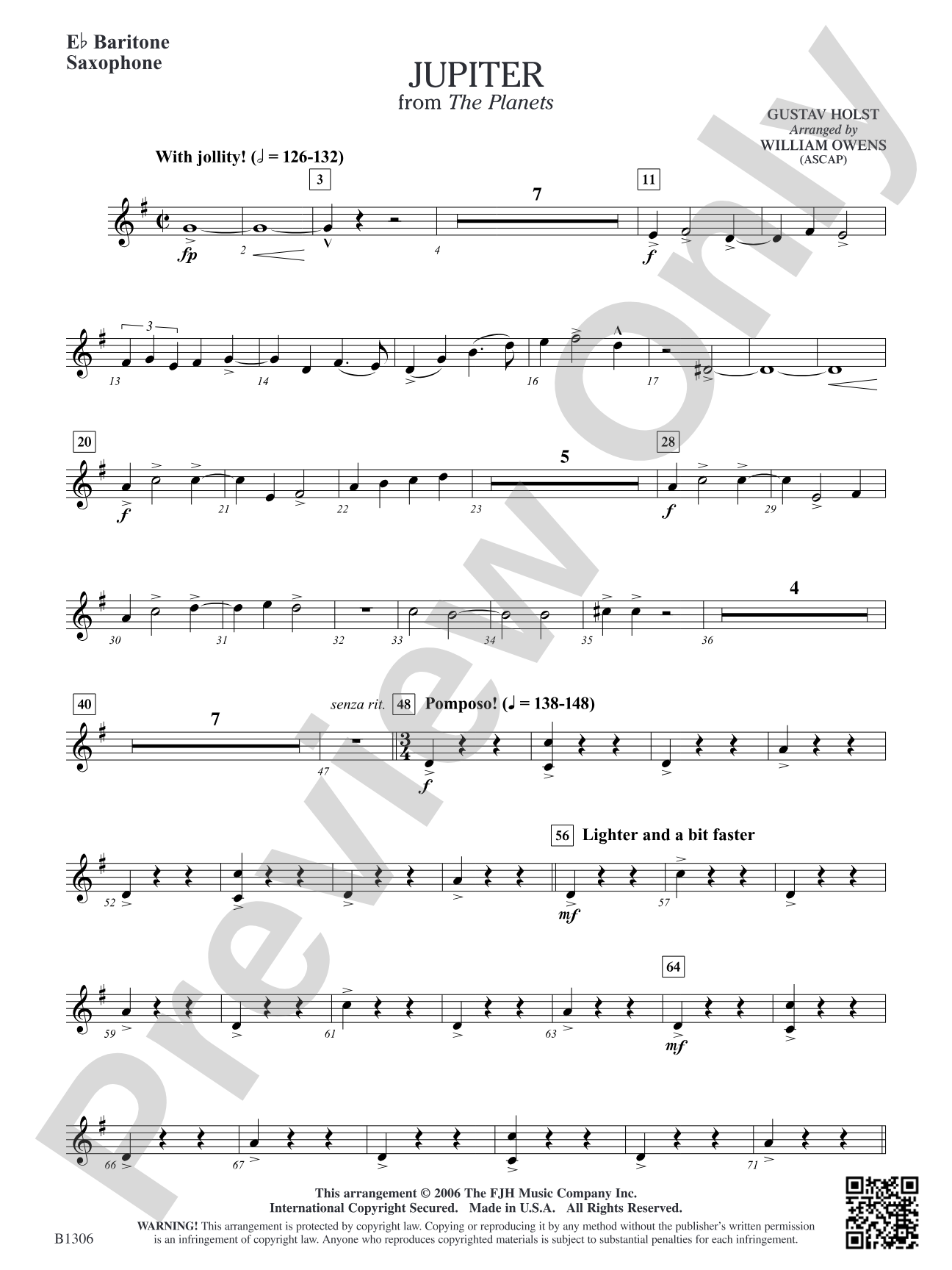
Jupiter (from The Planets): E-flat Baritone Saxophone

from The Planets

By Gustav Holst / arr. William Owens

Grade: 3

Item: 98-PC-DB1306_BTX

Digital Download
$7.00
Description
Remarkably similar to the original yet extremely approachable by medium-level bands, this arrangement of Jupiter captures all the fire of the original orchestral version. An excellent way to explore one of the most popular works by British composer Gustav Holst and include a classic on your next program.

Jupiter (from The Planets): E-flat Baritone Saxophone isn't in MakeMusic Cloud just yet...but it could be. Let us know you'd like to see it, and you'll help shape what comes next. In the meantime, start a free trial and dive into thousands of interactive titles your students can play along with today.

Sample Audio
0:00
0:00
Sample Video
Additional Details
Series: FJH Concert Band
Publisher: The FJH Music Company, Inc.
SKU: 98-PC-DB1306_BTX

More about this title

About the Composer: Gustav Holst

Gustav Holst (1874, 1934) was an English composer whose orchestral suite The Planets stands as one of the twentieth century's most performed and recognizable classical works. A skilled orchestrator with deep knowledge of instrumental capabilities, Holst wrote music that balances structural clarity with rich harmonic language, making his work both intellectually engaging and immediately affecting for listeners.

Why we love this

This arrangement preserves the swagger and majesty of the original orchestral movement while remaining genuinely playable by Grade 3 ensembles. The arranger has made smart choices about what to feature and what to simplify, so your band gets to perform a legitimate masterwork rather than a watered-down version. It's the kind of piece that reminds your students why they joined band in the first place.

What to expect

Regal and optimistic, with the kind of soaring melody that stays with audiences long after the concert ends. There's ceremonial weight to the opening, followed by moments of genuine joy that feel earned rather than saccharine.

Who it's for

Directors programming a concert band repertoire that includes legitimate masterworks without overwhelming intermediate players. Grade 3 bands ready to tackle something that sounds substantial and feels like a real achievement.

How to get the most out of it

  • Balance the melodic lines across your sections. The tune floats between trumpets and horns, so make sure your voicing doesn't let it disappear into the ensemble texture.
  • Shape the phrasing in four-bar chunks rather than pushing constantly forward. Jupiter's character depends on generous, almost stately articulation.
  • Pay attention to the dynamics the arranger marked for you. They're there to help you build the structure Holst intended without requiring superhuman technique.

How to use it

This works beautifully as the centerpiece of a fall or spring concert, especially if you want to program something that appeals to an audience beyond the usual band supporters. It pairs well with lighter contemporary works and gives your program instant credibility.

Skills your students will build

  • Balancing multiple melodic lines within a homophonic texture
  • Shaping long-lined melodies across phrase boundaries
  • Reading and executing the harmonic vocabulary of early twentieth-century classical music
  • Responding to dynamic and articulation markings as structural cues

You May Also Like