
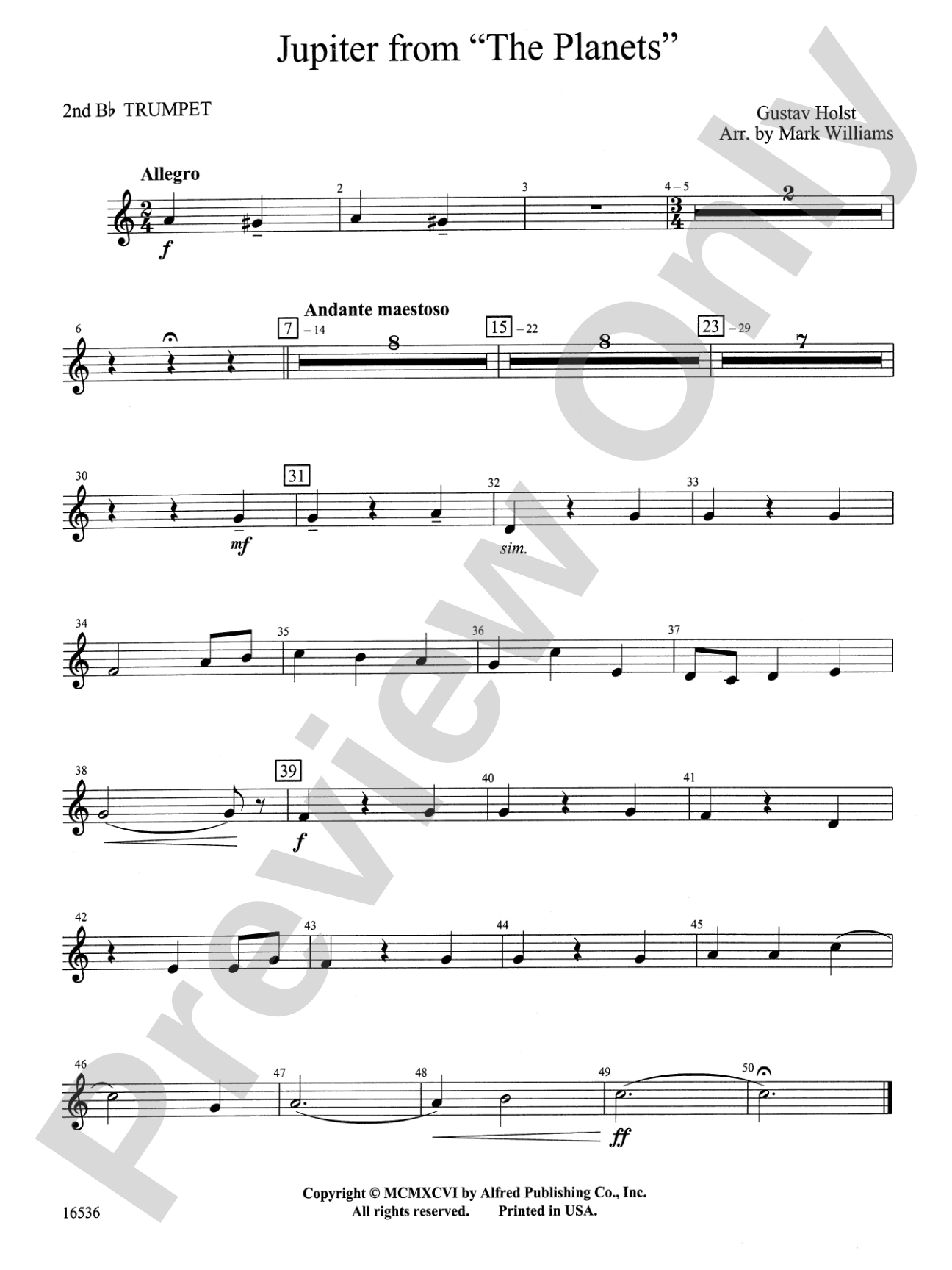

Jupiter from "The Planets": 2nd B-flat Trumpet
By Gustav Holst / arr. Mark Williams
Grade: 1.5 (Easy)
Item: 00-PC-0000183_T2
$3.00
Pickup currently not available
Description
The gorgeous chorale from this most famous of Holst's orchestral works has been exquisitely scored for this version for young band by Mark Williams. The potential for expressive playing and development of sensitivity in this arrangement is virtually limitless. A superior choice for developing musicality.


Don't just read it, hear it, play along with it, and watch your students grow with it. In MakeMusic Cloud, Jupiter from "The Planets": 2nd B-flat Trumpet comes alive with professional accompaniment, adjustable tempo, and built-in practice tools that turn solo practice into real progress.
Open in the Player
Jump straight in and assign it today.
Start Your Free Trial
Open this title and explore the full library in minutes.
Sample Audio
1
Audio File
--:--
0:00
0:00
Sample Video
No sample videos found.
Additional Details
Series:
Challenger Band Series
Publisher:
Alfred Music
Page Count:
118
SKU:
00-PC-0000183_T2
More about this title
About the Arranger: Mark Williams

Mark Williams built a legacy as one of the most prolific and influential voices in school band repertoire. His career spanned composing and arranging over 200 works, teaching elementary band in Washington state for decades, and serving as a clinician and guest conductor across North America and Australia. Williams earned degrees from Eastern Washington University and performed professionally on bassoon with the 560th Air Force Band while maintaining an active schedule as woodwind arranger and conductor of the Spokane British Brass Band.
Recognized with numerous awards including the Gralia Competition and multiple ASCAP Special Awards, Williams understood the pedagogical needs of young musicians at every level. His arrangements and compositions became staples in concert band programs nationwide, balancing musical substance with accessibility. He co-authored the Accent on Achievement Band Method, establishing himself as both artist and educator.
Why we love this
Williams strips away the orchestral complexity of Holst's masterpiece while preserving its emotional core, giving young bands access to genuinely sophisticated music. The chorale breathes naturally when scored for this ensemble, and the expressive demands feel earned rather than imposed. Your students will discover that maturity in sound comes not from difficulty but from thoughtful phrasing and commitment to musical line.
What to expect
Warm and contemplative, this arrangement invites listeners into an intimate musical moment rather than assaulting them with orchestral grandeur. The chorale unfolds with the grace of a hymn, creating space for reflection and genuine emotional expression. There's nobility here, but also tenderness; Holst's gift for melody shines brightly without distraction.
Who it's for
This arrangement serves bands looking to program substantial concert repertoire that demands musicianship without extreme technical demands. Young musicians can access one of classical music's most beloved melodies while developing sensitivity and expressive awareness. It works equally well for developing ensembles prioritizing musicality and for established groups seeking a crowd-pleasing, artistically satisfying selection.
How to get the most out of it
- Establish a singing tone from the opening note; this arrangement thrives on legit sustained sound rather than mechanical precision.
- Balance the melodic voices carefully across sections to ensure the chorale unfolds with transparency, especially when multiple instrumental families carry the line.
- Shape each phrase with gentle dynamic contours that follow the harmonic rhythm rather than playing mechanically loud or soft.
- Allow space for breath and silence between phrases; the arrangement gains dignity and power from restraint.
How to use it
Open a concert with this piece to establish an elegant, thoughtful tone for the entire evening. It pairs beautifully alongside contemporary concert band works or classical transcriptions, bridging the familiar and the exploratory. Consider programming it as a moment of respite within a longer concert, allowing the audience and your musicians to reconnect with simplicity and beauty.
Skills your students will build
- Sustained legit tone production across moderate dynamic ranges
- Phrasing that follows harmonic movement rather than metric convention
- Balance and blend when multiple sections carry melodic material simultaneously
- Musical sensitivity and expressive control at accessible technical levels