
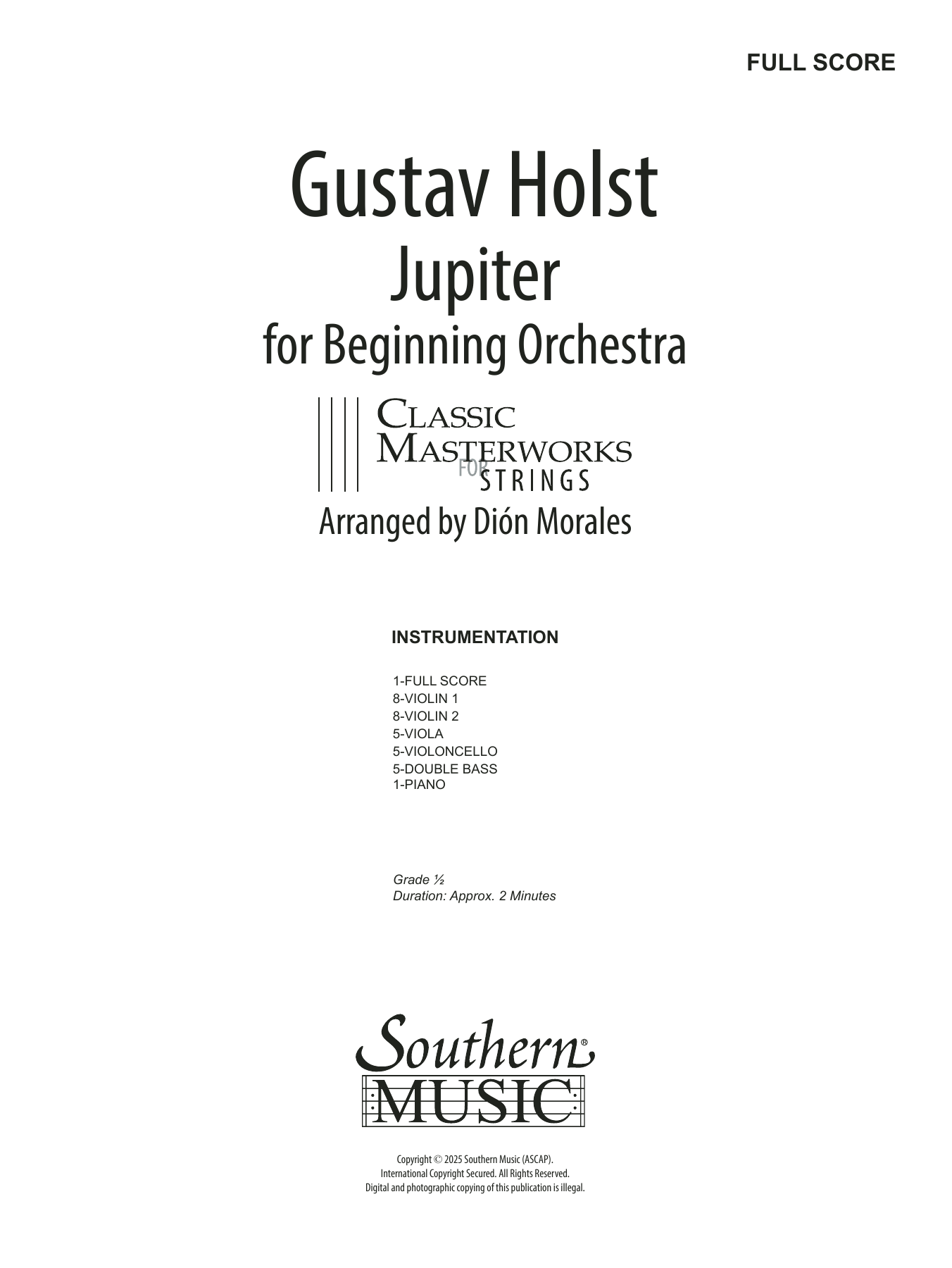

Jupiter for Beginning Orchestra (arr. Dion Morales): String Orchestra Conductor Score & Parts
By Gustav Holst / Arranged by Dion Morales
Grade: 0.5
Item: 35-PK01725888
$40.00
Pickup currently not available
Buy Extra Parts (Digital PDF Download)
Parts Added to Cart!
Description
Gustav Holsts The Planets is one of the most iconic orchestral suites of the 20th century, with each movement representing the astrological character of a different planet. Jupiter, the Bringer of Jollity, is among the most well-known movements of the suite, capturing a feeling of abundance, joy, and grandeur.


Jupiter for Beginning Orchestra (arr. Dion Morales): String Orchestra Conductor Score & Parts isn't in MakeMusic Cloud just yet...but it could be. Let us know you'd like to see it, and you'll help shape what comes next. In the meantime, start a free trial and dive into thousands of interactive titles your students can play along with today.
Request This Title
Tell us you want it.
Start Your Free Trial
Explore everything that's ready to play right now.
Sample Audio
No sample audio found.
Sample Video
No sample videos found.
Additional Details
Publisher:
Hal Leonard
SKU:
35-PK01725888
More about this title
About the Composer: Gustav Holst
Gustav Holst (1874–1934) was an English composer whose imaginative orchestration and gift for melody made him one of the most performed classical composers in schools today. Though trained in the German tradition, Holst developed his own voice by drawing on folk music, Eastern philosophy, and bold harmonic thinking. His influence on music education extends far beyond The Planets; he composed extensively for young musicians and believed deeply in music's power to develop character and creativity.
Why we love this
This arrangement gives beginning orchestras access to one of classical music's most crowd-pleasing moments without the complexity of the full orchestration. Dion Morales has preserved the sweeping melodic lines and harmonic richness that make Jupiter instantly recognizable, while keeping the string writing clean and achievable. Your students get to perform a movement that audiences genuinely love, which builds confidence and motivation at exactly the moment when young musicians need it most.
What to expect
Warmth and abundance wash over the room from the opening phrase. The melody soars with the kind of unguarded optimism that feels both timeless and celebratory, inviting listeners into a moment of pure musical joy. There's a generosity in the harmonic movement that lets younger players feel like they're part of something genuinely grand.
Who it's for
Beginning string orchestras that want to program substantial concert repertoire without specialized instrumentation or extreme technical demands. This works equally well for school orchestras building confidence and for community ensembles seeking repertoire that audiences recognize and enjoy.
How to get the most out of it
- Shape the main theme with gentle dynamic swells rather than playing it as a single melodic line; this captures the breadth that makes Jupiter feel grand without requiring technical wizardry.
- Balance the violas and cellos when they carry inner voices, since string orchestras often weight tone toward the violins. Bring out that harmonic foundation so the arrangement has structural depth.
- Resist the urge to rush the broader sections. The joy in this movement lives in the space and generosity of the phrasing, not in urgency.
How to use it
Open a concert with this to establish an uplifting tone, or place it strategically in the second half when audience energy might need a lift. It pairs naturally with other accessible masterworks and gives students a recognizable anchor point that builds program coherence.
Skills your students will build
- Sustaining long melodic lines with consistent tone and phrasing
- Balancing multiple melodic voices within the string section
- Managing dynamic expression across full phrases rather than note-to-note
- Reading and performing within the extended range of a full orchestral arrangement