Jupiter Sheet Music Preview

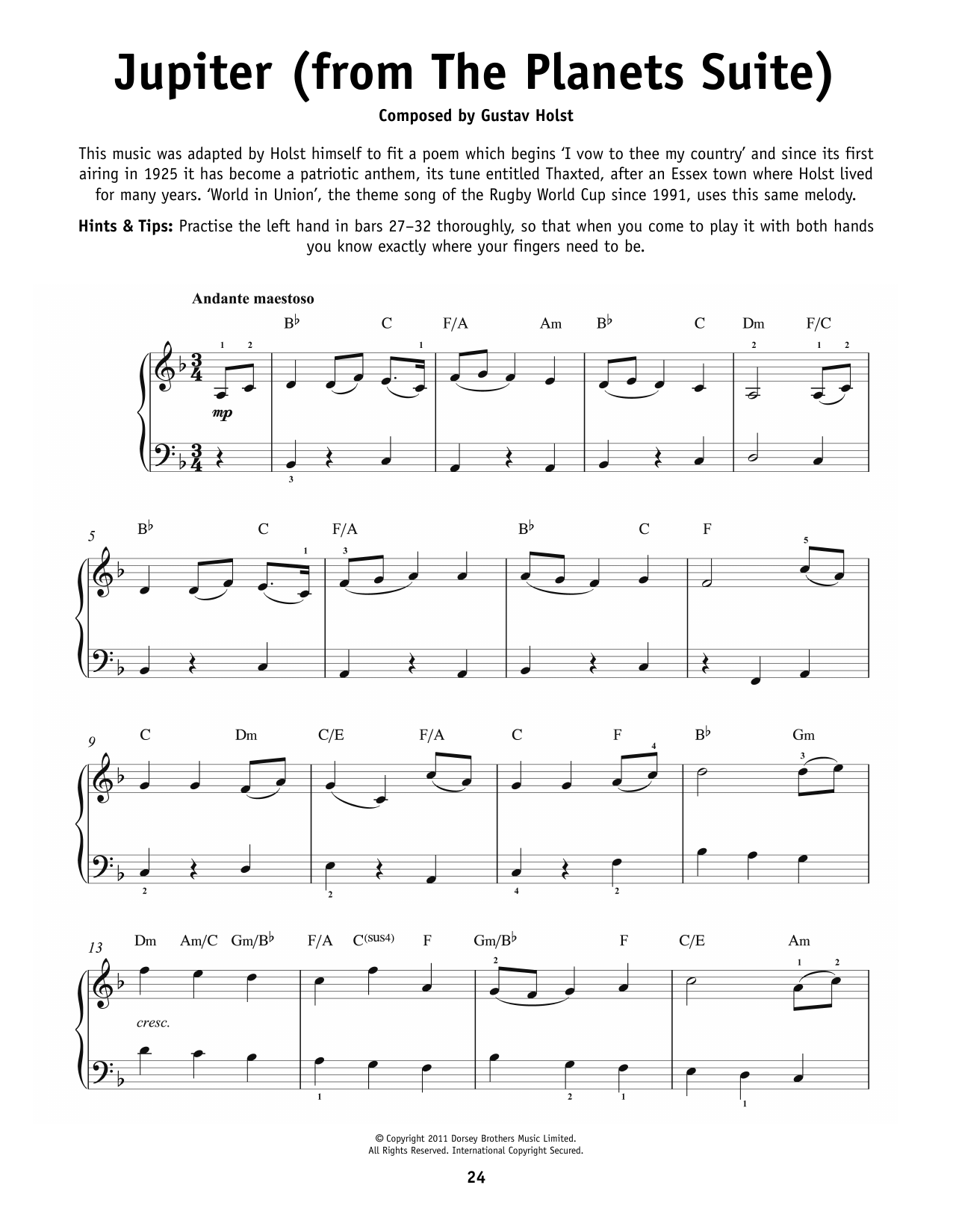
Jupiter: Really Easy Piano

As performed by Gustav Holst

Item: 35-DS01587921

Digital Download
$4.99
Description

Discover MakeMusic Cloud: thousands of interactive titles your students can play along with today.

Sample Audio
No sample audio found.
Sample Video
Additional Details
Publisher: Hal Leonard
Page Count: 2
SKU: 35-DS01587921

More about this title

About the Artist: Gustav Holst

Gustav Holst (1874–1934) shaped twentieth-century British music through his refusal to follow convention. A composer, conductor, and educator, he drew inspiration from English folk traditions, Hindu philosophy, and astrology to create works that balanced modernist harmonies with accessible melodies. His teaching at St. Paul's Girls' School influenced generations of musicians, and his commitment to music for amateurs ensured his works reached far beyond concert halls.

Holst's compositional voice emerged from curiosity and restlessness. He studied at the Royal Academy of Music, traveled to Scandinavia and beyond, and constantly experimented with instrumentation and form. His legacy rests not on a single masterpiece but on a body of work that proves accessible music need not be simplistic, and that a composer's greatest gift can be making music matter to ordinary musicians.

Why we love this

Jupiter radiates confidence and optimism in a way that makes any ensemble sound larger than life. The piece builds naturally from lyrical beauty to triumphant joy, giving performers genuine moments to shine without requiring virtuosic technique. Holst's orchestration here translates beautifully across different ensemble sizes, and the emotional arc makes it a conductor's dream for rehearsal engagement.

What to expect

Jupiter captures a moment of expansive contentment. The opening unfolds like a slow realization of beauty, then builds steadily toward unrestrained joy. By the final section, the piece feels inevitable and inevitable, affirming something fundamental about human optimism and connection.

Who it's for

This arrangement works for intermediate to advanced ensembles seeking a piece that combines emotional depth with celebratory impact. Conductors value it for concert closers, festive occasions, or programs where you need something beloved by audiences that also respects your musicians' musicianship.

How to get the most out of it

  • Establish the opening melody with warmth and breadth; resist the urge to rush even when the harmonic motion quickens. The initial phrases set the character for everything that follows.
  • Balance the texture when multiple voices enter simultaneously. Jupiter thrives on transparency, so ensure inner parts don't disappear beneath the top line.
  • Shape the final triumphant section with a sense of earned exuberance rather than aggressive pushing. The power comes from clarity and unified commitment, not volume alone.
  • Mark your structural points during early rehearsals. Identifying where Holst modulates or reintroduces earlier material helps musicians understand the journey they're creating.

How to use it

This stands naturally as a concert finale, rewarding audiences and performers alike with its sense of arrival and celebration. It also pairs effectively with other Holst works or early twentieth-century British composers, giving your program thematic coherence without feeling academic.

Skills your students will build

  • Lyrical phrasing across longer melodic lines
  • Dynamic control and shaping within a single phrase
  • Balancing ensemble texture when voices enter at different times
  • Understanding formal structure and how themes develop and return
  • Sustaining musical tension through harmonic movement

You May Also Like