
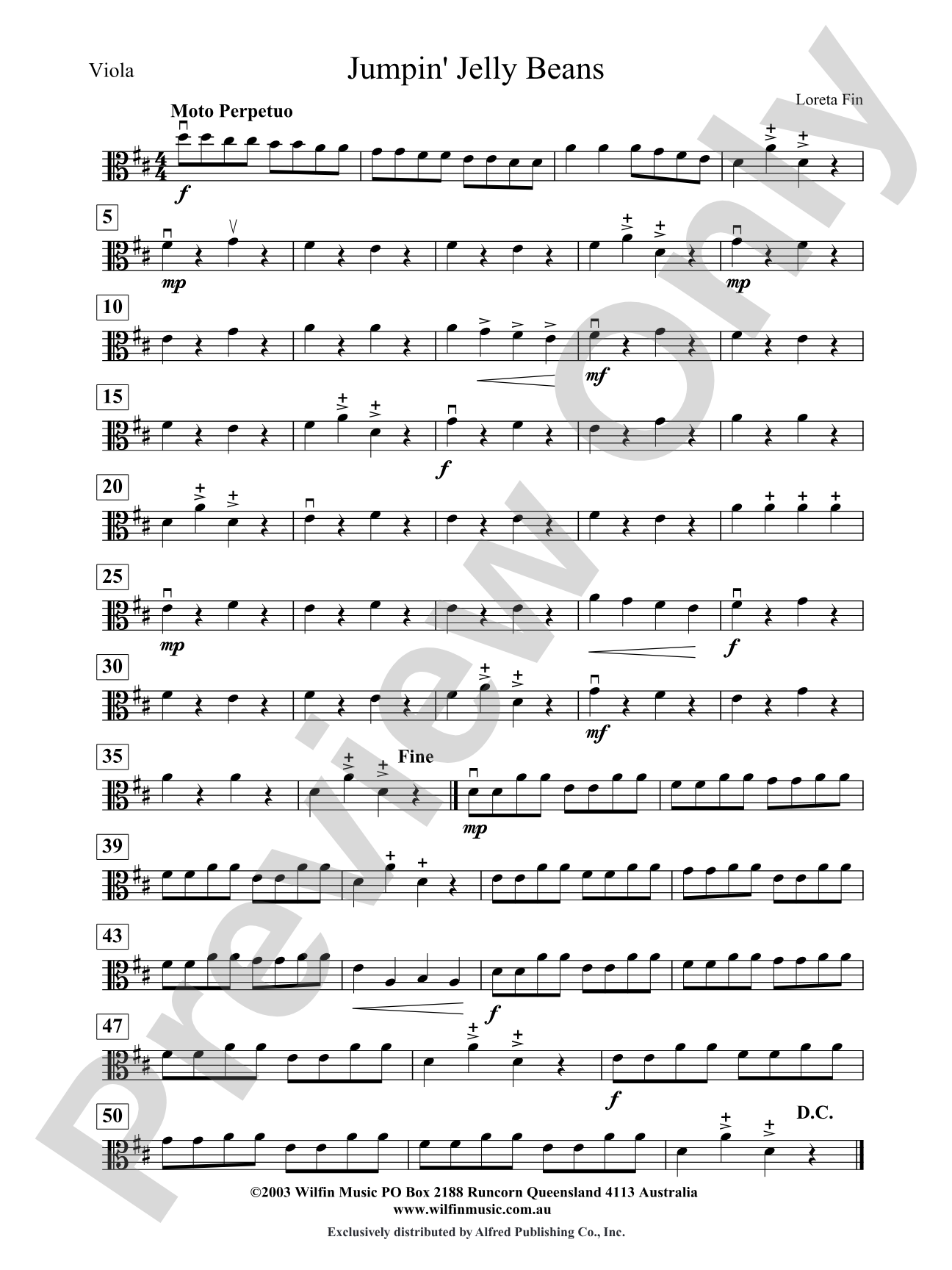

Jumpin' Jelly Beans: Viola
By Loreta Fin
Grade: 1.5-2
Item: 76-PC-0000022_VA1
$5.99
Pickup currently not available
Description
It is in Moto Perpetuo style and very uncomplicated. The piece uses left-hand pizzicato.


Jumpin' Jelly Beans: Viola isn't in MakeMusic Cloud just yet...but it could be. Let us know you'd like to see it, and you'll help shape what comes next. In the meantime, start a free trial and dive into thousands of interactive titles your students can play along with today.
Request This Title
Tell us you want it.
Start Your Free Trial
Explore everything that's ready to play right now.
Sample Audio
No sample audio found.
Sample Video
No sample videos found.
Additional Details
Series:
Wilfin String Orchestra: Young String Ensemble Series
Publisher:
Wilfin Music
Page Count:
82
SKU:
76-PC-0000022_VA1
More about this title
About the Composer: Loreta Fin

Loreta Fin is an Australian string educator, conductor, and composer whose career spans performance, teaching, and advocacy at the highest levels of music education. A trained violinist and violist, she studied at the Sydney Conservatorium of Music and has performed with chamber ensembles and orchestras throughout her career, including a 25-year tenure as principal viola with the Queensland Pops Orchestra. She worked alongside internationally recognized artists across multiple genres.
Fin has directed strings at Somerville House School in Brisbane since 1993 and has authored more than 100 published string orchestra compositions. She served on the Australian Strings Association committee for over 25 years, including terms as both state and national president, and was recognized with a Queensland State Award in 2009. An accomplished adjudicator and conference presenter, Fin has judged competitions across Australia and presented at national conferences in both Australia and the United States. Since 2015, she has conducted honors ensembles at the state and national level. In 2017, she released her Beginner String Ensemble Series, and in 2018 and 2019, she conducted the Miri Music Project in Malaysia. Fin received the National Award for Services to Music and String Teaching in Australia and was nominated for an ARIA "Best Teacher" award.
Why we love this
Fin writes string orchestra music that respects young players' technical limits while keeping rehearsals rhythmically engaging. The perpetual motion style of this piece prevents the stilted pacing that can bog down early-level repertoire, and the left-hand pizzicato technique introduces a playful technical challenge without overwhelming the ensemble.
What to expect
Bouncy, whimsical, and propulsive. The perpetual motion creates forward momentum that feels almost playful, with the novelty element giving the piece a lighthearted personality that young musicians find immediately engaging. Left-hand pizzicato adds a surprising technical twist that delights audiences and players alike.
Who it's for
This piece suits beginning orchestral students working at grades 1.5 to 2 who are ready for rhythmic complexity but still developing technical facility. It works well for ensembles mixing ability levels, since the straightforward harmonic language lets younger players focus on rhythm and technique while more advanced students shape interpretation.
How to get the most out of it
- Establish a steady pulse before introducing the moto perpetuo texture. Young string players often rush when navigating repeated figures, so anchor the rhythm section in early rehearsals.
- Work the left-hand pizzicato passage by passage. Students may default to right-hand plucking out of habit, so mark the exact measures in parts and demonstrate the technique clearly.
- Balance the novelty elements with articulation clarity. The playful character invites loose playing, but crisp note clarity keeps the piece from sounding muddied at tempo.
- Let the energy build gradually. Young ensembles sometimes peak early with novelty pieces, so shape the arc across the full score and reserve dynamic flexibility for the final phrases.
How to use it
Program this early in a concert to establish energy and set a playful tone for the evening, or use it as a palate cleanser between more serious baroque or classical selections. The novelty character and manageable technical demands make it ideal for family concerts, school assemblies, and end-of-year showcases where audience engagement matters alongside musical development.
Skills your students will build
- Left-hand pizzicato technique and hand independence
- Sustaining rhythmic accuracy in moto perpetuo figures
- Maintaining evenness in repeated sixteenth-note or similar motion patterns
- Balancing articulation clarity with perpetual-motion fluidity
- Reading and executing style direction (novelty/whimsical character)