Jumpin' Jack Flash: Low Brass & Woodwinds #1 - Bass Clef Sheet Music Preview

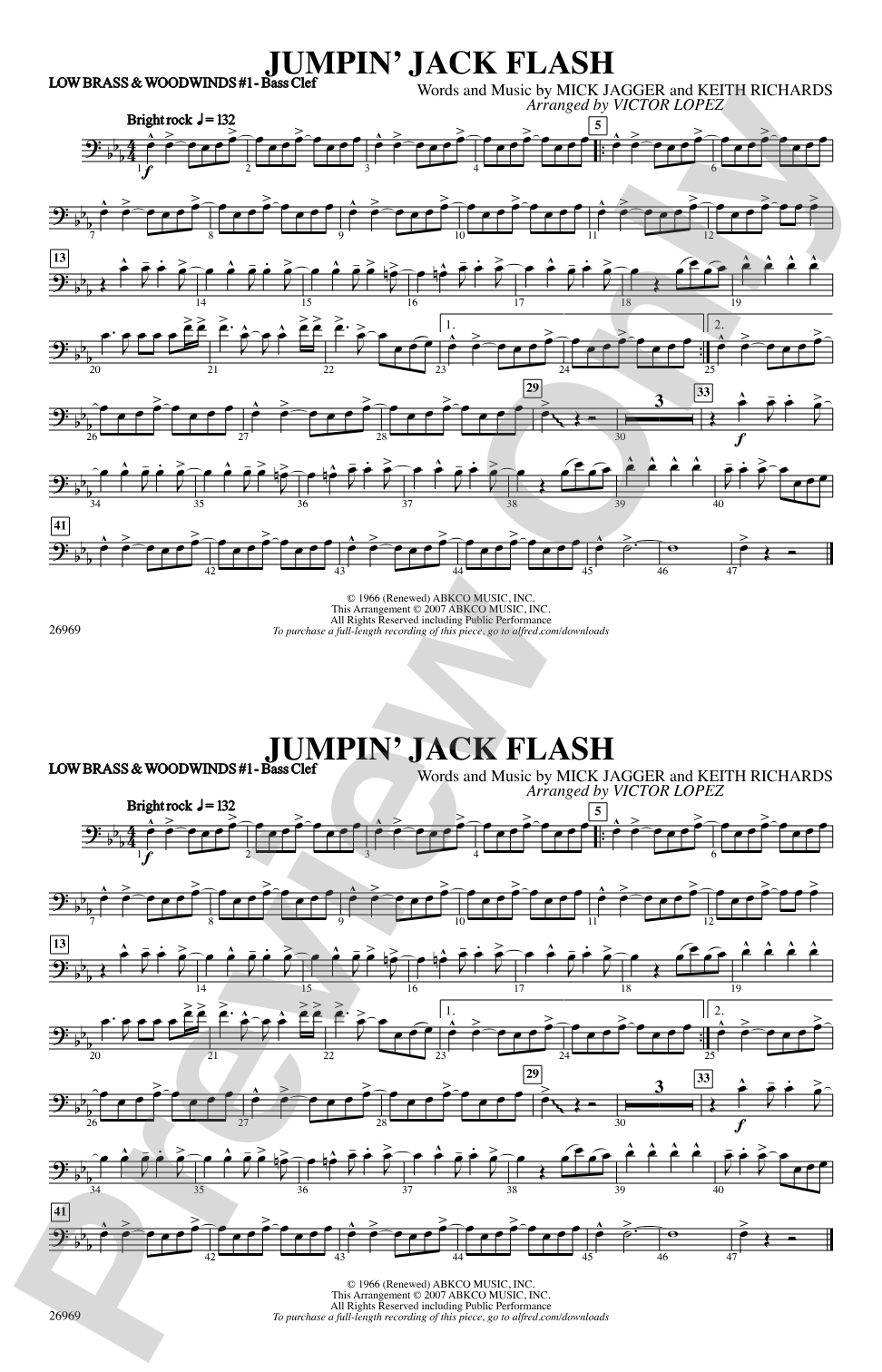
Jumpin' Jack Flash: Low Brass & Woodwinds #1 - Bass Clef

By Mick Jagger and Keith Richards / arr. Victor López

Grade: 3 (Medium)

Item: 00-PC-0018138_LBW1BC

Digital Download
$3.00
Description
The Rolling Stones are still going strong, and this tune is one of their biggest hits. Victor López's arrangement is big, fat, and full-sounding, but will come together quickly. It's perfect for the field, stands, or pep band!

Don't just read it, hear it, play along with it, and watch your students grow with it. In MakeMusic Cloud, Jumpin' Jack Flash: Low Brass & Woodwinds #1 - Bass Clef comes alive with professional accompaniment, adjustable tempo, and built-in practice tools that turn solo practice into real progress.

Sample Audio
0:00
0:00
Sample Video
Additional Details
Series: Mega Sounds for Marching Band
Publisher: Alfred Music
Page Count: 112
SKU: 00-PC-0018138_LBW1BC

More about this title

About the Composer: Mick Jagger

Mick Jagger co-wrote "Jumpin' Jack Flash" with Keith Richards in 1968, establishing himself as one of rock music's most prolific and enduring songwriters. His gift for crafting instantly memorable melodies and driving rhythmic hooks has defined The Rolling Stones' sound across six decades, making their catalog a rich source for educational arrangements.

Jagger's songwriting balances accessibility with sophistication, creating songs that work equally well in stripped-down and fully orchestrated contexts. This flexibility has made his compositions ideal candidates for marching band and concert band arrangements that need to maintain their original energy while engaging school musicians.

Why we love this

Victor López has captured everything that makes this song a stadium anthem without letting the arrangement overwhelm a Grade 3 band. The arrangement sits perfectly for what your students can execute while keeping the authentic swagger and drive of the original. It's the kind of piece that builds ensemble confidence because the big sound comes from clean fundamentals and rhythmic unity, not technical pyrotechnics.

What to expect

Raw, propulsive energy with just enough space for your students to breathe. The arrangement pulses with the swagger of the original recording, full of articulate brass hits and driving percussion that make a stadium or parking lot come alive. Even at Grade 3, it never sounds simplified or diluted; it sounds like a band that knows how to commit to a groove.

Who it's for

Directors programming Grade 3 marching bands who want an instantly recognizable hit that feels sophisticated without becoming a rehearsal burden. This works especially well for groups with solid fundamentals and secure rhythm sections, as the arrangement builds on tight ensemble playing rather than individual virtuosity.

How to get the most out of it

  • Lock the kick drum and low brass into a unified pulse from the very first run-through. This song lives and dies on its groove, so establish that pocket early and keep it rock solid through every transition.
  • Let the mallet percussion breathe in those rhythmic syncopations. They're not just coloring the arrangement; they're part of the driving engine, so make sure they sit confidently in the time.
  • Keep the energy constant even during the softer passages. The arrangement drops dynamics strategically, but never loses its forward motion. Train your students to think "controlled intensity" rather than "pull back."
  • Balance the upper woodwinds carefully when they carry melodic lines. They need to cut through the low brass foundation without sounding thin or strident against a full arrangement.

How to use it

Deploy this mid-season when your ensemble has solid fundamentals and can focus on style and execution rather than basic technique. It's an excellent choice for pep band appearances, football halftime shows, or as a lead-off piece in a fall concert that showcases contemporary repertoire alongside traditional marching band fare.

Skills your students will build

  • Locking a steady rhythmic foundation in ensemble playing
  • Balancing syncopated rhythms between sections
  • Sustaining energy and drive through dynamic contrast
  • Playing with stylistic accuracy in rock idiom
  • Managing articulation and clarity in a full arrangement

You May Also Like