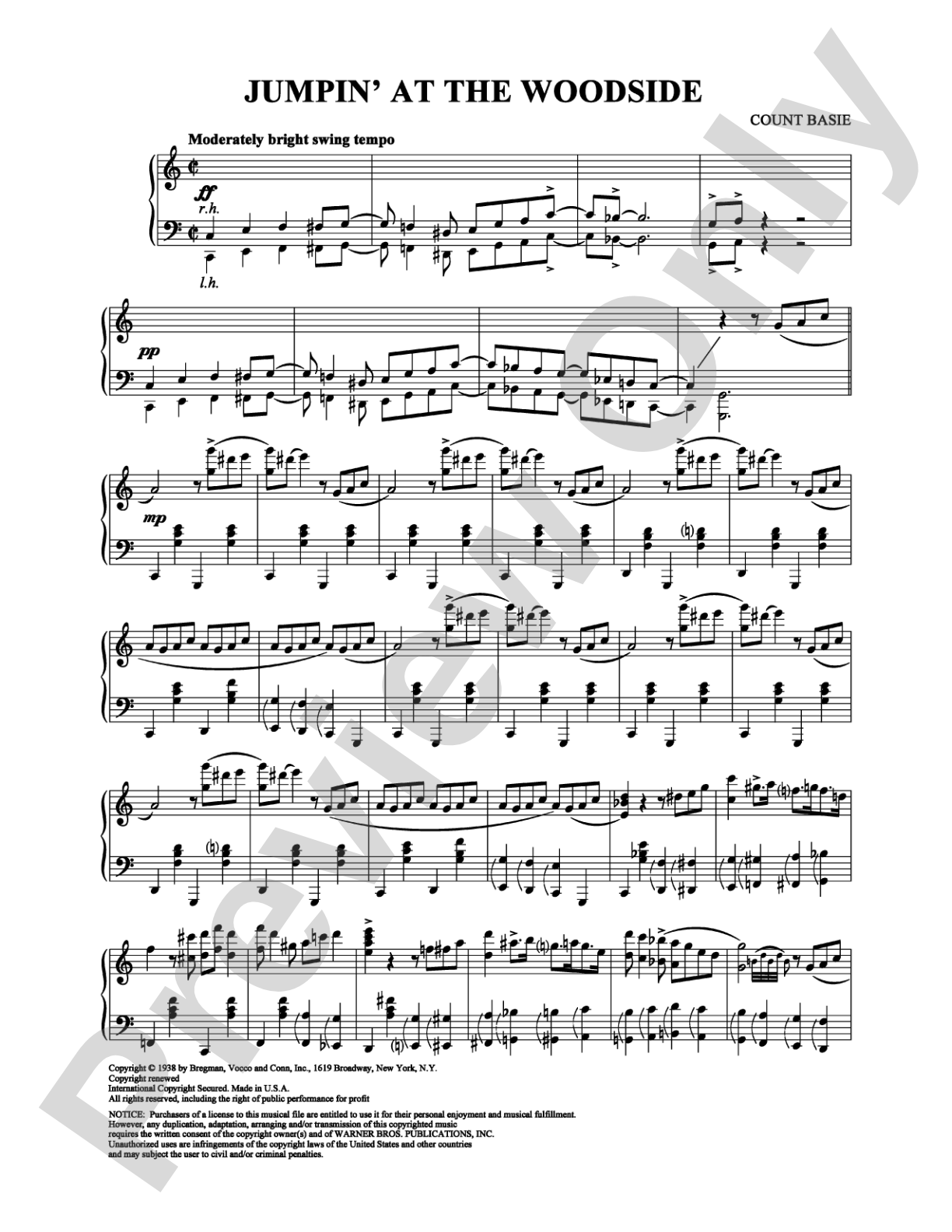
Jumpin' at the Woodside: Piano Digital Sheet Music

Jumpin' at the Woodside: Piano Digital Sheet Music

Count Basie

Item: 00-PS-0000329

Digital Download
$3.99
Description

Jumpin' at the Woodside: Piano Digital Sheet Music isn't in MakeMusic Cloud just yet...but it could be. Let us know you'd like to see it, and you'll help shape what comes next. In the meantime, start a free trial and dive into thousands of interactive titles your students can play along with today.

Sample Audio
No sample audio found.
Sample Video
Additional Details
SKU: 00-PS-0000329

More about this title

About the Artist: Count Basie

Count Basie (1904-1984) built the most swinging big band in jazz history through his mastery of stride piano and his gift for sparse, perfectly timed comping. His bands were defined by their irresistible groove, relentless four-to-the-bar pulse, and Basie's own understated elegance at the keyboard. He understood that less could be more, and that a few perfectly placed notes could drive an entire orchestra forward with unstoppable momentum.

As a pianist and bandleader, Basie became a cornerstone of American jazz education. His recordings remain essential listening for any student of swing, and his compositions and arrangements continue to teach what happens when technique serves the music's rhythmic soul. His influence spans generations of pianists who learned that the real power of jazz lies not in flash, but in pocket, timing, and an unshakeable sense of swing.

Why we love this

Basie's grooves have an almost hypnotic pull that makes even inexperienced jazz pianists sound locked in the moment they find the pocket. This particular tune captures the essence of swing-era big band energy in a form students can tackle without years of advanced technique behind them. Programming it offers an immediate, joyful entry point into jazz standards that audiences recognize and performers feel.

What to expect

Jumpin' at the Woodside radiates infectious energy and forward momentum, with a melody that feels like it's bursting to get out. The tune has the warmth and earthiness of a packed jazz club in its heyday, where the bandstand is cooking and everybody in the room can feel the groove. It's the sound of pure swing joy.

Who it's for

Jazz pianists working to internalize swing-era style and rhythm, students transitioning from classical to jazz repertoire, and ensemble pianists who need accessible big band standards for jam sessions or rehearsals. This piece works well for pianists at the intermediate level who have solid technique but are still developing their jazz vocabulary and time feel.

How to get the most out of it

  • Locate the heartbeat of the rhythm section first. Count Basie's comping style depends entirely on locking with the walking bass and drums, so establish that groove before layering in melody or fills.
  • Use space deliberately. Basie rarely fills every beat; he leaves gaps that create tension and make the notes that do land hit harder. Resist the urge to over-play.
  • Listen to Basie's original recording multiple times before finalizing your interpretation. His touch, timing, and rhythmic placement can't fully be conveyed by notation alone.
  • Swing the eighth notes in the manner of the era you're exploring. The degree of swing alters the whole personality of the tune.

How to use it

Feature this in a jazz or American standards concert to showcase your program's swing repertoire and connect with audiences who grew up with Count Basie recordings. It pairs naturally with other big band era pieces and can anchor a set focused on blues-based jazz compositions. Consider programming it as a solo feature with optional rhythm section accompaniment for maximum flexibility.

Skills your students will build

  • Swing articulation and phrasing characteristic of the 1930s-40s big band era
  • Comping rhythms and sparse, intentional voicing in left hand
  • Lock and pocket with an imagined rhythm section
  • Blues-inflected chord changes and improvisation on a 12-bar blues form
  • Interpretation and stylistic authenticity through listening and transcription

You May Also Like