
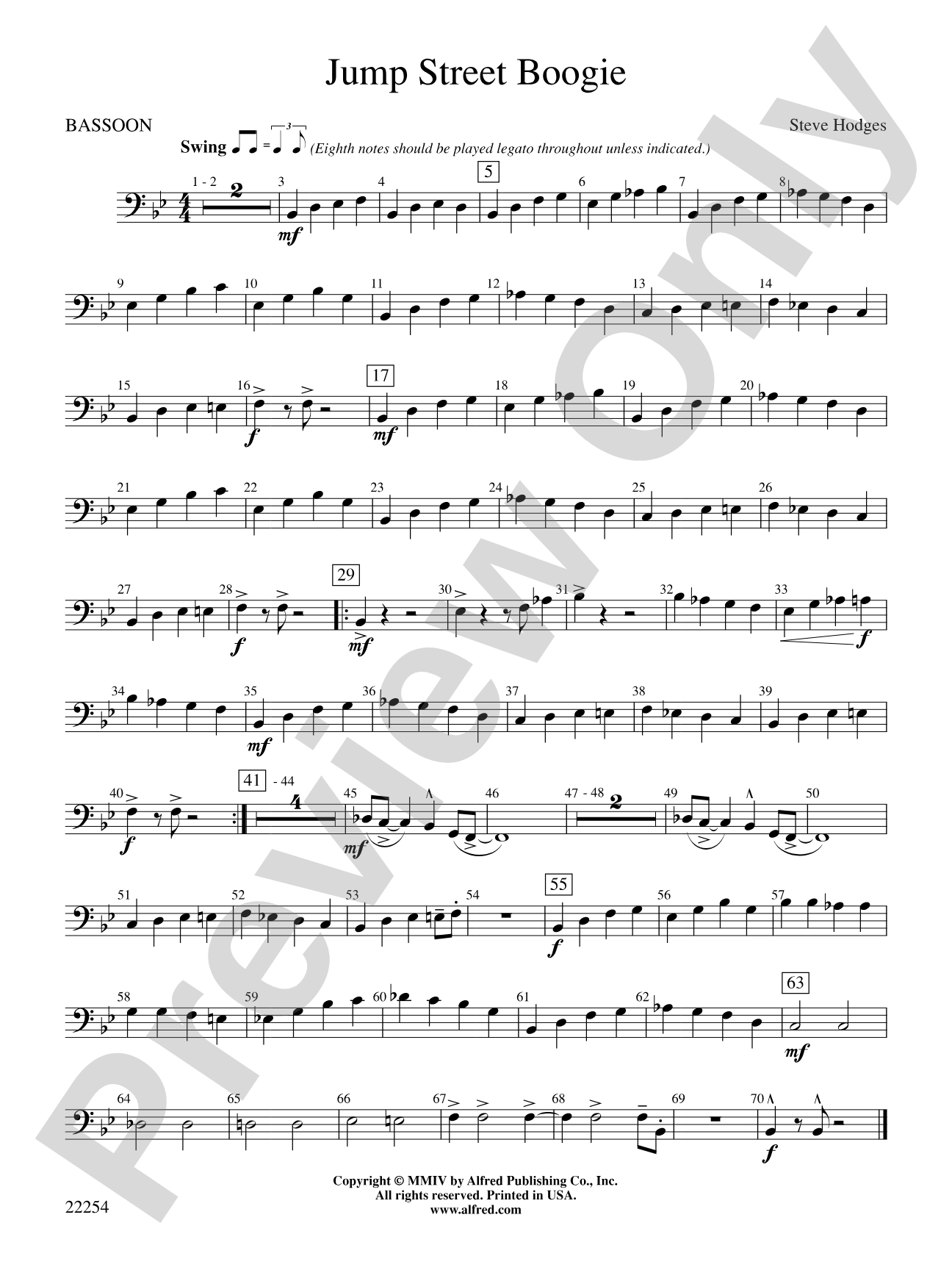

Jump Street Boogie: Bassoon
By Steve Hodges
Grade: 1.5 (Easy)
Item: 00-PC-0000508_B1
$3.00
Pickup currently not available
Description
Jump into some big-band jazz with this new swingin' chart! Featuring some blues, some optional solos, some call and response and a rip-roarin' shout chorus, this piece will have your band and audience jumpin' and jivin'. A great way to introduce classic jazz elements to the concert band! This title is available in MakeMusic Cloud.


Don't just read it, hear it, play along with it, and watch your students grow with it. In MakeMusic Cloud, Jump Street Boogie: Bassoon comes alive with professional accompaniment, adjustable tempo, and built-in practice tools that turn solo practice into real progress.
Open in the Player
Jump straight in and assign it today.
Start Your Free Trial
Open this title and explore the full library in minutes.
Sample Audio
1
Audio File
--:--
0:00
0:00
Sample Video
No sample videos found.
Additional Details
Series:
Challenger Band Series
Publisher:
Alfred Music
Page Count:
120
SKU:
00-PC-0000508_B1
More about this title
About the Composer: Steve Hodges

Steve Hodges holds degrees from Western Oregon University (Bachelor of Science) and Central Washington University (Master of Music Education). Over a four-decade career in public school music education, he directed concert bands, choirs, and chamber ensembles at all levels before retiring from full-time teaching.
Since 1986, Hodges has composed more than 120 concert band works published by Alfred Music, along with choral arrangements released through Staff Music and Shawnee Press. His compositions have appeared at festivals and state conventions across multiple countries, and he has fulfilled commissions for honor bands and school programs throughout North America. His music has also been licensed by major television networks including TBS and ESPN. A member of ASCAP, Hodges continues to live in The Dalles, Oregon, where he remains active in community music alongside his family.
Why we love this
Hodges brings four decades of band directing experience directly into his writing, and it shows in how well this chart sits in young players' hands. The piece manages to pack genuine jazz vocabulary—blues changes, call-and-response phrasing, and a driving shout section—into Grade 1.5 difficulty without sacrificing any swing or personality. For many students, this will be their first real encounter with how big-band jazz actually sounds and feels to play.
What to expect
Infectious and fun. The piece bounces along with the easy confidence of a classic big-band number, complete with blues inflection and conversation between sections that keeps everyone engaged. Players and listeners alike will feel the pull to move—this is music built for joy.
Who it's for
This chart works beautifully for first- and second-year concert bands eager to move beyond march and hymn-style arrangements while staying within a comfortable technical range. It's equally suited for middle school ensembles taking their first steps into jazz and for community or recreational bands looking to add some swing to their repertoire.
How to get the most out of it
- Establish the swing eighth-note feel early in rehearsal by having the rhythm section lock the groove first, then layer in the rest of the band. A steady pulse from drums and bass makes everything else fall into place.
- Balance the optional solos carefully; they should cut through but not overwhelm the ensemble background. Use sectional rehearsals to ensure accompaniment figures stay tight and supportive.
- Lean into the blues idiom's laid-back phrasing. Young players often rush jazz, so explicitly conduct with a relaxed, flowing beat and encourage them to sit slightly behind the pulse rather than on top of it.
- The shout chorus needs energy and commitment. Once the band hears how exciting it sounds with full voicing and confident articulation, they'll lock in naturally.
How to use it
Program this alongside more traditional concert fare to show audiences the full range of what a concert band can do. It works especially well on spring concerts or casual performance events where you want to shift the mood toward entertainment and lighter energy. The accessible difficulty makes it ideal for festival play early in the season when the ensemble is still building chops.
Skills your students will build
- Swing eighth-note articulation and feel
- Blues chord progression recognition and improvisation (for soloists)
- Call-and-response ensemble coordination
- Sectional independence within a homophonic texture
- Dynamics and balance across changing instrumental roles