July Blue Sheet Music Preview

July Blue: Piano

By Glafkos Kontemeniotis

Level: Early Intermediate

Item: 00-PS-0017767

Digital Download
$5.99
Description
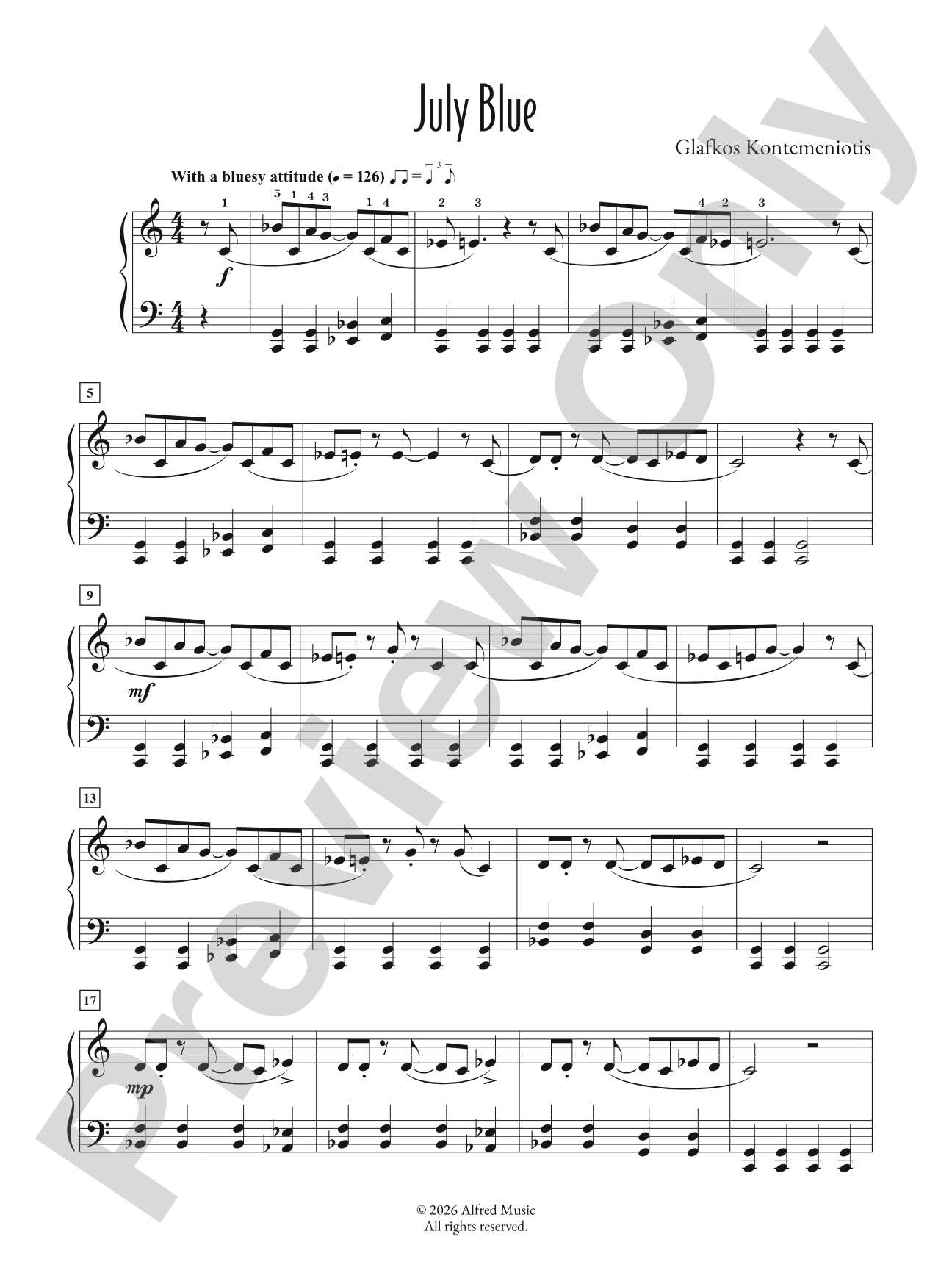
This rollicking, high-energy piece captures the carefree spirit of summer. With each return of the melody, small rhythmic and melodic variations create an improvisatory feel while offering students a variety of articulation and rhythmic patterns to explore.

July Blue: Piano isn't in MakeMusic Cloud just yet...but it could be. Let us know you'd like to see it, and you'll help shape what comes next. In the meantime, start a free trial and dive into thousands of interactive titles your students can play along with today.

Sample Audio
0:00
0:00
Sample Video
Additional Details
Series: Signature Series
SKU: 00-PS-0017767

More about this title

About the Composer: Glafkos Kontemeniotis

Glafkos Kontemeniotis

Glafkos Kontemeniotis is a pianist, composer, and arranger based in New York whose career spans jazz performance, classical training, and original composition. Born in Cyprus, he began musical studies young and discovered jazz in his early teens; after relocating to New York in 1988, he pursued formal training in classical piano with Paul Sheftel and jazz piano with Harold Danko at the Manhattan School of Music, later studying with renowned jazz educator Mike Longo and composer Anthony Branker. He holds a graduate degree in composition from Hunter College.

Kontemeniotis has performed at prestigious venues including the Blue Note, Iridium, Birdland, Alice Tully Hall, and universities such as Yale and Princeton. His discography includes the trio album Progress (2007), the all-original project Yugen (2019), collaborative free-improvisation recordings with bassist Fred Berman, and the 2023 trio release Places Gone featuring twelve new compositions. Critics have recognized him as "an under-recognized force of jazz to be reckoned with" and noted his work as "unmistakably personal," drawing from diverse musical and emotional experiences, including formative episodes from the 1974 war and displacement in Cyprus.

Why we love this

Kontemeniotis writes with a jazz musician's ear for spontaneity and variation, which makes this piece feel fresh and alive on repeated hearings rather than predictable. The built-in opportunities for different articulations and rhythmic interpretations give students agency in the performance, turning a "simple" melody into a vehicle for expressive choice.

What to expect

Summer warmth and movement captured in sound; the piece exudes carefree joy without requiring virtuosity. Each melodic return feels like a conversation with yourself, reimagining the same idea from a fresh angle, creating the loose, spontaneous quality of someone playing without a script.

Who it's for

Early intermediate pianists ready to move beyond static interpretations will thrive with this piece. It rewards students who can think actively about performance choices rather than simply executing notes, making it ideal for advancing players developing their own musical voice.

How to get the most out of it

  • Treat each return of the melody as a new statement. The variations Kontemeniotis provides are compositional gifts, not corrections; lean into them as intentional reimaginings rather than modifications.
  • Balance energy with clarity. The rollicking tempo can easily become muddy; stay crisp with articulation, especially during the rhythmic variations, so the improvisatory quality stays buoyant rather than frantic.
  • Listen to how the variations change the harmonic or melodic color. When you shift articulation or rhythmic placement, the same notes can feel playful or poignant; use this to shape the narrative arc across the piece.

How to use it

Pair this with other contemporary works by composers working in accessible, character-driven writing to showcase modern piano repertoire. It also works beautifully as a lighter moment in a recital, offering audiences music that's immediately engaging without demanding their full concentration.

Skills your students will build

  • Interpreting melodic variations and understanding compositional intent beyond the written notes
  • Controlling articulation changes (legato, staccato, accent) to shape phrasing
  • Balancing rhythmic independence when melody and accompaniment shift at different rates
  • Sustaining consistent energy and pulse through a moderately fast tempo with character changes

You May Also Like