
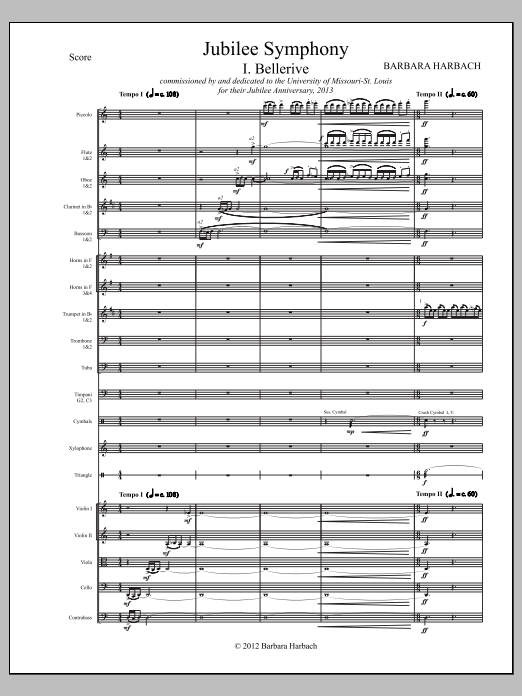

Jubilee Symphony: Full Orchestra Conductor Score & Parts
By Barbara Harbach
Item: 35-PK00291469
$30.50
Pickup currently not available
Buy Extra Parts (Digital PDF Download)
| Product | Price | Quantity |
|---|---|---|
| Jubilee Symphony - Piccolo | $2.45 | |
| Jubilee Symphony - F Horn | $2.45 | |
| Jubilee Symphony - F Horn | $2.60 | |
| Jubilee Symphony - Full Score | $11.00 | |
| Jubilee Symphony - Flute | $3.05 | |
| Jubilee Symphony - Oboe | $2.90 | |
| Jubilee Symphony - Clarinet | $3.05 | |
| Jubilee Symphony - Bassoon | $2.75 | |
| Jubilee Symphony - Trumpet | $2.75 | |
| Jubilee Symphony - Trombone | $2.60 | |
| Jubilee Symphony - Tuba | $2.60 | |
| Jubilee Symphony - Timpani | $2.45 | |
| Jubilee Symphony - Percussion | $3.35 | |
| Jubilee Symphony - Percussion | $6.35 | |
| Jubilee Symphony - Percussion | $2.90 | |
| Jubilee Symphony - Violin | $3.20 | |
| Jubilee Symphony - Violin | $3.20 | |
| Jubilee Symphony - Viola | $3.05 | |
| Jubilee Symphony - Violoncello | $3.20 | |
| Jubilee Symphony - Contrabass | $2.60 |
Parts Added to Cart!
Description
Commissioned for the Jubilee Anniversary of the University of Missouri-St. Louis. I-Bellerive, takes its name from the beautiful Bellerive Country Club which became the location for the university. A fugue evolves from these opening materials to become a conversation among the many partners that were needed to realize this dream. The euphoria of this actually happening is based on a lively jig before the rhythmic energy and melodies return. II. Mirth Day Fiesta showcases the many cultures and ethnicities. Dance-like rhythms and playful flourishes by the winds exhaust the revelers, returning to the quietness of the opening, but the seductive rhythms and melodies draw the dancers into merriment once again. III. Tritons Ascending returns to the sea, beginning dark and mysterious slowly rising, the melodies lead to the engaging fugue.
Duration: 14:00


Jubilee Symphony: Full Orchestra Conductor Score & Parts isn't in MakeMusic Cloud just yet...but it could be. Let us know you'd like to see it, and you'll help shape what comes next. In the meantime, start a free trial and dive into thousands of interactive titles your students can play along with today.
Request This Title
Tell us you want it.
Start Your Free Trial
Explore everything that's ready to play right now.
Sample Audio
No sample audio found.
Sample Video
No sample videos found.
Additional Details
Publisher:
Hal Leonard
SKU:
35-PK00291469
More about this title
About the Composer: Barbara Harbach
Barbara Harbach is a prolific composer whose orchestral works span symphonic, chamber, and educational settings. Her compositional voice combines structural clarity with vivid programmatic storytelling, often drawing inspiration from place and community. Harbach's commissions for universities and performing ensembles demonstrate her ability to craft music that honors specific histories while remaining musically substantial and engaging for performers of varied levels.
Why we love this
Harbach writes orchestral music that balances genuine craftsmanship with theatrical flair. Each movement serves a distinct dramatic purpose, giving your orchestra clear narrative anchors while the contrapuntal writing in both fugues provides rewarding challenges for ensemble precision and textural clarity.
What to expect
Jubilee Symphony captures institutional pride through musical color and motion. Spirited fugal conversations give way to celebratory dance rhythms and cultural diversity, then descend into primordial mystery before ascending toward light and affirmation.
Who it's for
Orchestras seeking a substantial work that combines musical substance with programmatic engagement. The three-movement structure and clear narrative arc make this compelling for university ensembles and community orchestras looking to program something beyond standard repertoire while still maintaining accessible orchestration.
How to get the most out of it
- Balance the contrapuntal texture in the Bellerive fugue by bringing out individual instrumental voices gradually as they enter; this clarifies the architecture for both players and listeners.
- The rhythmic precision required in Mirth Day Fiesta benefits from sectional rehearsals that isolate each ethnic flavor before combining them into the full texture.
- Shape the opening mystery of Tritons Ascending with soft dynamics and restrained vibrato in the strings; this foundation makes the subsequent rise more dramatically effective.
How to use it
Consider this as a centerpiece for a concert celebrating university history or community partnership. Its three distinct movements allow programming flexibility; the work functions as a unified whole or can anchor a concert themed around dance, cultural fusion, or sea imagery.
Skills your students will build
- Sustaining independent melodic lines within dense contrapuntal textures
- Interpreting programmatic intent through dynamic and tonal shaping
- Coordinating rhythmic precision across sections during syncopated and polyrhythmic passages
- Balancing sectional roles during fugal writing where the same material passes between instrument families