Jubilee Stomp: Piano Digital Sheet Music

Jubilee Stomp: Piano Digital Sheet Music

Duke Ellington

Item: 00-PS-0008194

Digital Download
$2.95
Description

Jubilee Stomp: Piano Digital Sheet Music isn't in MakeMusic Cloud just yet...but it could be. Let us know you'd like to see it, and you'll help shape what comes next. In the meantime, start a free trial and dive into thousands of interactive titles your students can play along with today.

Sample Audio
No sample audio found.
Sample Video
Additional Details
SKU: 00-PS-0008194

More about this title

About the Artist: Duke Ellington

Duke Ellington (1899-1974) was a bandleader, composer, and pianist whose output shaped American music across seven decades. He wrote over a thousand compositions, from extended concert works to memorable standards, and his band served as a laboratory for harmonic innovation and instrumental color. His influence on jazz pedagogy remains direct: educators teach his orchestrations to show how arranging deepens ensemble sound, and pianists study his compositions to understand stride technique, reharmonization, and rhythmic sophistication.

Why we love this

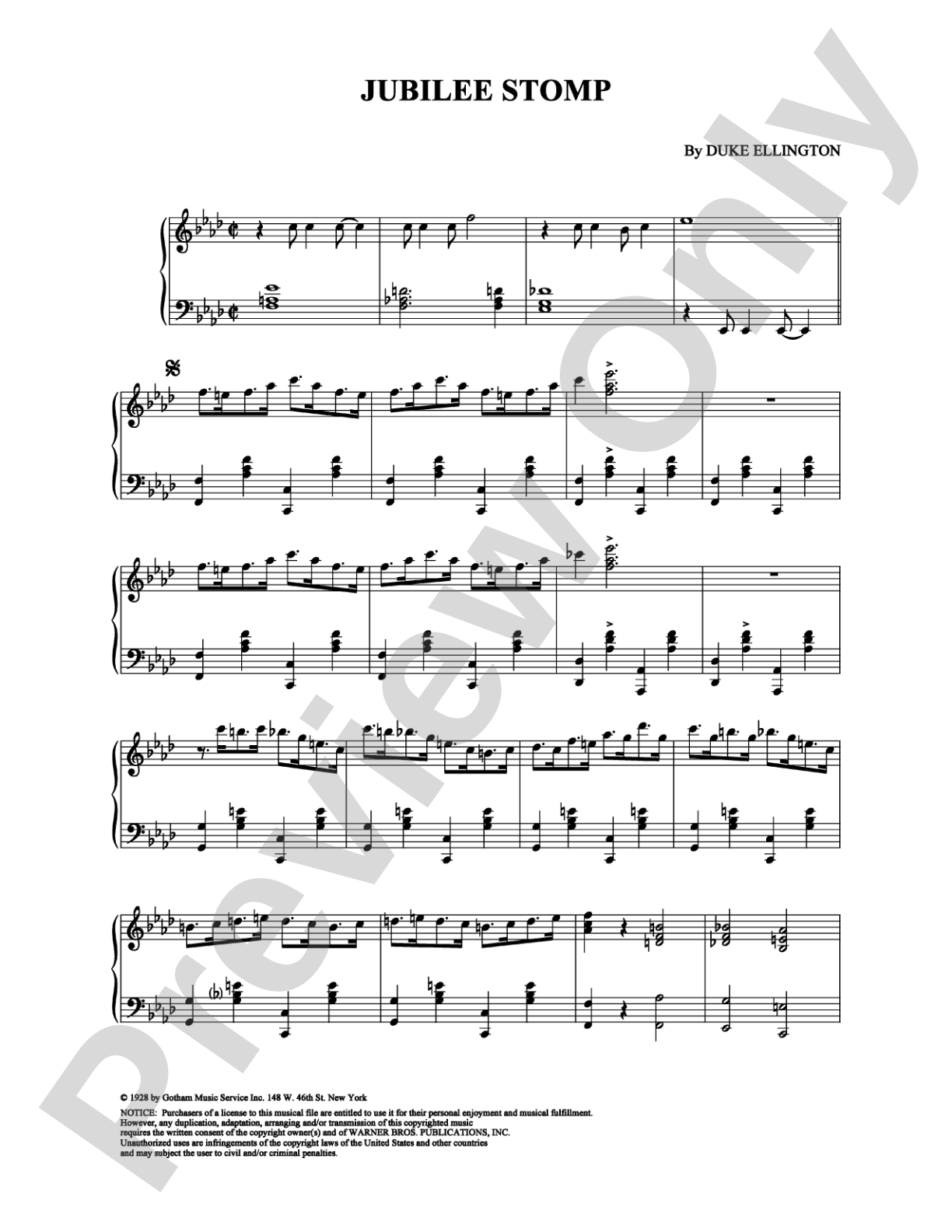
Jubilee Stomp captures Ellington's gift for writing piano music that swings without requiring virtuosity beyond the reach of accomplished secondary students. The piece balances stride patterns and syncopation in ways that reveal how jazz pianists think harmonically, making it genuinely instructive rather than merely flashy. Programming it signals that your piano students are studying composition and performance on equal terms.

What to expect

A spring in the step, full of character and swagger without pretension. The stomp pulses with the rhythm section energy of Ellington's orchestra reduced to two hands, and the melody sits comfortably in the pocket, inviting the player to relax into the groove rather than fight against it.

Who it's for

Jazz pianists who have moved beyond basic blues changes and are ready to explore how a master composer structures a complete piece within traditional popular song form. Secondary and early college-level pianists benefit from its combination of technical accessibility and sophisticated harmonic language. Solo pianists preparing for jazz recitals or accompanying ensemble performances will find material that sounds complete and substantial in any setting.

How to get the most out of it

  • Lock into a steady swing feel rather than playing straight eighths; let the rhythmic bounce emerge naturally from the syncopation, especially in the accompaniment figures.
  • Differentiate the melody from the stride pattern by bringing out the tune while keeping the left hand groove consistent and relaxed.
  • Listen closely to the harmonic movement beneath the surface; Ellington's chord changes reward intentional voicing choices that shape phrasing.
  • Approach the tempo as a conversation between precision and pocket, not as a race; the stomp lands harder when the time feel is grounded.

How to use it

Present this as a solo feature in a jazz or pops concert, or pair it with other stride-based or swing-era piano works to show how the language of jazz piano evolved. It works equally well as a recital piece for an accomplished young pianist or as a teaching demonstration when you want students to hear how professional composers write for their own instrument.

Skills your students will build

  • Swing feel and rhythmic precision in syncopated contexts
  • Left-hand stride technique and independence from the melody
  • Reading and executing jazz articulations and dynamic shadings
  • Understanding harmonic movement and voice leading in jazz idiom
  • Balancing written sophistication with performable clarity

You May Also Like