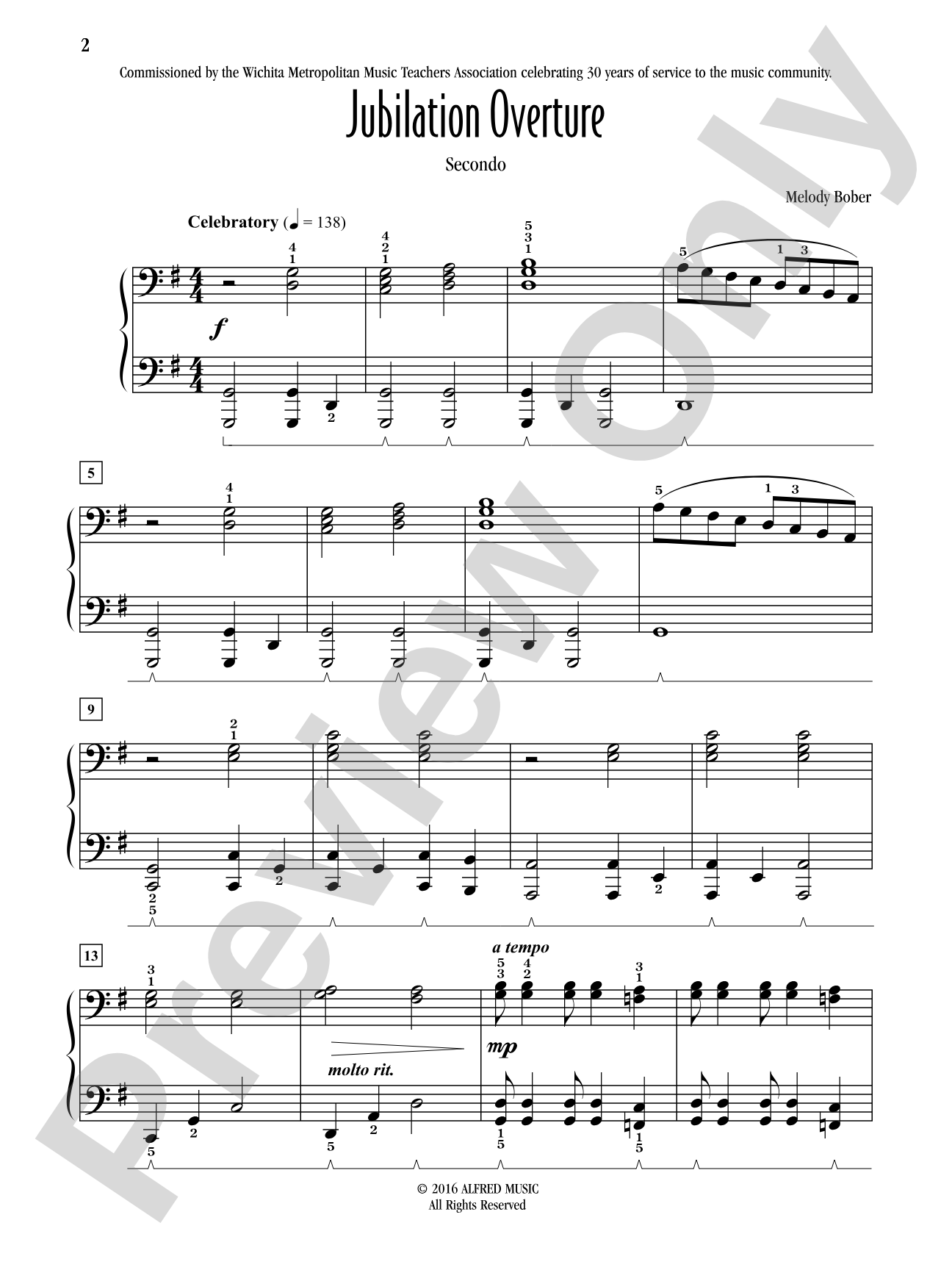
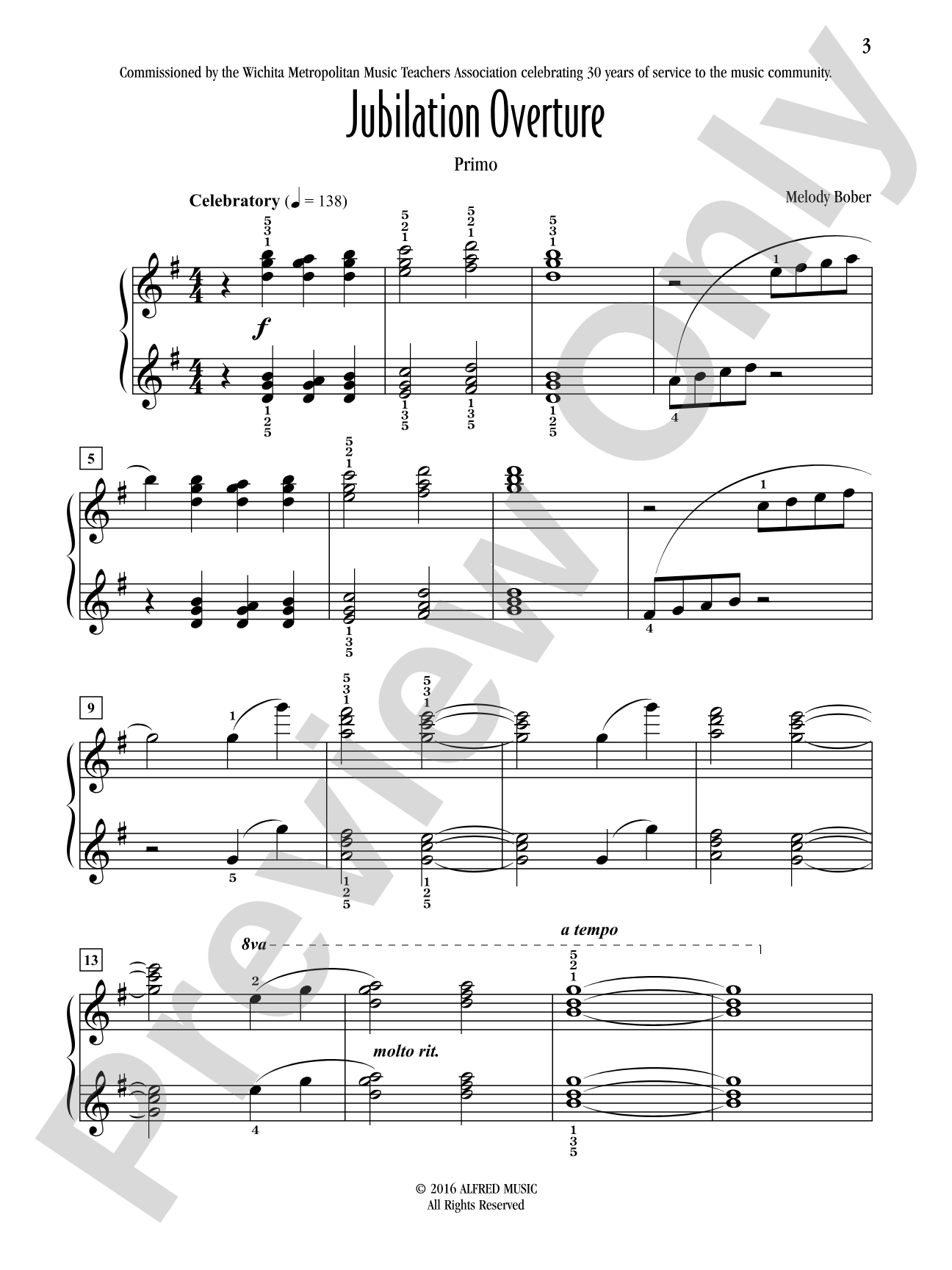
Jubilation Overture - Piano Duet (1 Piano, 4 Hands) Sheet Music Preview

Jubilation Overture - Piano Duet (1 Piano, 4 Hands): Piano Duets & Four Hands

By Melody Bober

Level: Intermediate

Item: 00-PB-0000678

Digital Download
$5.99
Description
Commissioned by the Wichita Metropolitan Music Teachers Association, this intermediate-level duet celebrates their 30 years of service to the music community. Written in A-B-A form, the introduction to the A section features chords and scale figures that introduce a lyrical melody over a syncopated accompaniment. The B section in a contrasting key continues the lyrical ideas. In both sections, melodies are divided between the primo and secondo. A Federation Festivals 2020-2024 selection. A Federation Festivals 2024-2028 selection.

Jubilation Overture - Piano Duet (1 Piano, 4 Hands): Piano Duets & Four Hands isn't in MakeMusic Cloud just yet...but it could be. Let us know you'd like to see it, and you'll help shape what comes next. In the meantime, start a free trial and dive into thousands of interactive titles your students can play along with today.

Sample Audio
No sample audio found.
Sample Video
Additional Details
Series: The Alfred Duet Series
Publisher: Alfred Music
Page Count: 12
SKU: 00-PB-0000678

More about this title

About the Composer: Melody Bober

Melody Bober

Melody Bober's compositional voice emerges from two decades of classroom teaching, private studio instruction, and church music work. She holds degrees in music education from the University of Illinois at Champaign-Urbana and in piano performance from Minnesota State University, Moorhead, where she studied under respected mentors including Joel Shapiro and Andrew Froelich.

Known for creating pieces that deepen students' connection to music, Bober brings both pedagogical insight and performance experience to her writing. She regularly conducts clinics and workshops for piano teachers nationwide and serves as an active accompanist and church music director. Her work balances accessibility with musical substance, a quality earned through years spent in the practice studio and rehearsal hall.

Why we love this

Jubilation Overture demonstrates what happens when a composer understands the specific needs of duet playing. The division of melody between primo and secondo keeps both hands engaged and invested rather than relegating one partner to accompaniment duty. The syncopated figures and contrasting B section provide enough textural variety to keep intermediate players attentive across twelve pages.

What to expect

Jubilation Overture celebrates with genuine warmth rather than bombast. The lyrical melodies float across familiar harmonic territory, while syncopated rhythms underneath create gentle forward momentum. There's a sense of occasion here, fitting for a work commissioned to honor a music teachers association.

Who it's for

Intermediate piano students who are ready to engage with duet literature that demands musicianship alongside technical facility. This works equally well for student pairs seeking meaningful collaborative repertoire and for teacher-student performance partnerships.

How to get the most out of it

  • Balance the syncopated accompaniment figures so they support rather than overshadow the lyrical material. Both parts deserve to sing, even when one plays rhythmic support.
  • Establish the tempo during the introductory section so the chords and scale figures feel purposeful rather than rushed. This foundation steadies the meter for everything that follows.
  • Listen across the keyboard when melodies trade between primo and secondo. The handoff should feel seamless, as though one voice continues unbroken.

How to use it

Consider this for studio recitals where intermediate students showcase duet work, or as a concert opener when you want something that's both accessible and substantial. It also serves as strong material for the Federation Festivals selections it carries, allowing students to build a polished performance across multiple playing opportunities.

Skills your students will build

  • Balancing melody and accompaniment across four hands
  • Executing syncopated rhythms with precision
  • Tracking independent melodic lines in A-B-A form
  • Collaborating with a partner to shape phrase direction
  • Navigating key changes between contrasting sections

You May Also Like