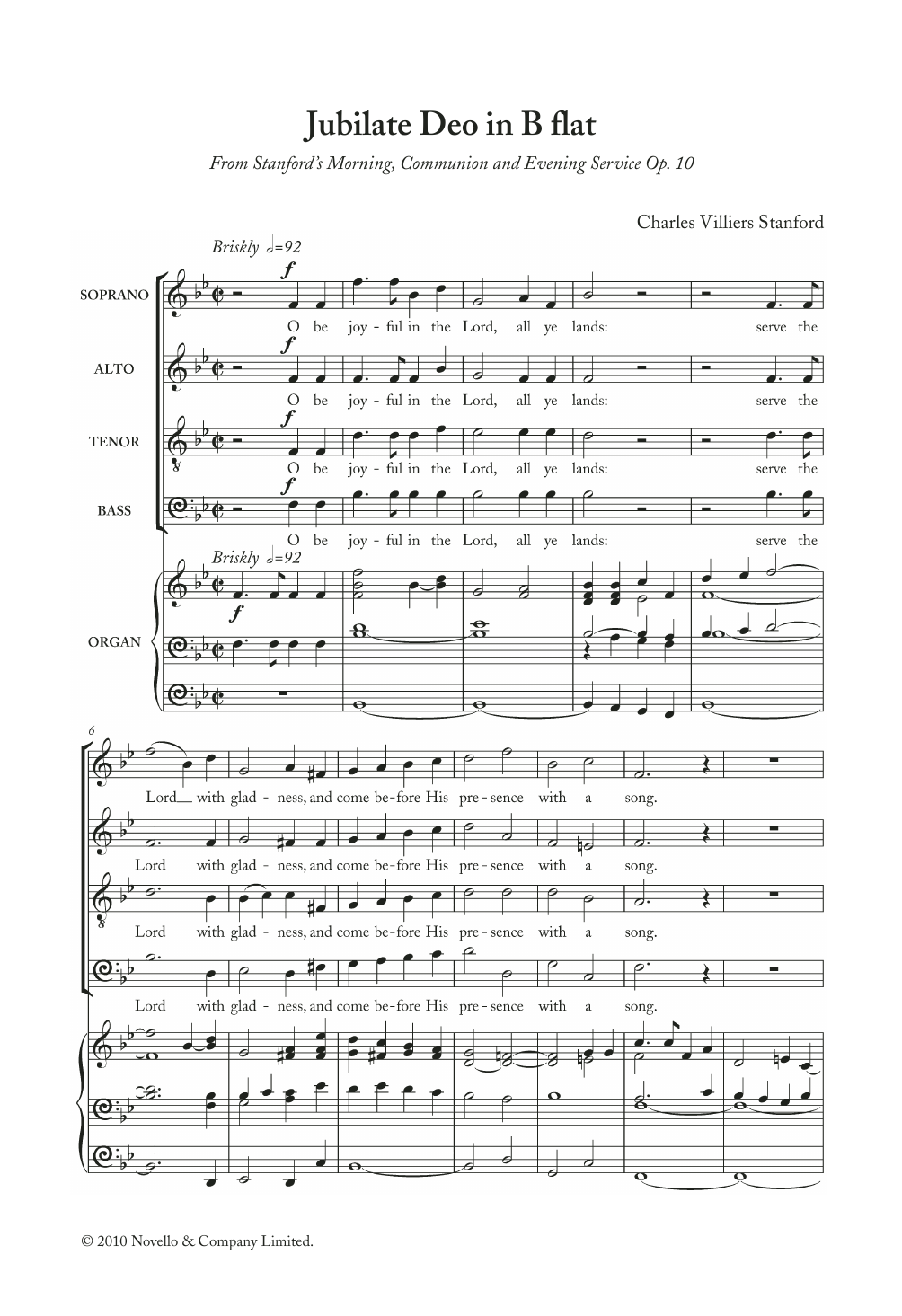
Jubilate Deo In B Flat, Op. 10 Sheet Music Preview

Jubilate Deo In B Flat, Op. 10: Choral Octavo

By Charles Villiers Stanford

Item: 35-DS00339749

Digital Download
$2.99
Description

Jubilate Deo In B Flat, Op. 10: Choral Octavo isn't in MakeMusic Cloud just yet...but it could be. Let us know you'd like to see it, and you'll help shape what comes next. In the meantime, start a free trial and dive into thousands of interactive titles your students can play along with today.

Sample Audio
No sample audio found.
Sample Video
Additional Details
Publisher: Hal Leonard
Page Count: 8
SKU: 35-DS00339749

More about this title

About the Composer: Charles Villiers Stanford

Charles Villiers Stanford (1852-1924) was a towering figure in English musical life, equally commanding as composer, conductor, and pedagogue. His tenure at Cambridge University shaped generations of British musicians, while his prolific output across symphonies, operas, and choral works established him as a central voice in late Romantic music. Stanford's gift for vocal writing earned him particular esteem; his understanding of the human voice and choral sonority remains unmatched among his contemporaries.

Why we love this

Stanford's choral writing balances accessibility with genuine sophistication, and this octavo demonstrates both qualities in abundance. The piece sits comfortably in most amateur voices while maintaining the harmonic interest and structural integrity that makes Stanford's work endure in the repertoire. Directors benefit from his economical use of resources; the piece delivers impressive results without demanding virtuosic soloists or elaborate staging.

What to expect

The piece unfolds with a sense of purposeful joy and jubilation grounded in restraint. Stanford's harmonic language lends a luminous quality to the text, creating moments of genuine uplift that never tip into sentimentality.

Who it's for

This octavo works for mixed choirs at the intermediate to advanced amateur level and university ensembles seeking elegant secular repertoire. It suits programs that value Romantic-era craftsmanship and choral writing that rewards focused rehearsal without excessive technical demands.

How to get the most out of it

  • Shape each phrase as a small arc rather than driving relentlessly forward; Stanford's phrasing rewards gentleness and careful dynamic tapering.
  • Balance the upper voices with precision during homophonic passages so text clarity emerges without sacrificing blend.
  • Attend to the harmonic rhythm in slower sections; resist the urge to rush, allowing Stanford's voice leading to speak.

How to use it

Program this as a centerpiece on a concert devoted to Stanford or late Romantic British choral music, or pair it with lighter secular fare for a varied concert arc. The piece also works as an excellent teaching vehicle for developing ensemble singers' sensitivity to harmonic color and phrase architecture.

Skills your students will build

  • Sustaining blend while navigating chromatic harmony
  • Sensitivity to text underlay and natural speech rhythm
  • Balancing individual voice lines within four-part counterpoint
  • Dynamic control in sustained passages
  • Reading and executing period-appropriate phrasing in Romantic idiom

You May Also Like