Jubilate Deo Sheet Music Preview

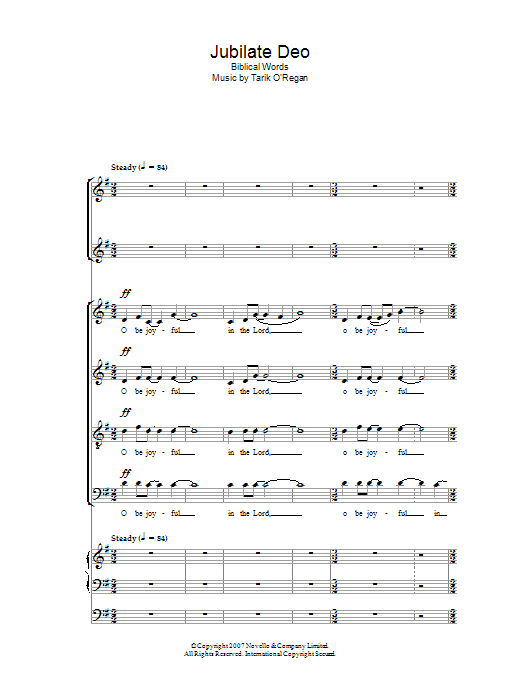
Jubilate Deo: Choral Octavo

As performed by Tarik O'Regan

Item: 35-DS00243049

Digital Download
$2.99
Description

Jubilate Deo: Choral Octavo isn't in MakeMusic Cloud just yet...but it could be. Let us know you'd like to see it, and you'll help shape what comes next. In the meantime, start a free trial and dive into thousands of interactive titles your students can play along with today.

Sample Audio
No sample audio found.
Sample Video
Additional Details
Publisher: Hal Leonard
Page Count: 29
SKU: 35-DS00243049

More about this title

About the Artist: Tarik O'Regan

Tarik O'Regan is a British composer whose choral writing has earned recognition across concert halls and educational venues. His works balance lyrical accessibility with thoughtful harmonic language, creating pieces that engage singers while respecting their musicality and range.

Why we love this

O'Regan's setting avoids the predictable rhetorical gestures that often accompany sacred Latin texts, instead building something more intimate and meditative. The scoring sits comfortably for mixed voices while still offering harmonic richness that rewards careful voicing and breath control.

What to expect

The piece breathes with contemplative warmth. Rather than jubilation as outward celebration, O'Regan explores it as an inward turning toward light and gratitude. The harmonic language is modern without being austere, creating moments of genuine luminosity within a carefully controlled sonic palette.

Who it's for

This work suits intermediate to advanced mixed choirs looking to expand beyond the most familiar choral repertoire. Directors seeking a meditation on joy that neither simplifies nor overwhelms singers will find this a natural fit for concert or sacred programming.

How to get the most out of it

  • Shape the text in phrases rather than measures; let the Latin prosody guide your rubato and phrasing decisions.
  • Balance blend across the parts by isolating each voice section on its entrance and checking intonation without accompaniment.
  • Mark breath points in rehearsal that honor both musical line and textual meaning, avoiding cuts that would fragment a phrase.
  • Listen for moments where parts move in contrary motion; these create transparency and should be conducted with clarity to prevent rhythmic drift.

How to use it

Pair this as the centerpiece of a concert exploring contemporary settings of Latin texts, or program it as a reflective moment between more extroverted works. Its moderate length and performance requirements make it an intelligent choice for spring concert programming when both rehearsal time and energy reserves run thin.

Skills your students will build

  • Navigating contemporary harmonic language with confidence
  • Sustaining legit tone across extended melodic lines
  • Balancing independence in voice parts with ensemble cohesion
  • Interpreting text through compositional detail rather than conventional interpretation
  • Managing ensemble blend across shifting harmonic densities

You May Also Like