Juba: Dance from the Suite In the Bottoms - Piano Solo Sheet Music Preview

Juba: Dance from the Suite In the Bottoms - Piano Solo: Piano

By R. Nathaniel Dett

Level: Late Intermediate

Item: 00-PB-0000809

Digital Download
$4.99
Description
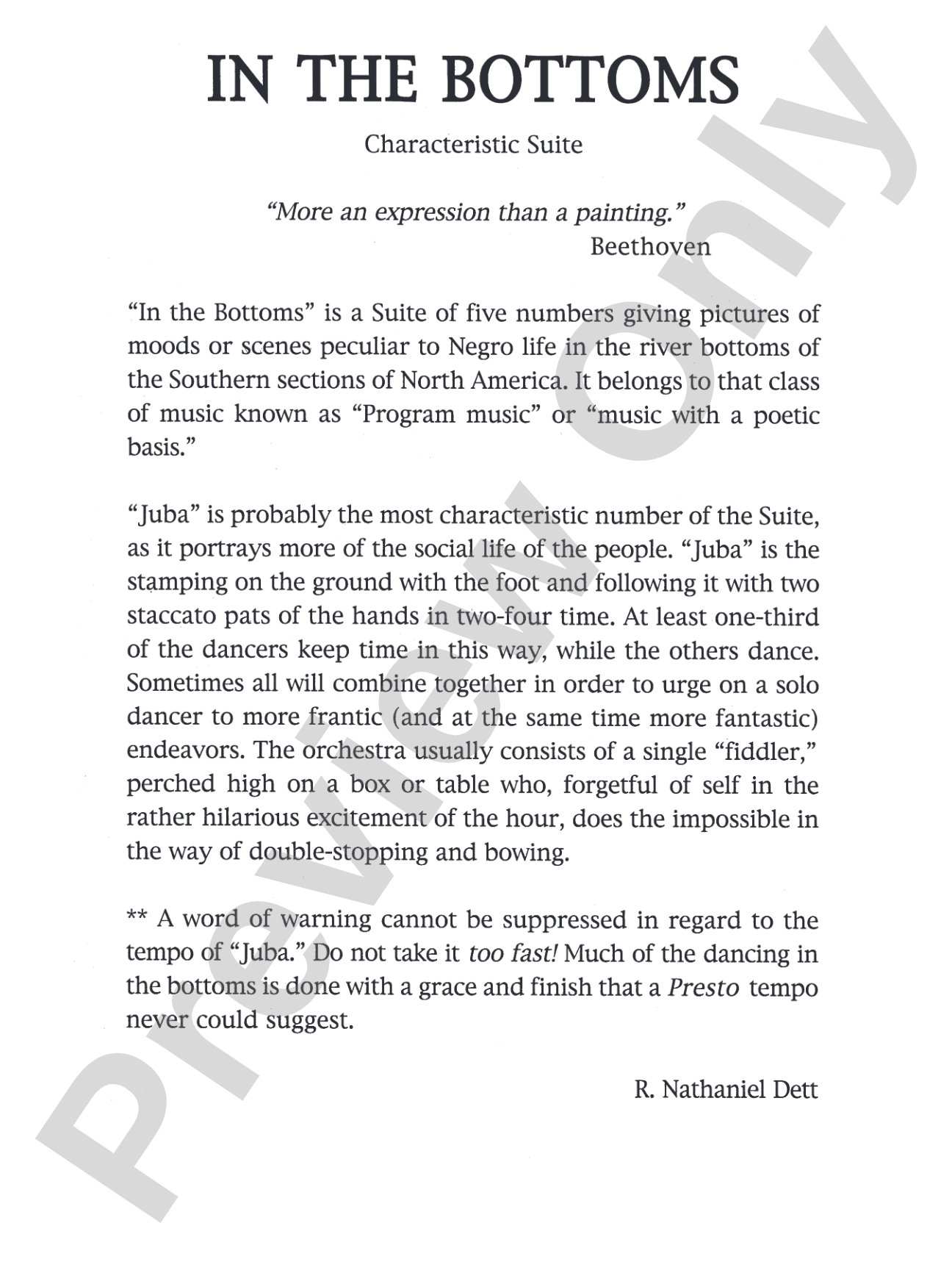
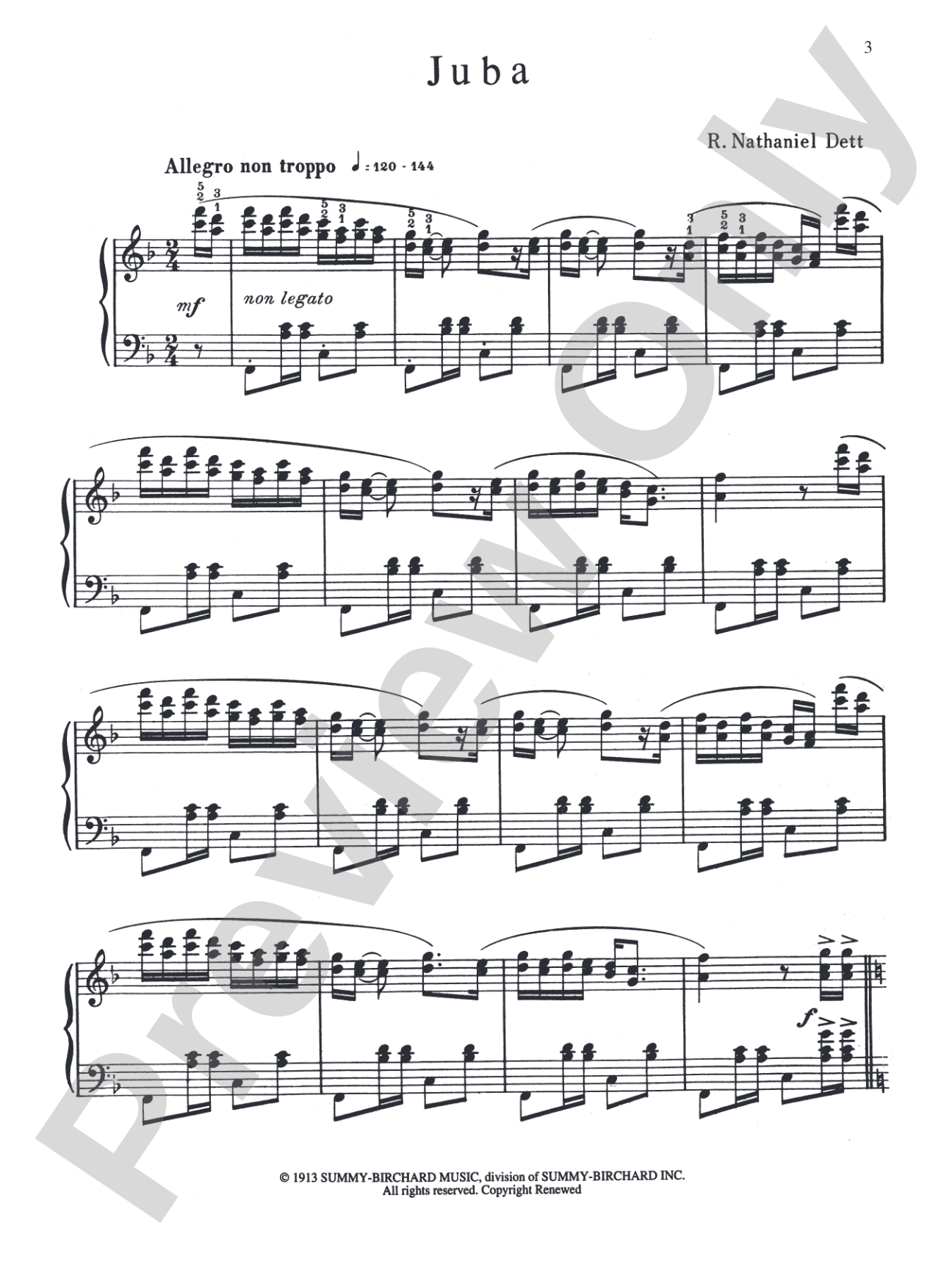
'Juba' is one of the earliest and possibly best compositions by R. Nathaniel Dett. Majoring in composition and piano at Oberlin, in 1908, Dett was the first black person to earn a Bachelor of Music degree. A few years later he received a masters from Eastman, then honorary Doctorates from both Oberlin and Howard University. Most of Dett's music-writing and music-making was devoted to the music of his people. 'Juba' is the result of a well-schooled composer making effective use of elements of ragtime. A crowd-pleaser. A Federation Festivals 2016-2020 selection.

Juba: Dance from the Suite In the Bottoms - Piano Solo: Piano isn't in MakeMusic Cloud just yet...but it could be. Let us know you'd like to see it, and you'll help shape what comes next. In the meantime, start a free trial and dive into thousands of interactive titles your students can play along with today.

Sample Audio
No sample audio found.
Sample Video
Additional Details
Publisher: Alfred Music
Page Count: 8
SKU: 00-PB-0000809

More about this title

About the Composer: R. Nathaniel Dett

R. Nathaniel Dett was a composer and pianist who broke significant barriers in American music education. In 1908, he became the first Black person to earn a Bachelor of Music degree, completing his studies in composition and piano at Oberlin Conservatory. He went on to earn a master's degree from Eastman School of Music and received honorary doctorates from both Oberlin and Howard University.

Dett's artistic mission centered on elevating and celebrating the musical traditions of African Americans. He drew deeply from spirituals, folk idioms, and popular forms of his time, synthesizing them into concert works that honored their roots while demonstrating sophisticated compositional craft. His legacy extends far beyond his own performances; his music remains essential repertoire for pianists exploring the rich contributions of Black composers to American classical music.

Why we love this

Dett wrote this piece with both craft and accessibility in mind. He knew ragtime idioms intimately and deployed them not as novelty but as legitimate musical material in the hands of a trained composer. The result feels both historically rooted and immediately engaging—the kind of work that reminds students why they fell in love with music in the first place.

What to expect

Juba captures the energy and joy of a gathering—the interplay between a spirited melody and a supporting groove that feels both spontaneous and finely controlled. There's a warmth and accessibility to the writing that never sacrifices harmonic or rhythmic sophistication.

Who it's for

This piece suits late intermediate pianists ready to engage with American vernacular forms in a classical context. It works equally well for students exploring African American musical heritage and for those building comfort with syncopation and stride accompaniment patterns.

How to get the most out of it

  • Approach the ragtime rhythms with precision and clarity rather than rushing. Crisp articulation in the accompaniment figures will let the melody sing through without muddying the texture.
  • Balance the syncopated lines between the hands carefully; the offbeat figures can easily overwhelm the main voice if not regulated with dynamic control.
  • Listen for the stride patterns and maintain a steady, unhurried pulse. Ragtime sounds best when the groove is relaxed, not frantic.

How to use it

Program this in a recital alongside other American piano works to anchor a thematic set exploring American idioms and voices. It also serves beautifully as a bridge between classical technique and jazz-inflected repertoire, making it ideal for students preparing festival or competition programs.

Skills your students will build

  • Playing ragtime stride accompaniment patterns with rhythmic precision
  • Balancing syncopated melody against accompanying figures
  • Controlling tempo and articulation to maintain groove without rushing
  • Understanding how vernacular forms function in concert music

You May Also Like