Joyful Variations: 4th F Horn Sheet Music Preview

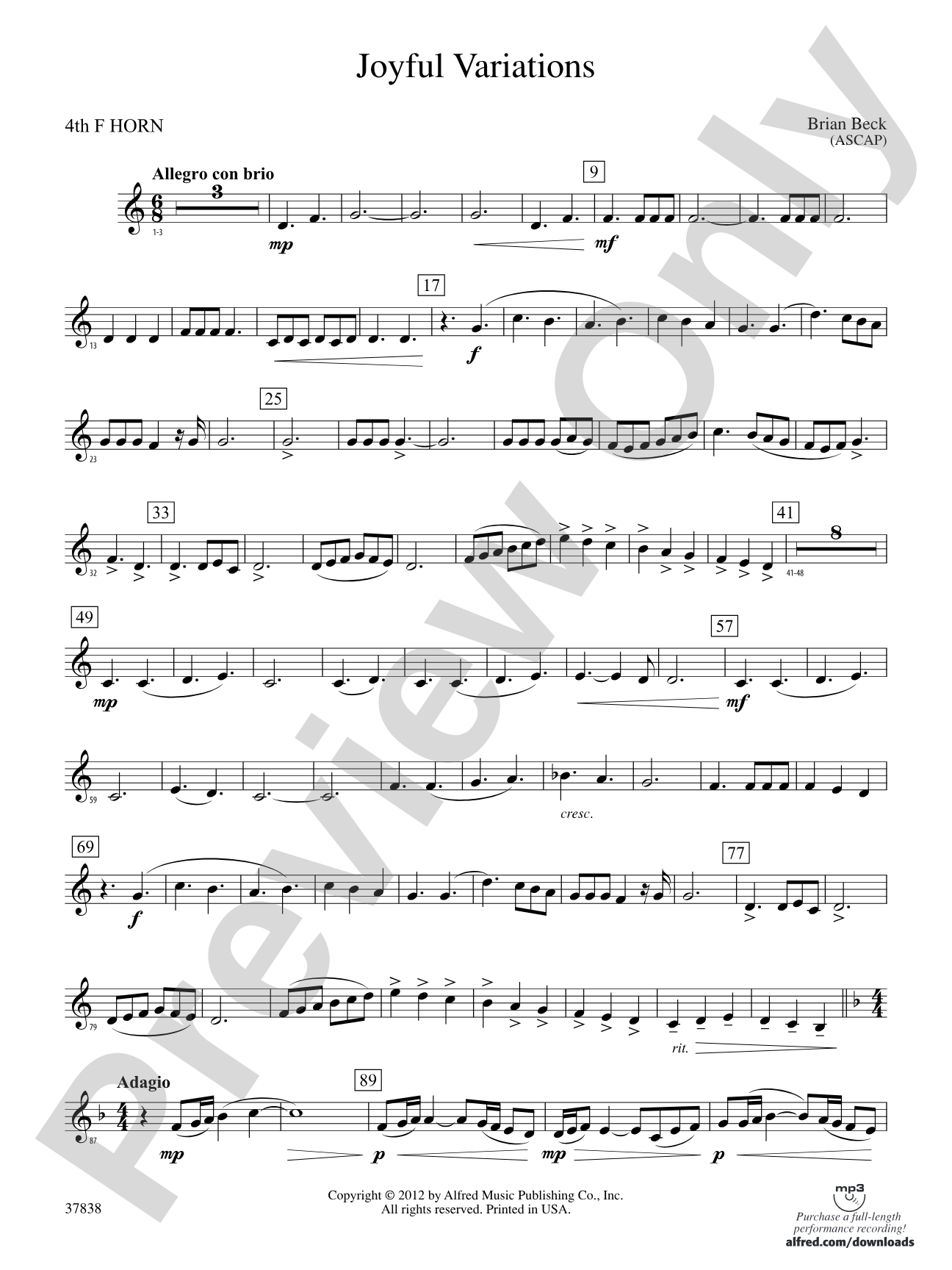
Joyful Variations: 4th F Horn

Based on Beethoven's "Ode to Joy"

By Brian Beck

Grade: 3.5 (Medium)

Item: 00-PC-0015367_H4

Digital Download
$3.00
Description
The grandeur and beauty of "Joyful Variations" takes the listener on a journey through one of the most famous melodies ever written---Beethoven's theme from Symphony No. 9. Noble fanfares open and close these variations, set in ternary form, while sweeping renditions of the theme provide color and lyricism in a contrasting Adagio section. An excellent piece to open or close any concert! This title is available in MakeMusic Cloud.

Don't just read it, hear it, play along with it, and watch your students grow with it. In MakeMusic Cloud, Joyful Variations: 4th F Horn comes alive with professional accompaniment, adjustable tempo, and built-in practice tools that turn solo practice into real progress.

Sample Audio
0:00
0:00
Sample Video
Additional Details
Series: Alfred Concert Band
Publisher: Alfred Music
Page Count: 272
SKU: 00-PC-0015367_H4

More about this title

About the Composer: Brian Beck

Brian Beck

Brian Beck is a composer and arranger whose concert band and choral works have appeared at TMEA Honor Band concerts, Midwest clinics, and UIL state competitions. His music has earned recognition as a Reviewer's Choice selection and been featured in Teaching Music Through Performance In Band and on numerous prescribed music lists across Texas, Ohio, Florida, and the Pacific Northwest.

Beck's experience as a band director at both middle and high school levels informs his compositional voice. He holds degrees in music education from Texas A&M University-Commerce and the University of Houston. Ensembles under his direction have earned consistent Superior ratings at UIL contests, appeared at the Midwest Band and Orchestra Clinic, and competed as finalists in the TMEA State Honor Band competition.

Why we love this

Beck's treatment of Beethoven's familiar melody avoids the obvious and instead builds genuine drama through the architectural clarity of ternary form. The noble fanfare framing and contrasting Adagio section give your band room to explore both virtuosic brilliance and genuine lyricism, making this equally compelling as a concert opener or closer depending on how you shape the pacing and dynamics.

What to expect

Stately and ceremonial from the first measure, with the opening fanfare establishing a sense of occasion. The Adagio section softens this formality into genuine warmth, allowing the famous theme to sing with elegance before the closing fanfare restores the initial grandeur.

Who it's for

Grade 3.5 bands with solid fundamentals and the ability to sustain broad phrasing across multiple textures. This score rewards ensembles ready to project confidence in fanfare writing while managing the control needed for lyrical passages.

How to get the most out of it

  • Balance the opening fanfare so the brass declare confidently without overwhelming the ensemble; the nobility comes from unified articulation and voicing, not sheer volume.
  • Shape the Adagio section with real breath, allowing the lyrical restatement of the theme to bloom. Resist the urge to hurry; let the sweeping quality emerge from sustained, connected phrasing.
  • Prepare the closing fanfare as a mirror to the opening. If you establish a particular character and tempo in measure one, return to that clarity at the end for structural satisfaction.
  • Use sectional rehearsals to isolate the transition into and out of the Adagio. Most bands stumble in the shift between character and tempo; lock this early and your overall performance gains coherence.

How to use it

Position this as your concert opener to set a formal, engaging tone immediately, or close your program with it to send the audience out on a note of triumph. It also works effectively in a contest or festival setting where you need a piece that demonstrates both technical precision and musical maturity without excessive length.

Skills your students will build

  • Conducting ternary form and major structural transitions
  • Balancing homophonic fanfare writing across the full ensemble
  • Sustaining legit phrasing in slow, lyrical sections
  • Achieving tonal blend and release precision in closing statements

You May Also Like