
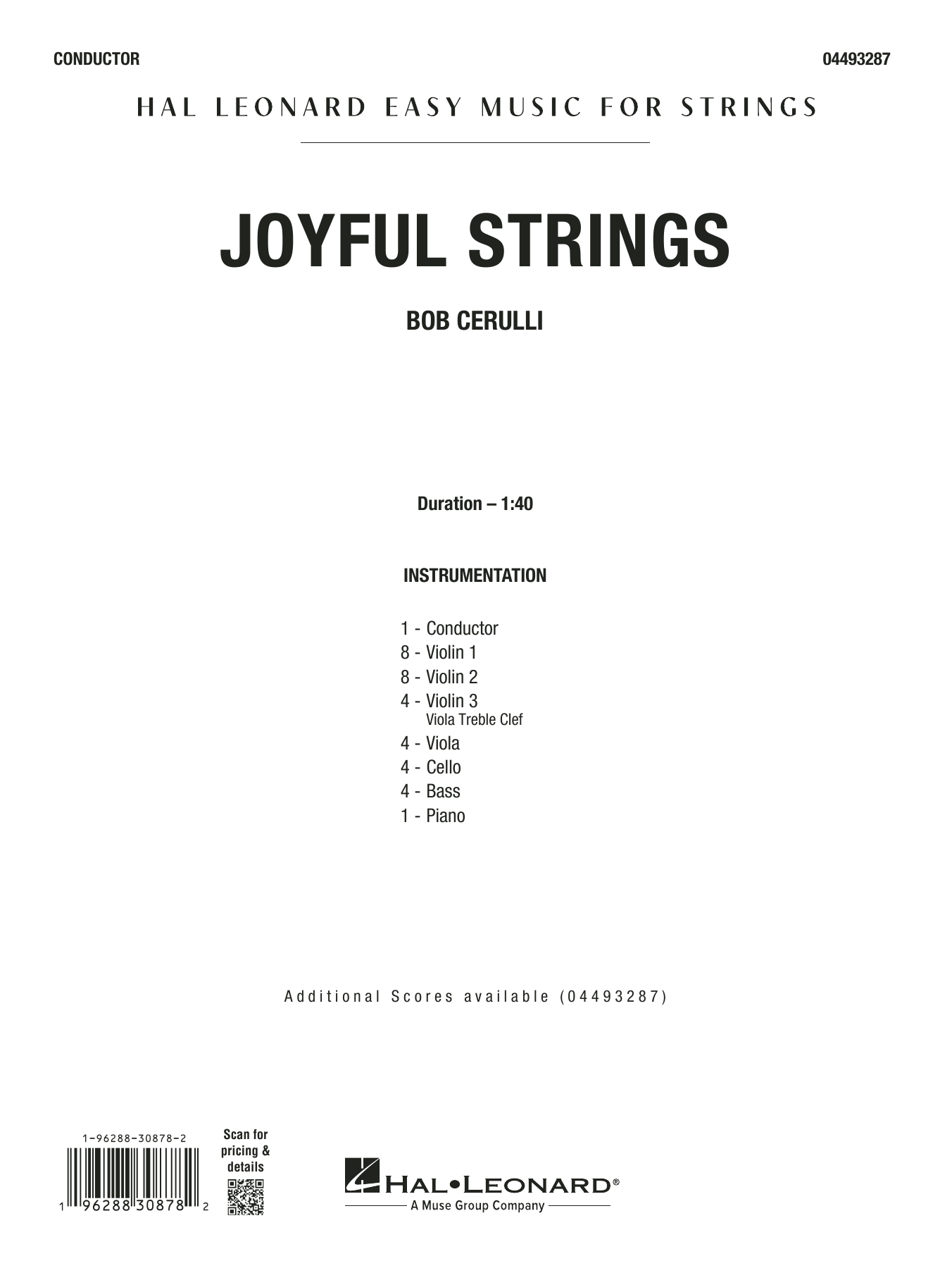

Joyful Strings: String Orchestra Conductor Score & Parts
By Bob Cerulli
Grade: 2
Item: 35-PK01597988
$60.00
Pickup currently not available
Buy Extra Parts (Digital PDF Download)
| Product | Price | Quantity |
|---|---|---|
| Joyful Strings - Conductor Score (Full Score) | $7.50 | |
| Joyful Strings - Violin 1 | $7.00 | |
| Joyful Strings - Violin 2 | $7.00 | |
| Joyful Strings - Violin 3 (Viola Treble Clef) | $7.00 | |
| Joyful Strings - Viola | $7.00 | |
| Joyful Strings - Cello | $7.00 | |
| Joyful Strings - Bass | $7.00 | |
| Joyful Strings - Piano | $7.00 |
Parts Added to Cart!
Description
A happy and playful melody in G major sets the tone for this fun, original work that reinforces staccato, dynamics and pizzicato. All sections get a turn at the "joyful" tune.


Joyful Strings: String Orchestra Conductor Score & Parts isn't in MakeMusic Cloud just yet...but it could be. Let us know you'd like to see it, and you'll help shape what comes next. In the meantime, start a free trial and dive into thousands of interactive titles your students can play along with today.
Request This Title
Tell us you want it.
Start Your Free Trial
Explore everything that's ready to play right now.
Sample Audio
No sample audio found.
Sample Video
No sample videos found.
Additional Details
Publisher:
Hal Leonard
SKU:
35-PK01597988
More about this title
About the Composer: Bob Cerulli

Bob Cerulli's path through music spans performance, composition, and education in equal measure. After training at the Curtis Institute under Roger Scott and earning degrees in music education and conducting, he built a career as Principal Bass for multiple regional orchestras while freelancing extensively in Philadelphia and Atlantic City. He performed alongside Henry Mancini, Luciano Pavarotti, and Andrea Bocelli, and his own compositions have been championed by major ensembles; The Philadelphia Orchestra performed his work Celebration, and Principal Cellist William Stokking premiered his Romance in D Major.
For nearly three decades, Cerulli shaped young musicians as a public school music teacher. He now serves as Senior Adjunct Professor at Rowan College at Burlington County and continues to conduct orchestral reading sessions at regional festivals, bringing both artistic depth and pedagogical insight to his compositions for developing musicians.
Why we love this
A composer who spent 29 years in the classroom wrote this piece, and it shows. Cerulli delivers genuine musical substance without overcomplicating it; the G major tonality sits comfortably on young strings, while the scoring ensures every section gets the spotlight rather than clustering all the fun in the first violins. The balance of technical reinforcement (staccato, dynamics, pizzicato) with sheer musical joy makes this one of those pieces students actually want to play again.
What to expect
Bright, unpretentious, and genuinely cheerful without veering into saccharine. The melody bounces forward with an almost conversational ease, and the mix of pizzicato moments, dynamic shaping, and staccato passages gives the piece rhythmic buoyancy and color.
Who it's for
String orchestras in grades 2 through early intermediate, particularly those ready to move beyond basic rhythmic patterns into genuine stylistic work. Directors seeking a piece that teaches fundamental techniques while keeping students engaged will find this especially useful.
How to get the most out of it
- Establish the character from the opening attack. Crisp staccato articulation in the opening sections sets the playful tone; ask students to think of the bow bouncing rather than just shortening the note.
- Shape the phrase through dynamic changes rather than tempo shifts. Let each section's entrance of the 'joyful' tune breathe and swell naturally, which keeps forward momentum while building contrast.
- Balance pizzicato passages cleanly by having students anchor their left hand position before plucking. Inconsistent hand placement during pizzicato tends to blur both tone and rhythm in young ensembles.
- Bring out the melody wherever it lands rather than auto-piloting back to first violins. Since the tune moves around the sections, emphasize this in rehearsal so the piece feels like genuine conversation.
How to use it
This works well as a concert opener or closer for family audiences; the immediately accessible character and playful energy set a warm tone without demanding serious listening stamina. It also serves as an ideal reinforcement piece after introducing staccato and pizzicato in separate lessons, giving students a real musical context for applying those techniques together.
Skills your students will build
- Staccato articulation and bow control
- Pizzicato technique with consistent tone
- Dynamic shaping within phrases
- Sectional awareness and balanced ensemble playing
- Responding to conductor cues for stylistic entrances