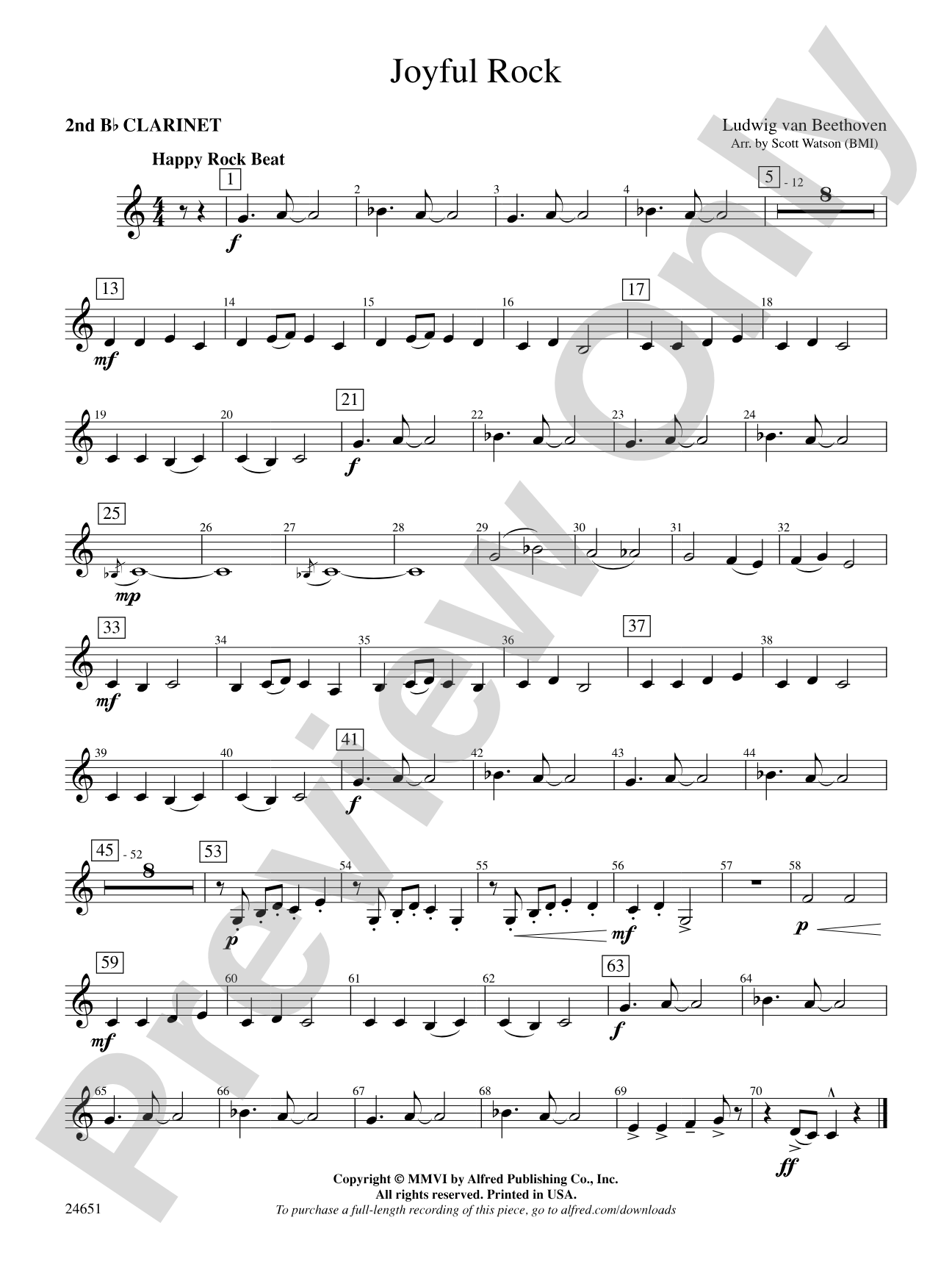
Joyful Rock: 2nd B-flat Clarinet Sheet Music Preview

Joyful Rock: 2nd B-flat Clarinet

Arr. Scott Watson

Grade: 1 (Very Easy)

Item: 00-PC-0000819_C2

Digital Download
$3.00
Description
Joyful Rock is a delightful and very playable version of Beethoven's "Ode to Joy" theme. This catchy tune with a happy rock beat will be sure to become a favorite of young band members everywhere. The familiar melody is a great addition to any band program. This title is available in MakeMusic Cloud.

Don't just read it, hear it, play along with it, and watch your students grow with it. In MakeMusic Cloud, Joyful Rock: 2nd B-flat Clarinet comes alive with professional accompaniment, adjustable tempo, and built-in practice tools that turn solo practice into real progress.

Sample Audio
0:00
0:00
Sample Video
Additional Details
Series: Alfred Debut Series
Publisher: Alfred Music
Page Count: 118
SKU: 00-PC-0000819_C2

More about this title

About the Arranger: Scott Watson

Scott Watson

Scott Watson spent 35 years in the Parkland School District (Allentown, PA) as a high school band director and later as coordinator of the elementary band and strings program across the district. During this time, he became an award-winning composer whose music has been performed at venues including the Academy of Music in Philadelphia, the Midwest Clinic in Chicago, and the White House.

Watson currently teaches at Cairn University (Langhorne, PA) and has published more than 120 works for concert band, string orchestra, and chamber ensembles at all levels. His compositions draw equally from his study of contemporary concert music and his deep experience with school bands. He is an exclusive composer and clinician for Alfred Publications and authored the music education text Using Technology to Unlock Musical Creativity (Oxford University Press, 2011).

Why we love this

Watson's arrangement captures everything that makes Beethoven's most iconic melody work in a young band setting: the tune stays front and center, the rock groove energizes without overwhelming beginning players, and the orchestration gives every section something engaging to play. A first-grade band that opens a concert with this will grab the audience immediately and build confidence in the ensemble.

What to expect

Bright and propulsive without pretension. The rock beat gives the classic melody a contemporary energy that feels fresh and accessible, inviting audiences to recognize the theme while hearing it in an entirely new context. Players get to feel the satisfaction of making music that sounds both complete and genuinely fun.

Who it's for

Beginning concert bands (Grade 1) looking for a confidence-building opener or closer that combines immediate audience appeal with genuine musical substance. Young players connect instantly with a melody they may already know, making this an excellent choice for programs serving schools where ensemble experience is still developing.

How to get the most out of it

  • Keep the rock beat driving forward without rushing. The quarter-note pulse should feel steady and comfortable, letting the familiar melody breathe naturally over the groove.
  • Balance the melody line so it sings clearly; support it without letting accompaniment parts overshadow the main tune.
  • Encourage players to listen for the rhythmic energy that comes from the rock style rather than treating it as a classical piece played with a different tempo marking.

How to use it

Open a concert with this to establish immediate momentum and audience connection. The recognizable melody guarantees engagement, and the very easy grade level means rehearsal time spent here pays dividends in morale and execution. It pairs well as a program contrast before or after classical arrangements, or as the anchor of a thematic concert exploring variations on famous melodies.

Skills your students will build

  • Maintaining steady tempo in a rock-influenced style
  • Balancing melody and accompaniment textures
  • Executing rhythmic accuracy in syncopated passages
  • Responding to a contemporary arrangement of a classical work

You May Also Like